


Personality traits and career choices among physicians in Finland: employment sector, clinical patient contact, specialty and change of specialty
- PMID: 29587722
- PMCID: PMC5870817
- DOI: 10.1186/s12909-018-1155-9
Personality traits and career choices among physicians in Finland: employment sector, clinical patient contact, specialty and change of specialty
Abstract
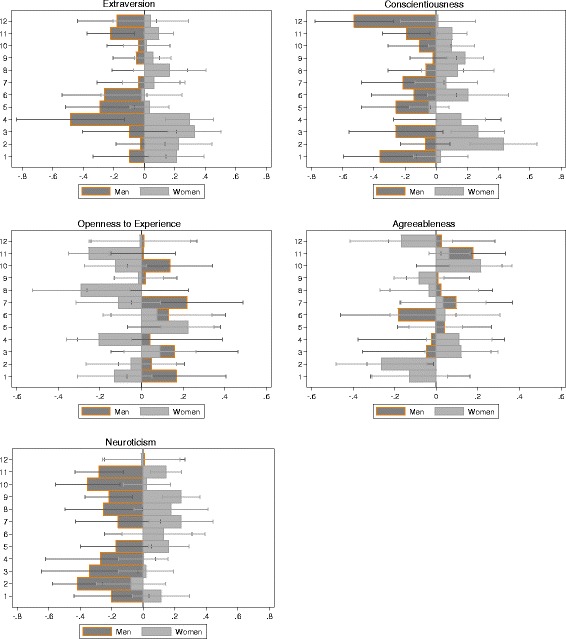
Background: Personality influences an individual's adaptation to a specific job or organization. Little is known about personality trait differences between medical career and specialty choices after graduating from medical school when actually practicing different medical specialties. Moreover, whether personality traits contribute to important career choices such as choosing to work in the private or public sector or with clinical patient contact, as well as change of specialty, have remained largely unexplored. In a nationally representative sample of Finnish physicians (N = 2837) we examined how personality traits are associated with medical career choices after graduating from medical school, in terms of employment sector, patient contact, medical specialty and change of specialty.
Methods: Personality was assessed using the shortened version of the Big Five Inventory (S-BFI). An analysis of covariance with posthoc tests for pairwise comparisons was conducted, adjusted for gender and age with confounders (employment sector, clinical patient contact and medical specialty).
Results: Higher openness was associated with working in the private sector, specializing in psychiatry, changing specialty and not practicing with patients. Lower openness was associated with a high amount of patient contact and specializing in general practice as well as ophthalmology and otorhinolaryngology. Higher conscientiousness was associated with a high amount of patient contact and specializing in surgery and other internal medicine specialties. Lower conscientiousness was associated with specializing in psychiatry and hospital service specialties. Higher agreeableness was associated with working in the private sector and specializing in general practice and occupational health. Lower agreeableness and neuroticism were associated with specializing in surgery. Higher extraversion was associated with specializing in pediatrics and change of specialty. Lower extraversion was associated with not practicing with patients.
Conclusions: The results showed distinctive personality traits to be associated with physicians' career and specialty choices after medical school independent of known confounding factors. Openness was the most consistent personality trait associated with physicians' career choices in terms of employment sector, amount of clinical patient contact, specialty choice and change of specialty. Personality-conscious medical career counseling and career guidance during and after medical education might enhance the person-job fit among physicians.
Keywords: Career counseling; Medical career; Medical education; Medical specialty; Person-job fit; Personality traits.
Conflict of interest statement
Authors’ information
Sari Mullola (sari.mullola@helsinki.fi; sari.mullola@tc.columbia.edu) is a Postdoctoral Researcher (Academy of Finland) at the Faculty of Educational Sciences, University of Helsinki, Finland, and is currently working as a Visiting Scholar at Teachers College Columbia University, New York, NY, USA.
Christian Hakulinen (christian.hakulinen@helsinki.fi) is a Postdoctoral Researcher (Academy of Finland) at the Department of Psychology and Logopedics, Medical Faculty, University of Helsinki, Finland.
Justin Presseau (jpresseau@ohri.ca) is an Assistant Professor at the School of Epidemiology, Public Health and Preventive Medicine, University of Ottawa, Canada.
David Gimeno Ruiz de Porras (david.gimeno@uth.tmc.edu) is an Associate Professor within the Division of Epidemiology, Human Genetics and Environmental Sciences at the San Antonio Campus of the University of Texas Health Science Center at the Houston School of Public Health (UTSPH), Texas, USA.
Markus Jokela (markus.jokela@helsinki.fi) is an Associate Professor at the Department of Psychology and Logopedics, Medical Faculty, University of Helsinki, Finland.
Taina Hintsa (taina.hintsa@helsinki.fi) is a University Lecturer (Psychology) at the Department of Psychology and Logopedics, Medical Faculty, University of Helsinki, Finland.
Marko Elovainio (marko.elovainio@helsinki.fi) is a Professor of Psychology at the Department of Psychology and Logopedics, Medical Faculty, University of Helsinki, Finland.
Ethics approval and consent to participate
The ethics committee of the National Research and Development Centre for Health and Welfare approved the study protocol. Written informed consent to participate in the Health Professionals’ Study was obtained from the participants before responding to the survey. The analysis and results of their assessments have been used anonymously.
Consent for publication
Not applicable.
Competing interests
The authors declare that they have no competing interests.
Publisher’s Note
Springer Nature remains neutral with regard to jurisdictional claims in published maps and institutional affiliations.
Figures
References
-
- Hoyler M, Finlayson SRG, McClain CD, Meara JG, Hagander L. Shortage of doctors, shortage of data: a review of the global surgery, obstetrics, and anesthesia workforce literature. World J Surg. 2014;38(2):269–280. - PubMed
-
- Cooper RA, Getzen TE, McKee HJ, Laud P. Economic and demographic trends signal an impending physician shortage. Health Aff. 2002;21(1):140–154. - PubMed
-
- Blackwelder R, Watson KH, Freedy JR. Physician wellness across the professional Spectrum. Prim Care. 2016;43(2):355–361. - PubMed
-
- Wallace JE, Lemaire JB, Ghali WA. Physician wellness: a missing quality indicator. Lancet. 2009;374(9702):1714–1721. - PubMed
MeSH terms
Grants and funding
LinkOut - more resources
Full Text Sources
Other Literature Sources
