


Prediction equations of forced oscillation technique: the insidious role of collinearity
- PMID: 29587758
- PMCID: PMC5869763
- DOI: 10.1186/s12931-018-0745-8
Prediction equations of forced oscillation technique: the insidious role of collinearity
Abstract
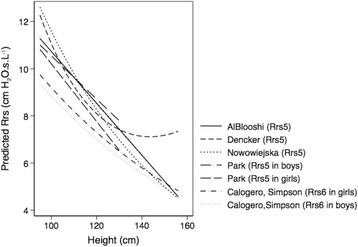
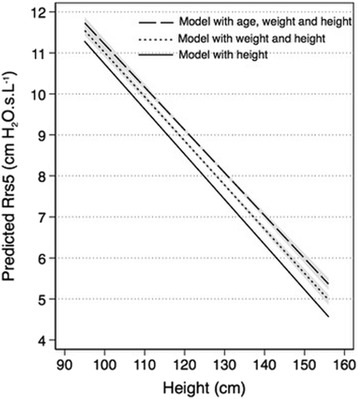
Many studies have reported reference data for forced oscillation technique (FOT) in healthy children. The prediction equation of FOT parameters were derived from a multivariable regression model examining the effect of age, gender, weight and height on each parameter. As many of these variables are likely to be correlated, collinearity might have affected the accuracy of the model, potentially resulting in misleading, erroneous or difficult to interpret conclusions.The aim of this work was: To review all FOT publications in children since 2005 to analyze whether collinearity was considered in the construction of the published prediction equations. Then to compare these prediction equations with our own study. And to analyse, in our study, how collinearity between the explanatory variables might affect the predicted equations if it was not considered in the model. The results showed that none of the ten reviewed studies had stated whether collinearity was checked for. Half of the reports had also included in their equations variables which are physiologically correlated, such as age, weight and height. The predicted resistance varied by up to 28% amongst these studies. And in our study, multicollinearity was identified between the explanatory variables initially considered for the regression model (age, weight and height). Ignoring it would have resulted in inaccuracies in the coefficients of the equation, their signs (positive or negative), their 95% confidence intervals, their significance level and the model goodness of fit. In Conclusion with inaccurately constructed and improperly reported models, understanding the results and reproducing the models for future research might be compromised.
Keywords: Collinearity; Forced oscillation technique; Multicollinearity; Multivariable models.
Conflict of interest statement
Ethics approval and consent to participate
This study was approved by Al Ain medical district human research ethics committee (Ref. DT/bb/15–32).
Consent for publication
Not applicable
Competing interests
The authors declare that they have no competing interests.
Publisher’s Note
Springer Nature remains neutral with regard to jurisdictional claims in published maps and institutional affiliations.
Figures

References
-
- Beydon N, Davis SD, Lombardi E, Allen JL, Arets HG, Aurora P, Bisgaard H, Davis GM, Ducharme FM, Eigen H, et al. An official American Thoracic Society/European Respiratory Society statement: pulmonary function testing in preschool children. Am J Respir Crit Care Med. 2007;175(12):1304–1345. doi: 10.1164/rccm.200605-642ST. - DOI - PubMed
-
- Rosenfeld M, Allen J, Arets BH, Aurora P, Beydon N, Calogero C, Castile RG, Davis SD, Fuchs S, Gappa M. An official American Thoracic Society workshop report: optimal lung function tests for monitoring cystic fibrosis, bronchopulmonary dysplasia, and recurrent wheezing in children less than 6 years of age. Ann Am Thorac Soc. 2013;10(2):S1–S11. doi: 10.1513/AnnalsATS.201301-017ST. - DOI - PubMed
Publication types
MeSH terms
LinkOut - more resources
Full Text Sources
Other Literature Sources
Research Materials
