


Treatment of intraoperatively detected peritoneal carcinomatosis of colorectal origin with cytoreductive surgery and intraperitoneal chemotherapy
- PMID: 29587771
- PMCID: PMC5870809
- DOI: 10.1186/s12957-018-1369-7
Treatment of intraoperatively detected peritoneal carcinomatosis of colorectal origin with cytoreductive surgery and intraperitoneal chemotherapy
Abstract
Background: Diagnosis of peritoneal carcinomatosis (PC) may be missed by preoperative imaging. We are presenting our experience with incidentally detected PC of colorectal origin treated with cytoreductive surgery (CRS) and intraperitoneal chemotherapy (IPC) at the same operation.
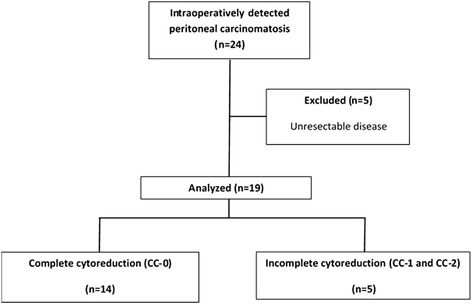
Methods: Between January 2010 and September 2016, 19 patients underwent CRS and IPC due to incidentally detected PC of colorectal origin. Data were analyzed from a prospectively collected database.
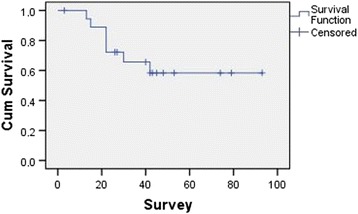
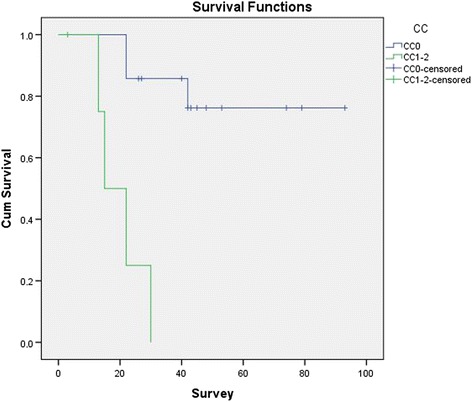
Results: The median age was 59 (29-78). In three patients, PC was diagnosed during emergency surgery. The primary tumor was located in the rectum (three patients; one with recurrent disease), left colon (9 patients), and right colon (7 patients). All patients underwent CRS and IPC, and one patient operated laparoscopically. Median peritoneal cancer index (PCI) was 5 (range, 3-14), and complete cytoreduction (CC-0) was achieved in 14 patients. After CRS, 8 patients received early postoperative intraperitoneal chemotherapy (EPIC), 7 patients received hyperthermic intraperitoneal chemotherapy (HIPEC), and 4 patients received both HIPEC and EPIC. The median hospital stay was 9 (6-29) days. Postoperative complications occurred in 6 patients. There was no postoperative mortality. Median follow-up was 40.2 (12-94) months. Five-year overall survival was 63.2%. Estimated mean survival time is longer in patients who underwent complete cytoreduction compared to patients having CC-1 or CC-2 cytoreduction (87.7 vs. 20.3 months; p < 0.001).
Conclusion: Cytoreductive surgery and IPC can be performed safely in patients with intraoperatively detected incidental PC of colorectal origin.
Keywords: Colorectal; EPIC; HIPEC; Incidental; Intraoperative detected; Intraperitoneal chemotherapy; Peritoneal carcinomatosis.
Conflict of interest statement
Ethics approval and consent to participate
This study is approved by the Dokuz Eylul University Non-interventional Studies Ethics Committee (2012/34-03).
Consent for publication
Not applicable
Competing interests
The authors declare that they have no competing interests.
Publisher’s Note
Springer Nature remains neutral with regard to jurisdictional claims in published maps and institutional affiliations.
Figures
References
-
- Franko J, Shi Q, Goldman CD, Pockai BA, Nelson GD, Goldberg RM, et al. Treatment of colorectal peritoneal carcinomatosis with systemic chemotherapy: a pooled analysis of North Central Cancer Treatment Group phase III trials N9741 and N9841. J Clin Oncol. 2012;30:263–267. doi: 10.1200/JCO.2011.37.1039. - DOI - PMC - PubMed
-
- Schwartzberg LS, Rivera F, Karthaus M, Fasola G, Canon JL, Hecht JR, et al. PEAK: a randomized, multicenter phase II study of panitumumab plus modified fluorouracil, leucovorin, and oxaliplatin (mFOLFOX6) or bevacizumab plus mFOLFOX6 in patients with previously untreated, unresectable, wild-type KRAS exon 2 metastatic colorectal cancer. J Clin Oncol. 2014;32(21):2240–2247. doi: 10.1200/JCO.2013.53.2473. - DOI - PubMed
MeSH terms
LinkOut - more resources
Full Text Sources
Other Literature Sources
Medical
Miscellaneous
