


The need to revisit the definition of mesenchymal and adult stem cells based on their functional attributes
- PMID: 29587828
- PMCID: PMC5870685
- DOI: 10.1186/s13287-018-0833-1
The need to revisit the definition of mesenchymal and adult stem cells based on their functional attributes
Abstract
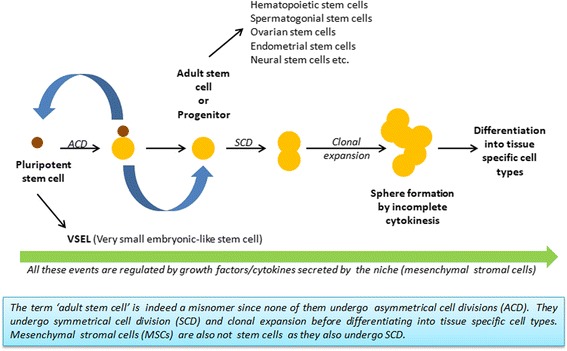
A debate is ongoing about the 'stem cell' status of mesenchymal stem cells (MSCs). This can easily be resolved based on the definition of a stem cell. 'True' stem cells are expected to undergo asymmetric cell divisions (ACD) whereby they divide to self-renew and give rise to a slightly bigger, differentiated cell. However, MSCs like any other adult tissue-specific stem cells, including hematopoietic (HSCs), spermatogonial (SSCs) and ovarian (OSCs) stem cells, do not undergo ACD; rather they undergo rapid symmetrical cell divisions. The true stem cells in adult tissues are possibly the pluripotent stem cells termed very small embryonic-like stem cells (VSELs), which were recently shown to undergo ACD to give rise to tissue-specific stem cells 'progenitors' (currently termed 'adult stem cells') that in turn undergo rapid symmetric cell divisions and clonal expansion (sphere formation with incomplete cytokinesis) followed by differentiation into tissue-specific cell types. MSCs can be cultured from any tissue source and are an excellent source of growth factors/cytokines and thus could provide a niche for proper functioning of the stem/progenitor cells.
Keywords: Asymmetric cell division; Mesenchymal cells; Stem cells; Very small embryonic-like stem cells.
Conflict of interest statement
Ethics approval and consent to participate
Not applicable.
Consent for publication
OTH/607/01-2018.
Competing interests
The author declares that she has no competing interests.
Publisher’s Note
Springer Nature remains neutral with regard to jurisdictional claims in published maps and institutional affiliations.
Figures
Comment on
-
Mesenchymal Stem Cells: Time to Change the Name!Stem Cells Transl Med. 2017 Jun;6(6):1445-1451. doi: 10.1002/sctm.17-0051. Epub 2017 Apr 28. Stem Cells Transl Med. 2017. PMID: 28452204 Free PMC article.
References
-
- Anand S, Bhartiya D, Sriraman K, Patel H, Manjramkar DD. Very small embryonic-like stem cells survive and restore spermatogenesis after busulphan treatment in mouse testis. J Stem Cell Res Ther. 2014;4:216.
Publication types
MeSH terms
LinkOut - more resources
Full Text Sources
Other Literature Sources
