Review
. 2018 Mar 27;11(1):216.
doi: 10.1186/s13071-018-2800-1.

Checks and balances? DNA replication and the cell cycle in Plasmodium

Affiliations
Review

Checks and balances? DNA replication and the cell cycle in Plasmodium

Holly Matthews et al. Parasit Vectors. .

Abstract

It is over 100 years since the life-cycle of the malaria parasite Plasmodium was discovered, yet its intricacies remain incompletely understood - a knowledge gap that may prove crucial for our efforts to control the disease. Phenotypic screens have partially filled the void in the antimalarial drug market, but as compound libraries eventually become exhausted, new medicines will only come from directed drug development based on a better understanding of fundamental parasite biology. This review focusses on the unusual cell cycles of Plasmodium, which may present a rich source of novel drug targets as well as a topic of fundamental biological interest. Plasmodium does not grow by conventional binary fission, but rather by several syncytial modes of replication including schizogony and sporogony. Here, we collate what is known about the various cell cycle events and their regulators throughout the Plasmodium life-cycle, highlighting the differences between Plasmodium, model organisms and other apicomplexan parasites and identifying areas where further study is required. The possibility of DNA replication and the cell cycle as a drug target is also explored. Finally the use of existing tools, emerging technologies, their limitations and future directions to elucidate the peculiarities of the Plasmodium cell cycle are discussed.

Keywords: Cell cycle; Malaria; Plasmodium; Replication.


Conflict of interest statement

Ethics approval

Not applicable.

Consent for publication

Not applicable.

Competing interests

The authors declare that they have no competing interests.

Publisher’s Note

Springer Nature remains neutral with regard to jurisdictional claims in published maps and institutional affiliations.

Figures
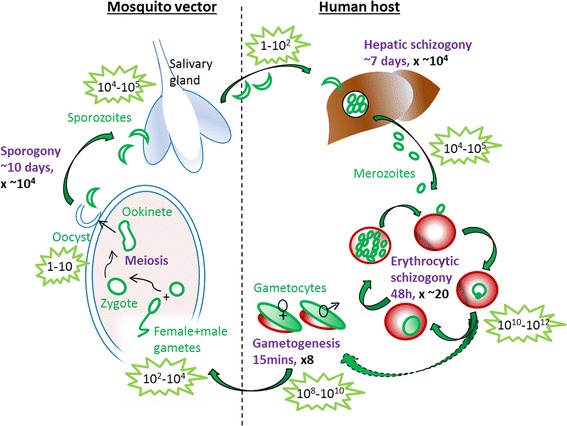
Fig. 1
Fig. 1
Schematic showing the life-cycle of P. falciparum. Each replicative stage of the life-cycle, together with the approximate fold-replication, is highlighted in purple. Approximate parasite numbers within each host at each stage are also shown to highlight the severe bottlenecks and massive expansions that occur throughout the life-cycle
Fig. 2
Fig. 2
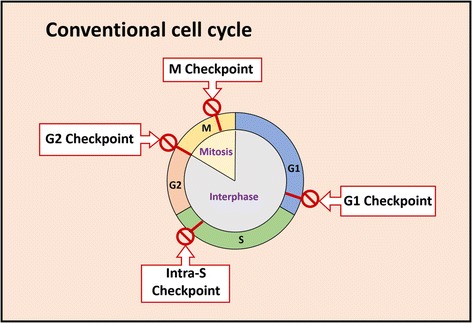
Schematic of the conventional eukaryotic cell cycle, highlighting the points at which cycle checkpoints operate
Fig. 3
Fig. 3
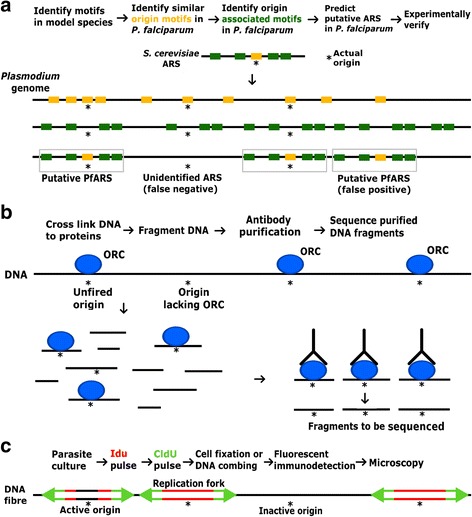
Development of techniques to examine the replication of the Plasmodium genome. a Bioinformatic analysis of conserved sequences at and surrounding replication origins in the S. cerevisiae genome has led to identification of common motifs for searching the Plasmodium genome [30]. Origins in S. cerevisiae consist of compact autonomously replicating sequences (ARS) with ‘A domain’ motifs (orange) and surrounding ‘B domains’ (green). The Plasmodium genome has a high concentration of individual A and B domains (~ every 2500 bp) but a much lower concentration when the requirement for closely associated domains is imposed (grey boxes). Bioinformatics approaches can only identify putative origin sites and may fail to identify true origins (*) or identify sequences which are incapable of functioning as origins. b Chromatin immuno-precipitation (ChIP) of the proteins required before and during replication, such as members of the Origin Recognition Complex (ORC), allows experimental characterisation of origin sequences [30]. Following reversible DNA-protein cross linking, the genome is fragmented and the proteins of interest are purified along with the associated DNA fragments, which are then sequenced. This may include origins that would never be activated, and may miss those where the protein complex has dissociated from the chromosome. c Synthetic nucleoside labelling and DNA combing techniques allow the labelling and fluorescent immunodetection of de novo DNA synthesis [31]. Parasites expressing viral thymidine kinase can incorporate the synthetic nucleosides IdU (red) and CldU (green) which can be visualised in individual nuclei or on combed DNA fibres, allowing the calculation of inter-origin distances and replication rates. The synthetic nucleosides will only be incorporated around active origins (*) while inactive origins will remain unlabelled and therefore undetected
Fig. 4
Fig. 4
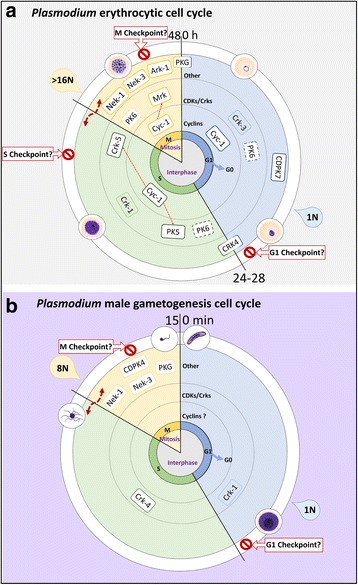
Illustration of cell cycle phases in Plasmodium erythrocytic schizogony (a) and Plasmodium male gametogenesis (b). The predicted involvement of cyclins, CDKs and other kinases is shown at each phase. Placement of such components is only loosely chronological since most details are unknown. CDKs/Crks with a dashed outline indicate cyclin independence. Crks or CDKs predicted to be involved in transcriptional regulation are transparent (without a white background). Interactions identified in vitro between cyclins and CDKs are indicated by a dashed orange arrow. Table 2 identifies all sources used to construct the figure. The cell cycles at sporogony and hepatic schizogony are omitted due to the lack of information about these stages

References

    1. Striepen B, Jordan CN, Reiff S, van Dooren GG. Building the perfect parasite: cell division in apicomplexa. PLoS Pathog. 2007;3:e78. - PMC - PubMed
    1. Arnot DE, Gull K. The Plasmodium cell-cycle: facts and questions. Ann Trop Med Parasitol. 1998;92:361–365. - PubMed
    1. Francia ME, Striepen B. Cell division in apicomplexan parasites. Nat Rev Microbiol. 2014;12:125–136. - PubMed
    1. Janse CJ, Van der Klooster PF, Van der Kaay HJ, Van der Ploeg M, Overdulve JP. Rapid repeated DNA replication during microgametogenesis and DNA synthesis in young zygotes of Plasmodium berghei. Trans R Soc Trop Med Hyg. 1986;80:154–157. - PubMed
    1. Kawamoto F, Alejo-Blanco R, Fleck SL, Sinden RE. Plasmodium berghei: ionic regulation and the induction of gametogenesis. Exp Parasitol. 1991;72:33–42. - PubMed

Publication types

LinkOut - more resources