


Distinctive features of immunostaining and mutational load in primary pulmonary enteric adenocarcinoma: implications for differential diagnosis and immunotherapy
- PMID: 29587865
- PMCID: PMC5870381
- DOI: 10.1186/s12967-018-1449-z
Distinctive features of immunostaining and mutational load in primary pulmonary enteric adenocarcinoma: implications for differential diagnosis and immunotherapy
Abstract
Background: Primary pulmonary enteric adenocarcinoma (PEAC) is an extremely rare variant of invasive lung cancer. It is highly heterogeneous while shares some common morphologic and immunohistochemical features with usual pulmonary adenocarcinoma (PAC) and colorectal adenocarcinoma (CRAC), making the differential diagnosis difficult. At present there are only limited studies about distinctive features of primary PEAC and the results are often inconsistent.
Methods: We retrospectively analyzed total 129 primary PEACs and 50 CRACs that were published since 1991 or diagnosed in our centre. Among them eight typical samples of primary PEACs and usual PACs were detected by targeted exome sequencing.
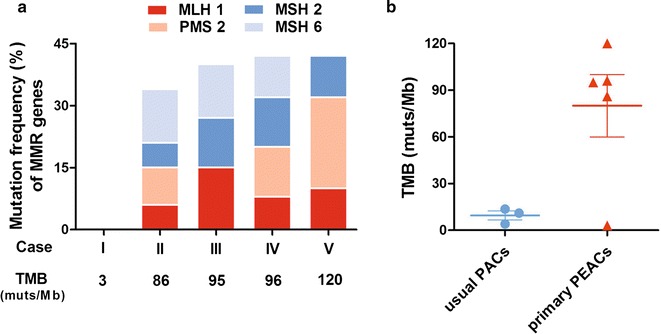
Results: The combination of CK7+/CDX2+ acquires high sensitivity (71.3%) and specificity (82%) in differential diagnosis of PEACs from CRAC. The primary PEACs harbor a high incidence of KRAS mutation but almost absent of EGFR mutation. Moreover, compared with usual PACs, the primary PEACs have higher nonsynonymous tumor mutation burden and more frequent MMR mutation.
Conclusions: The combination of CK7+/CDX2+ immunostaining and the distinctive genetic signatures, including low incidence of sensitivity genes mutations and high tumor mutation burden, is an important supplementary to the clinical differential diagnosis of primary PEACs. Our findings thus have significant implications for development of individualized treatment strategy in these patients.
Keywords: Immunohistochemistry; Immunotherapy; Primary pulmonary enteric adenocarcinoma; Targeted therapy; Tumor mutation burden.
Figures
References
-
- Travis WD, Brambilla E, Noguchi M, Nicholson AG, Geisinger K, Yatabe Y, Powell CA, Beer D, Riely G, Garg K, et al. International Association for the Study of Lung Cancer/American Thoracic Society/European Respiratory Society: international multidisciplinary classification of lung adenocarcinoma: executive summary. Proc Am Thorac Soc. 2011;8:381–385. doi: 10.1513/pats.201107-042ST. - DOI - PubMed
-
- Nottegar A, Tabbo F, Luchini C, Brunelli M, Bria E, Veronese N, Santo A, Cingarlini S, Gilioli E, Ogliosi C, et al. Pulmonary adenocarcinoma with enteric differentiation: immunohistochemistry and molecular morphology. Appl Immunohistochem Mol Morphol. 2016 - PubMed
-
- Nottegar A, Tabbo F, Luchini C, Guerrera F, Gaudiano M, Bria E, Brunelli M, Chilosi M, Inghirami G. Pulmonary adenocarcinoma with enteric differentiation: dissecting oncogenic genes alterations with DNA sequencing and FISH analysis. Exp Mol Pathol. 2017;102:276–279. doi: 10.1016/j.yexmp.2017.02.014. - DOI - PubMed
MeSH terms
Substances
LinkOut - more resources
Full Text Sources
Other Literature Sources
Medical
Research Materials
Miscellaneous
