


Adverse perinatal events, treatment gap, and positive family history linked to the high burden of active convulsive epilepsy in Uganda: A population-based study
- PMID: 29588948
- PMCID: PMC5719853
- DOI: 10.1002/epi4.12048
Adverse perinatal events, treatment gap, and positive family history linked to the high burden of active convulsive epilepsy in Uganda: A population-based study
Abstract
Objective: To determine the prevalence of active convulsive epilepsy (ACE) and describe the clinical characteristics and associated factors among a rural Ugandan population.
Methods: The entire population in Iganga/Mayuge Health Demographic Surveillance Site (IM-HDSS) was screened using two questions about seizures during a door-to-door census exercise. Those who screened positive were assessed by a clinician to confirm diagnosis of epilepsy. A case control study with the patients diagnosed with ACE as the cases and age/sex-matched controls in a ratio of 1:1 was conducted.
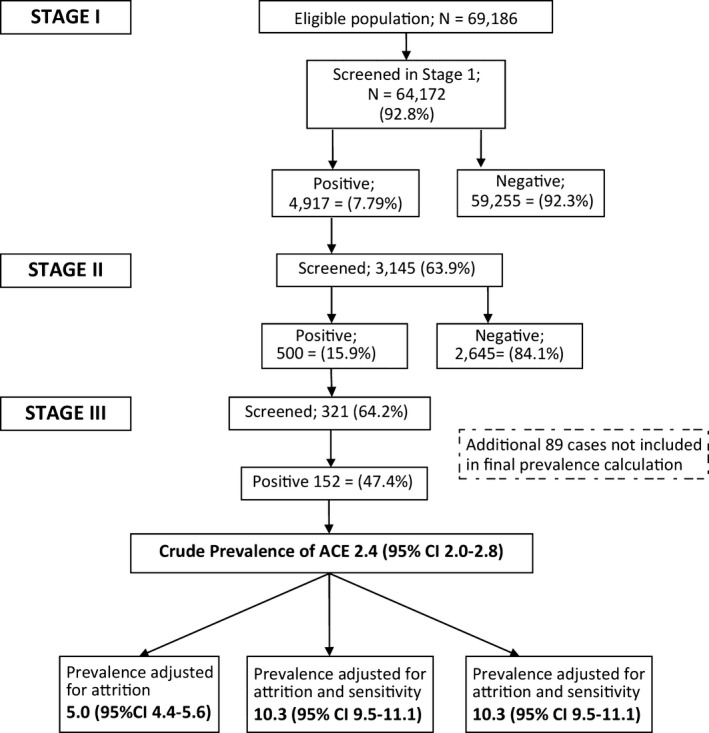
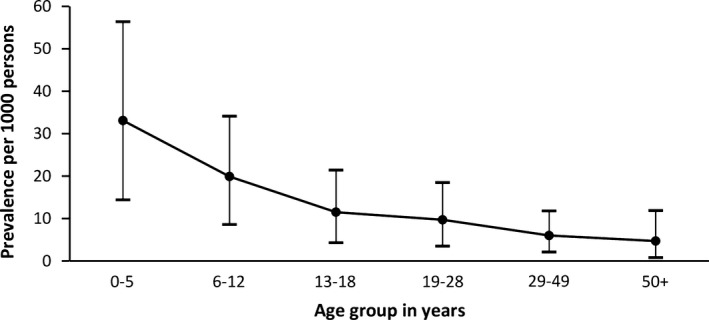
Results: A total of 64,172 (92.8%) IM-HDSS residents, with a median age of 15.0 years (interquartile range [IQR]: 8.0-29.0), were screened for epilepsy. There were 152 confirmed ACE cases, with a prevalence of 10.3/1,000 (95% confidence interval [CI]: 9.5-11.1) adjusted for nonresponse and screening sensitivity. Prevalence declined with age, with the highest prevalence in the 0-5 years age group. In an analysis of n = 241 that included cases not identified in the survey, nearly 70% were unaware of their diagnosis. Seizures were mostly of focal onset in 193 (80%), with poor electroencephalogram (EEG) agreement with seizure semiology. Antiepileptic drug use was rare, noted in 21.2% (95% CI: 16.5-25.8), and 119 (49.3%) reported using traditional medicines. History of an abnormal antenatal period (adjusted odds ratio [aOR] 10.28; 95%CI 1.26-83.45; p = 0.029) and difficulties in feeding, crying, breathing in the perinatal period (aOR 10.07; 95%CI 1.24-81.97; p = 0.031) were associated with ACE in children. In adults a family history of epilepsy (aOR 4.38 95%CI 1.77-10.81; p = 0.001) was the only factor associated with ACE.
Significance: There is a considerable burden of epilepsy, low awareness, and a large treatment gap in this population of rural sub-Saharan Africa. The identification of adverse perinatal events as a risk factor for developing epilepsy in children suggests that epilepsy burden may be decreased by improving obstetric and postnatal care.
Keywords: Adverse perinatal events; Population study of epilepsy; Risk factors; Treatment gap; Uganda.
Figures
References
-
- World Health Organization . Neurological Disorders: public health challenges. Geneva: World Health Organization; 2006.
-
- World Health Organization . Epilepsy in the WHO African region: bridging the gap. Geneva: World Health Organization; 2004.
-
- Sharper AG, Sharper L. Analysis of medical admissions to Mulago Hospital, 1957. East Afr Med J 1958;35:647. - PubMed
Grants and funding
LinkOut - more resources
Full Text Sources
Other Literature Sources
Miscellaneous
