


The effects of unilateral and bilateral eccentric overload training on hypertrophy, muscle power and COD performance, and its determinants, in team sport players
- PMID: 29590139
- PMCID: PMC5874004
- DOI: 10.1371/journal.pone.0193841
The effects of unilateral and bilateral eccentric overload training on hypertrophy, muscle power and COD performance, and its determinants, in team sport players
Abstract
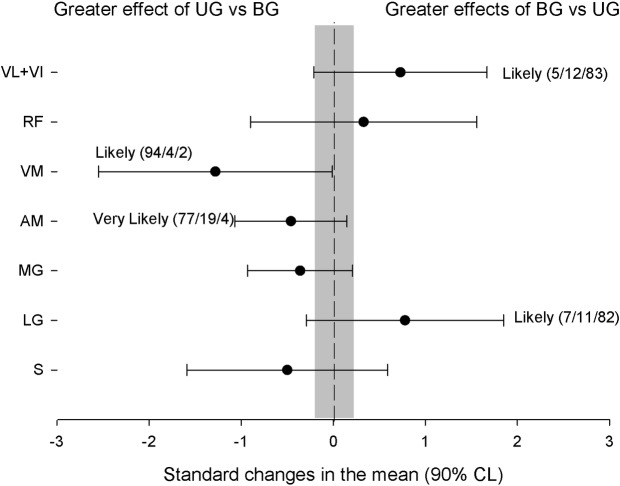
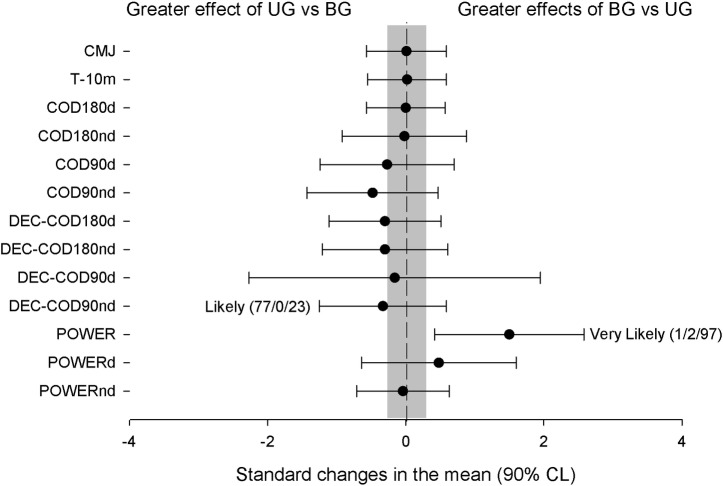
The study aimed to compare the chronic eccentric-overload training effects of unilateral (lateral lunge) vs bilateral (half-squat) using an inertial device, on hypertrophy and physical performance. Twenty-seven young team sports male players performed a 4 sets of 7 repetitions of inertial eccentric overload training, biweekly for 6 weeks, distributed in unilateral lunge group (UG: age: 22.8 ± 2.9 years; body mass: 75.3 ± 8.8 kg; height: 177.3 ± 3.7 cm) and bilateral squat group (BG: age: 22.6 ± 2.7 years; body mass: 79.5 ± 12.8 kg; height: 164.2 ± 7 cm). Lower limb muscle volume, counter movement jump (CMJ), power with both (POWER), dominant (POWERd) and no-dominant leg (POWERnd), change of direction turn of 90° with dominant (COD90d) and no-dominant leg (COD90nd) and 180° (COD180d and COD180nd), and 10m sprint time (T-10m) were measured pre and post-intervention. The UG obtained an increase of adductor major (+11.1%) and vastus medialis (+12.6%) higher than BG. The BG obtained an increase of vastus lateralis (+9.9%) and lateral gastrocnemius (+9.1%) higher than UG. Both groups improved CMJ, POWER, POWERd, POWERnd, COD90 and DEC-COD90, without changes in T-10m. The UG decrease DEC-COD90nd (-21.1%) and BG increase POWER (+38.6%) substantially more than the other group. Six-weeks of unilateral / bilateral EO training induce substantial improvements in lower limbs muscle volume and functional performance, although unilateral training seems to be more effective in improving COD90 performance.
Conflict of interest statement
Figures
References
-
- Ben Abdelkrim N, Chaouachi A, Chamari K, Chtara M, Castagna C. Positional role and competitive-level differences in elite-level men's basketball players. J Strength Cond Res. 2010;24(5):1346–55. Epub 2010/04/16. doi: 10.1519/JSC.0b013e3181cf7510 . - DOI - PubMed
-
- Brughelli M, Cronin J, Levin G, Chaouachi A. Understanding change of direction ability in sport: a review of resistance training studies. Sports Med. 2008;38(12):1045–63. Epub 2008/11/26. doi: 10.2165/00007256-200838120-00007 . - DOI - PubMed
-
- Sheppard JM, Young WB. Agility literature review: classifications, training and testing. J Sports Sci. 2006;24(9):919–32. Epub 2006/08/03. doi: 10.1080/02640410500457109 . - DOI - PubMed
-
- Gonzalo-Skok O, Tous-Fajardo J, Valero-Campo C, Berzosa C, Bataller AV, Arjol-Serrano JL, et al. Eccentric-Overload Training in Team-Sport Functional Performance: Constant Bilateral Vertical Versus Variable Unilateral Multidirectional Movements. Int J Sports Physiol Perform. 2017;12(7):951–8. Epub 2016/12/15. doi: 10.1123/ijspp.2016-0251 . - DOI - PubMed
-
- Young WB, James R, Montgomery I. Is muscle power related to running speed with changes of direction? J Sports Med Phys Fitness. 2002;42(3):282–8. Epub 2002/07/03. . - PubMed
MeSH terms
LinkOut - more resources
Full Text Sources
Other Literature Sources
Research Materials
