


Correlation between coronary artery calcification by non-cardiac CT and Framingham score in young patients
- PMID: 29590197
- PMCID: PMC5874063
- DOI: 10.1371/journal.pone.0195061
Correlation between coronary artery calcification by non-cardiac CT and Framingham score in young patients
Abstract
Background: Previous studies have established a correlation between coronary artery calcification (CAC) measured by ECG-gated chest computed tomography (CT) and cardiovascular disease. Recent reports which included asymptomatic patients suggest that CAC measured on non-ECG gated CT is similarly associated with cardiovascular risk. This study investigates the correlation between the Framingham Risk Score (FRS) and an incidental finding of CAC on a non-gated chest CT performed for non-cardiac indications in young and seemingly healthy adults.
Methods: A cross-sectional study that included 162 CT scans performed in young patients aged 18-50 years old for non-cardiac indications in our institution was conducted. CAC score (CACS) was calculated using the Agatston method. FRS was calculated and compared to the CACS using three different approaches. The correlations between the CACS and several specific factors (i.e. age, body mass index, smoking, statins, etc.), were also evaluated.
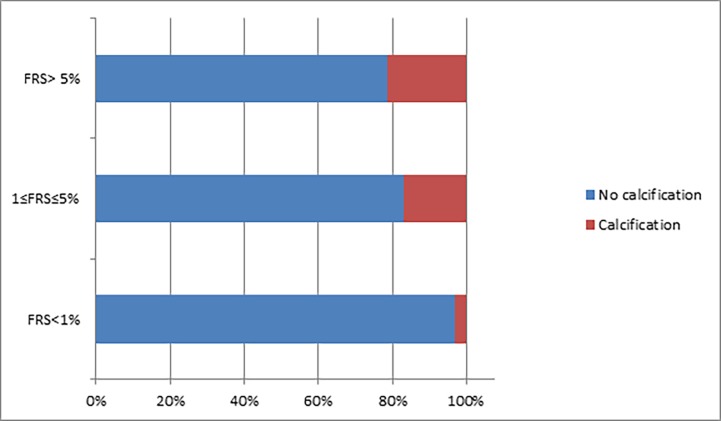
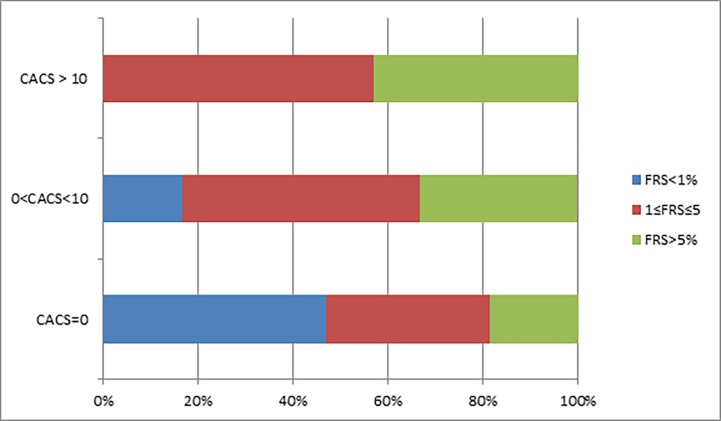
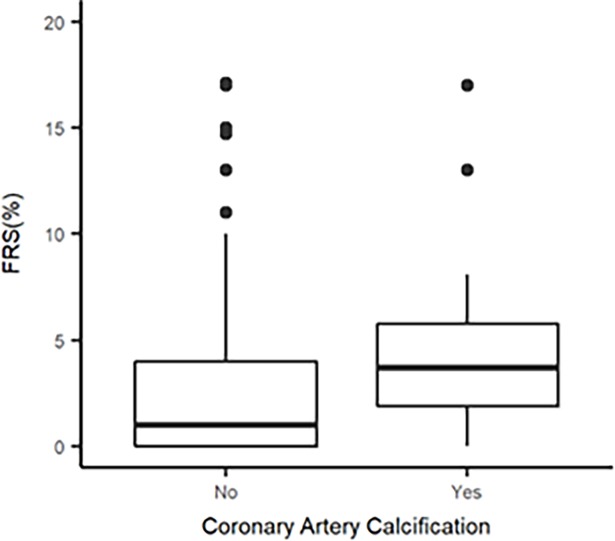
Results: Mean age of patients was 36.43 year old and 105 (64.8%) were male. We found a significant positive correlation between the CACS and the FRS in all three approaches (p<0.05). Increased age, smoking and statin use were the only individual factors clearly associated with an increase in CACS (p = 0.002, p = 0.045 and p = 0.009, respectively).
Conclusion: This is the first report indicating that incidental CACS identified in non-gated MDCT is also associated with cardiovascular risk evaluated by FRS in a young population. Our findings suggest that young asymptomatic individuals with incidental CAC should be seriously evaluated for cardiovascular risk factors despite presumption of belonging to a low cardiovascular risk category.
Conflict of interest statement
Figures
References
-
- Lloyd-Jones D, Adams RJ, Brown TM, Carnethon M, Dai S, De Simone G, et al. Executive summary: heart disease and stroke statistics—2010 update: a report from the American Heart Association. Circulation. 2010;121(7):948–54. Epub 2010/02/24. doi: 121/7/948 [pii] doi: 10.1161/CIRCULATIONAHA.109.192666 . - DOI - PubMed
-
- Wilson PW, D'Agostino RB, Levy D, Belanger AM, Silbershatz H, Kannel WB. Prediction of coronary heart disease using risk factor categories. Circulation. 1998;97(18):1837–47. Epub 1998/05/29. . - PubMed
-
- Allan GM, Garrison S, McCormack J. Comparison of cardiovascular disease risk calculators. Curr Opin Lipidol. 2014;25(4):254–65. Epub 2014/07/01. doi: 10.1097/MOL.0000000000000095 . - DOI - PubMed
-
- Agatston AS, Janowitz WR, Hildner FJ, Zusmer NR, Viamonte M Jr., Detrano R. Quantification of coronary artery calcium using ultrafast computed tomography. J Am Coll Cardiol. 1990;15(4):827–32. Epub 1990/03/15. doi: 0735-1097(90)90282-T [pii]. . - PubMed
-
- Arad Y, Spadaro LA, Goodman K, Lledo-Perez A, Sherman S, Lerner G, et al. Predictive value of electron beam computed tomography of the coronary arteries. 19-month follow-up of 1173 asymptomatic subjects. Circulation. 1996;93(11):1951–3. Epub 1996/06/01. . - PubMed
Publication types
MeSH terms
LinkOut - more resources
Full Text Sources
Other Literature Sources
Medical
