


Verrucomicrobia are prevalent in north-temperate freshwater lakes and display class-level preferences between lake habitats
- PMID: 29590198
- PMCID: PMC5874073
- DOI: 10.1371/journal.pone.0195112
Verrucomicrobia are prevalent in north-temperate freshwater lakes and display class-level preferences between lake habitats
Erratum in
-
Correction: Verrucomicrobia are prevalent in north-temperate freshwater lakes and display class-level preferences between lake habitats.PLoS One. 2018 Oct 22;13(10):e0206396. doi: 10.1371/journal.pone.0206396. eCollection 2018. PLoS One. 2018. PMID: 30346995 Free PMC article.
Abstract
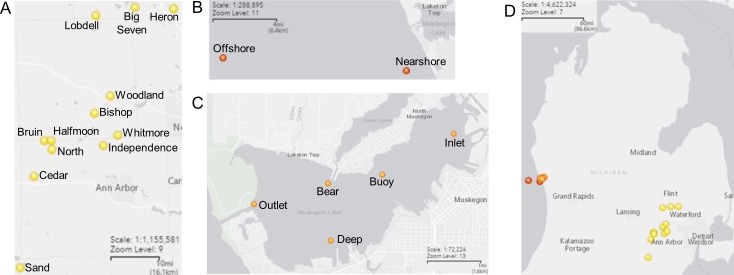
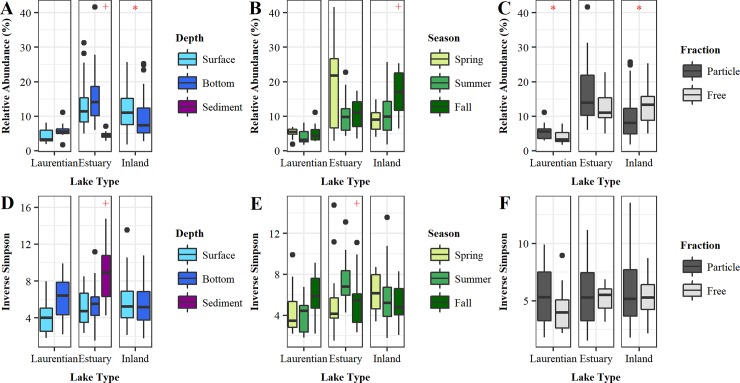
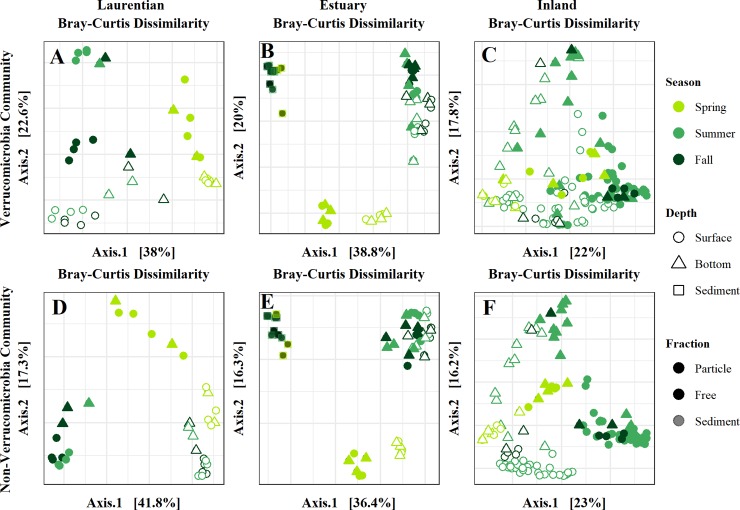
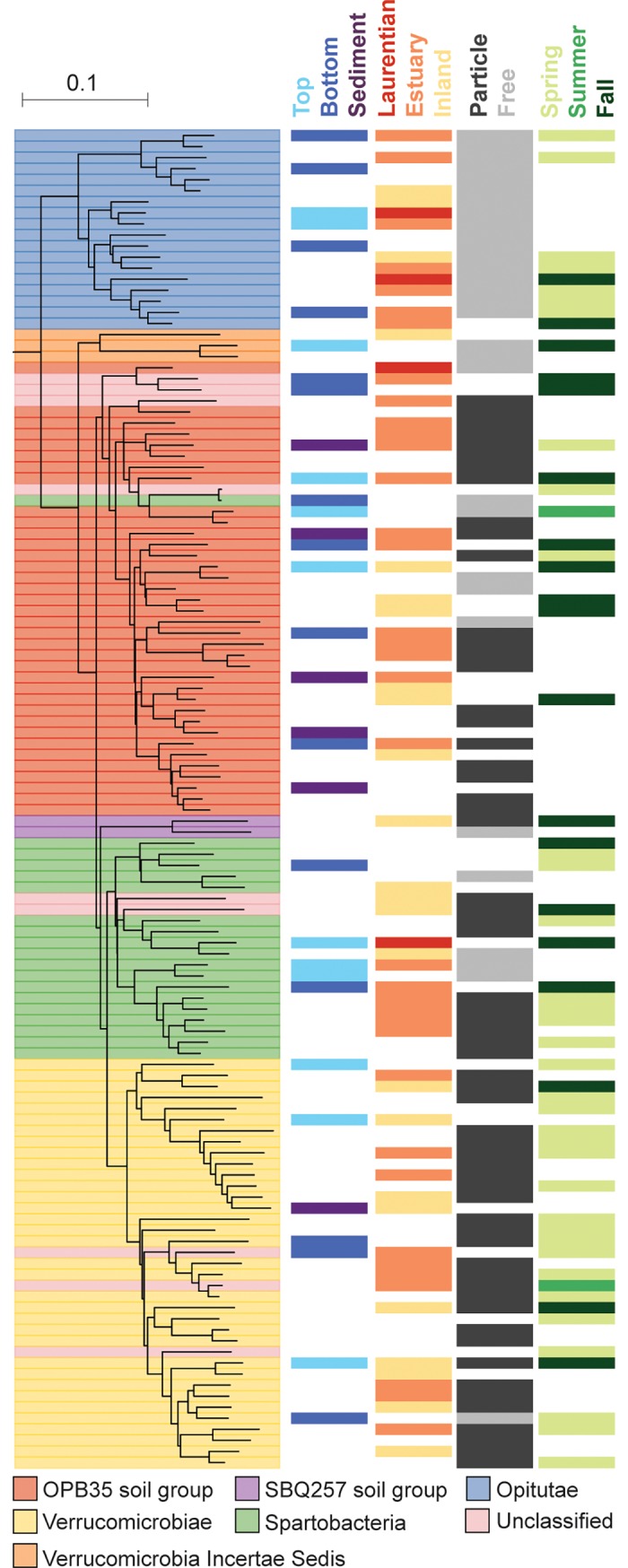
The bacterial phylum Verrucomicrobia was formally described two decades ago and originally believed to be a minor member of many ecosystems; however, it is now recognized as ubiquitous and abundant in both soil and aquatic systems. Nevertheless, knowledge of the drivers of its relative abundance and within-phylum habitat preferences remains sparse, especially in lake systems. Here, we documented the distribution of Verrucomicrobia in 12 inland lakes in Southeastern Michigan, a Laurentian Great Lake (Lake Michigan), and a freshwater estuary, which span a gradient in lake sizes, depths, residence times, and trophic states. A wide range of physical and geochemical parameters was covered by sampling seasonally from the surface and bottom of each lake, and by separating samples into particle-associated and free-living fractions. On average, Verrucomicrobia was the 4th most abundant phylum (range 1.7-41.7%). Fraction, season, station, and depth explained up to 70% of the variance in Verrucomicrobia community composition and preference for these habitats was phylogenetically conserved at the class-level. When relative abundance was linearly modeled against environmental data, Verrucomicrobia and non-Verrucomicrobia bacterial community composition correlated to similar quantitative environmental parameters, although there were lake system-dependent differences and > 55% of the variance remained unexplained. A majority of the phylum exhibited preference for the particle-associated fraction and two classes (Opitutae and Verrucomicrobiae) were identified to be more abundant during the spring season. This study highlights the high relative abundance of Verrucomicrobia in north temperate lake systems and expands insights into drivers of within-phylum habitat preferences of the Verrucomicrobia.
Conflict of interest statement
Figures
References
-
- De Bont J, Staley J, Pankratz H. Isolation and description of a non-motile, fusiform, stalked bacterium, a representatieve of a new genus. Antonie van Leeuwenhoek. 1970;36(1):397–407. - PubMed
-
- Hedlund BP, Gosink JJ, Staley JT. Verrucomicrobia div. nov., a new division of the bacteria containing three new species of Prosthecobacter. Antonie van Leeuwenhoek. 1997;72(1):29–38. - PubMed
-
- Schlesner H. Verrucomicrobium spinosum gen. nov., sp. nov.: a fimbriated prosthecate bacterium. Syst Appl Microbiol. 1987;10(1):54–6.
Publication types
MeSH terms
Substances
LinkOut - more resources
Full Text Sources
Other Literature Sources
