


Language acquisition with communication between learners
- PMID: 29593089
- PMCID: PMC5908541
- DOI: 10.1098/rsif.2018.0073
Language acquisition with communication between learners
Abstract
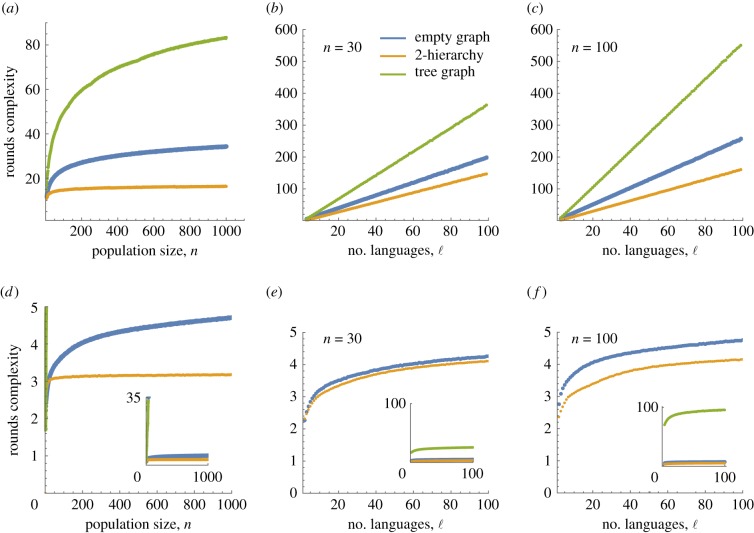
We consider a class of students learning a language from a teacher. The situation can be interpreted as a group of child learners receiving input from the linguistic environment. The teacher provides sample sentences. The students try to learn the grammar from the teacher. In addition to just listening to the teacher, the students can also communicate with each other. The students hold hypotheses about the grammar and change them if they receive counter evidence. The process stops when all students have converged to the correct grammar. We study how the time to convergence depends on the structure of the classroom by introducing and evaluating various complexity measures. We find that structured communication between students, although potentially introducing confusion, can greatly reduce some of the complexity measures. Our theory can also be interpreted as applying to the scientific process, where nature is the teacher and the scientists are the students.
Keywords: inductive inference; language learning; population structures in learning.
© 2018 The Author(s).
Conflict of interest statement
We declare we have no competing interests.
Figures


References
-
- Lightfoot D. 1999. The development of language: acquisition, change, and evolution. Hoboken, New Jersey: Wiley-Blackwell.
-
- Wexler K, Culicover P. 1980. Formal principles of language acquisition. Cambridge, MA: MIT Press.
-
- Smith JM. 1982. Evolution and the theory of games. Cambridge, UK: Cambridge university press.
-
- Nowak MA. 2006. Evolutionary dynamics. Cambridge, MA: Harvard University Press.
Publication types
MeSH terms
LinkOut - more resources
Full Text Sources
Other Literature Sources
