


The early mature part of bacterial twin-arginine translocation (Tat) precursor proteins contributes to TatBC receptor binding
- PMID: 29593092
- PMCID: PMC5949997
- DOI: 10.1074/jbc.RA118.002576
The early mature part of bacterial twin-arginine translocation (Tat) precursor proteins contributes to TatBC receptor binding
Abstract
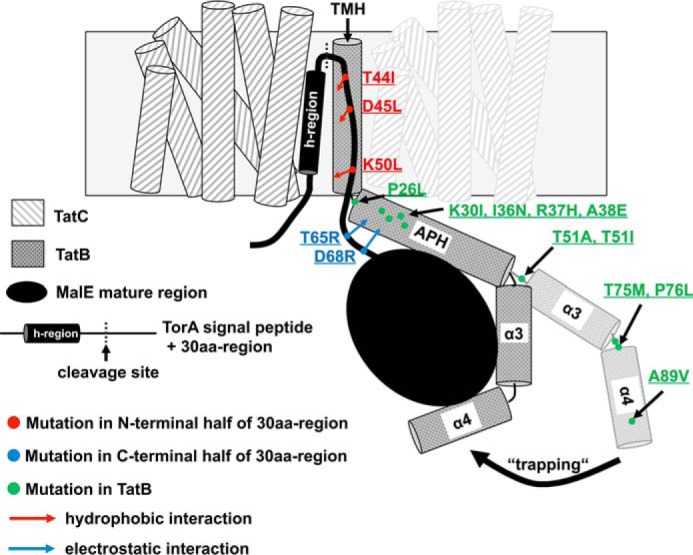
The twin-arginine translocation (Tat) pathway transports folded proteins across bacterial membranes. Tat precursor proteins possess a conserved twin-arginine (RR) motif in their signal peptides that is involved in the binding of the proteins to the membrane-associated TatBC receptor complex. In addition, the hydrophobic region in the Tat signal peptides also contributes to TatBC binding, but whether regions beyond the signal-peptide cleavage site are involved in this process is unknown. Here, we analyzed the contribution of the early mature protein part of the Escherichia coli trimethylamine N-oxide reductase (TorA) to productive TatBC receptor binding. We identified substitutions in the 30 amino acids immediately following the TorA signal peptide (30aa-region) that restored export of a transport-defective TorA[KQ]-30aa-MalE precursor, in which the RR residues had been replaced by a lysine-glutamine pair. Some of these substitutions increased the hydrophobicity of the N-terminal part of the 30aa-region and thereby likely enhanced hydrophobic substrate-receptor interactions within the hydrophobic TatBC substrate-binding cavity. Another class of substitutions increased the positive net charge of the region's C-terminal part, presumably leading to strengthened electrostatic interactions between the mature substrate part and the cytoplasmic TatBC regions. Furthermore, we identified substitutions in the C-terminal domains of TatB following the transmembrane segment that restored transport of various transport-defective TorA-MalE derivatives. Some of these substitutions most likely affected the orientation or conformation of the flexible, carboxy-proximal helices of TatB. Therefore, we propose that a tight accommodation of the folded mature region by TatB contributes to productive binding of Tat substrates to TatBC.
Keywords: Escherichia coli (E. coli); early mature region; membrane transport; protein export; protein folding; protein targeting; protein translocation; secretion pathway; substrate receptor; twin arginine translocation.
© 2018 Ulfig and Freudl.
Conflict of interest statement
The authors declare that they have no conflicts of interest with the contents of this article.
Figures


References
-
- Hou B., and Brüser T. (2011) The Tat-dependent protein translocation pathway. Biomol. Concepts 2, 507–523 - PubMed
MeSH terms
Substances
LinkOut - more resources
Full Text Sources
Other Literature Sources
Molecular Biology Databases
