. 2018 Mar 28;8(1):5307.
doi: 10.1038/s41598-018-23563-4.

Sample-Index Misassignment Impacts Tumour Exome Sequencing

Affiliations

Sample-Index Misassignment Impacts Tumour Exome Sequencing

Daniel Vodák et al. Sci Rep. .

Abstract

Sample pooling enabled by dedicated indexes is a common strategy for cost-effective and robust high-throughput sequencing. Index misassignment leading to mutual contamination between pooled samples has however been described as a general problem of the latest Illumina sequencing instruments utilizing exclusion amplification. Using real-life data from multiple tumour sequencing projects, we demonstrate that index misassignment can induce artefactual variant calls closely resembling true, high-quality somatic variants. These artefactual calls potentially impact cancer applications utilizing low allelic frequencies, such as in clonal analysis of tumours. We discuss the available countermeasures with an emphasis on improved library indexing methods, and provide software that can assist in the identification of variants that may be consequences of index misassignment.


Conflict of interest statement

The research has been in part funded by Illumina, Inc., which provided sequencing reagents and flow cells necessary to conduct the experiment for establishing the role of multiplexing in ExAmp-associated index misassignment.

Figures
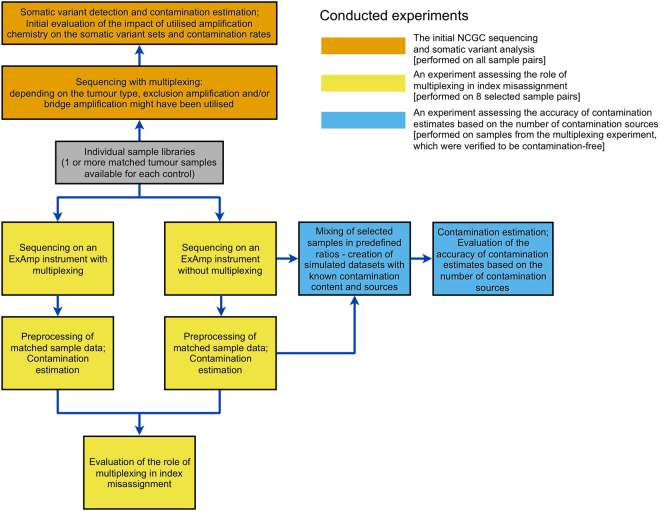
Figure 1
Figure 1
A schematic overview of the three main conducted experiments. The same library material was used for any given sample included in multiple experiments.
Figure 2
Figure 2
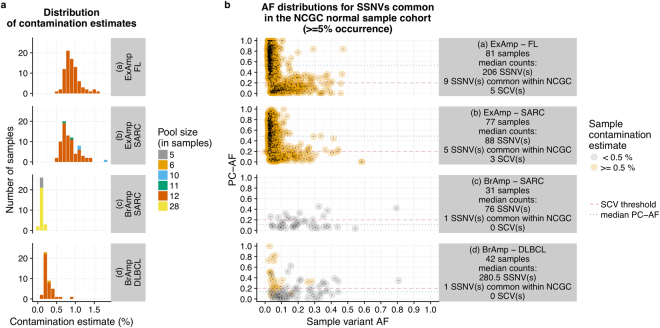
Amplification chemistry and its relationships to (a) sample contamination estimates and (b) variant counts and PC-AF values. All values are plotted separately for each combination of tumour type and amplification chemistry represented in the analysis. The colours distinguish between variants called in “high-contamination” samples (Conpair contamination estimate >  = 0.5%) and variants coming from samples with “low contamination” (Conpair contamination estimate < 0.5%). BrAmp: bridge amplification; FL: follicular lymphoma; SARC: sarcoma; DLBCL: diffuse large B-cell lymphoma; SCV: suspected contaminant variant.
Figure 3
Figure 3
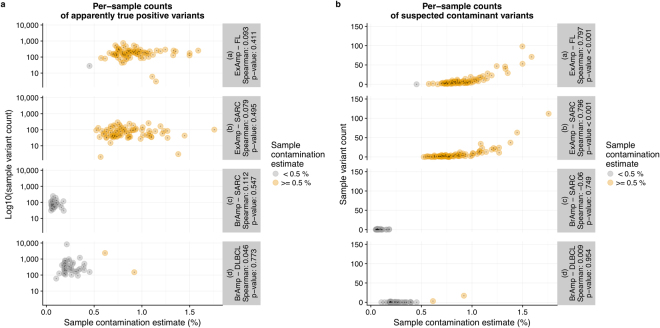
Per-sample counts of apparently true somatic variants (a) and suspected contaminant variants (b) plotted against contamination estimates. All values, including Spearman’s rank correlation coefficients and their associated p-values, are plotted separately for each combination of tumour type and amplification chemistry represented in the analysis. The colours distinguish between “high-contamination” samples (Conpair contamination estimate >  = 0.5%) and samples with “low contamination” (Conpair contamination estimate < 0.5%). BrAmp: bridge amplification; FL: follicular lymphoma; SARC: sarcoma; DLBCL: diffuse large B-cell lymphoma.

References

    1. Garraway LA. Genomics-Driven Oncology: Framework for an Emerging Paradigm. J. Clin. Oncol. 2013;31:1806–1814. doi: 10.1200/JCO.2012.46.8934. - DOI - PubMed
    1. Griffith M, et al. CIViC is a community knowledgebase for expert crowdsourcing the clinical interpretation of variants in cancer. Nat. Genet. 2017;49:170–174. doi: 10.1038/ng.3774. - DOI - PMC - PubMed
    1. Cibulskis K, et al. Sensitive detection of somatic point mutations in impure and heterogeneous cancer samples. Nat. Biotechnol. 2013;31:213–219. doi: 10.1038/nbt.2514. - DOI - PMC - PubMed
    1. Ryu D, Joung J-G, Kim NKD, Kim K-T, Park W-Y. Deciphering intratumor heterogeneity using cancer genome analysis. Hum. Genet. 2016;135:635–642. doi: 10.1007/s00439-016-1670-x. - DOI - PubMed
    1. Lee J-K, Choi Y-L, Kwon M, Park P. J. Mechanisms and Consequences of Cancer Genome Instability: Lessons from Genome Sequencing Studies. Annu. Rev. Pathol. 2016;11:283–312. doi: 10.1146/annurev-pathol-012615-044446. - DOI - PubMed

Publication types