


Curcuminoid-loaded poly(methyl methacrylate) nanoparticles for cancer therapy
- PMID: 29593406
- PMCID: PMC5863624
- DOI: 10.2147/IJN.S124021
Curcuminoid-loaded poly(methyl methacrylate) nanoparticles for cancer therapy
Abstract
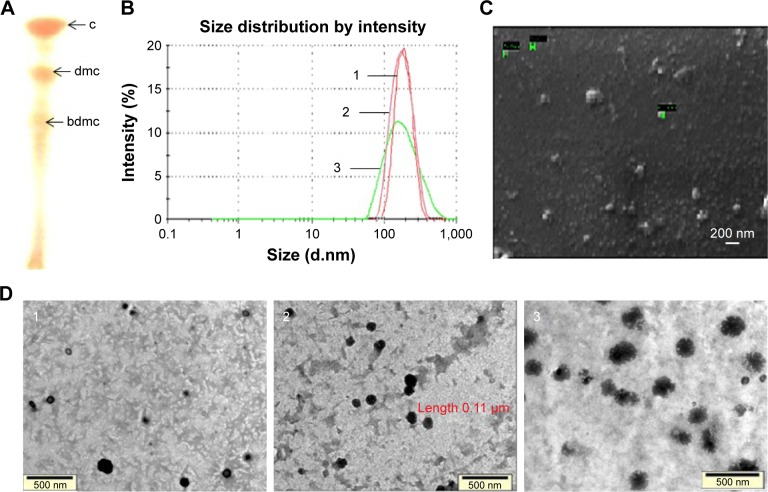
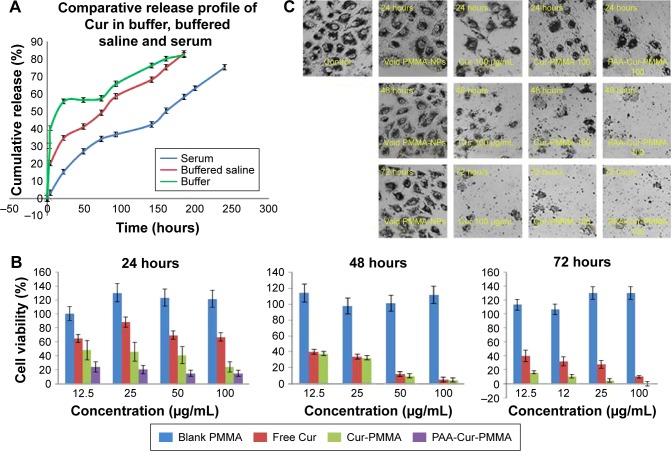
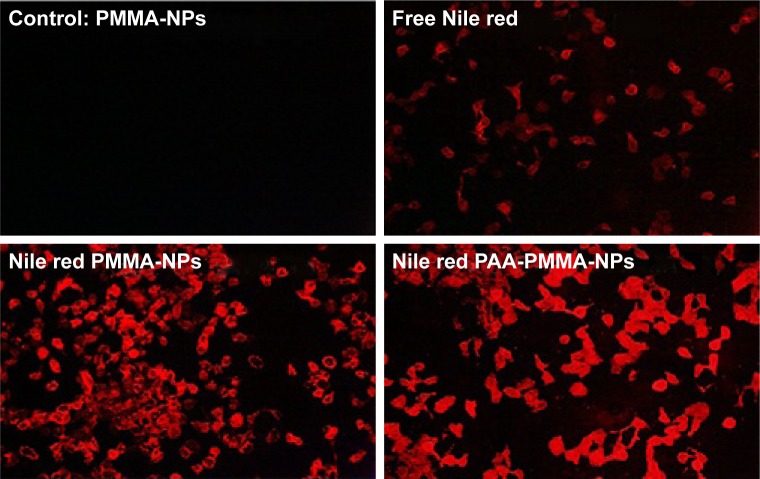
Curcuminoids (Curs), oleoresins from Curcuma longa L., have known anticarcinogenic and anti-inflammatory properties, but high toxicity, poor aqueous solubility and susceptibility to degradation in body fluids are deterrents to their clinical administration. Poly(methyl methacrylate) nanoparticles (PMMA-NPs) are biocompatible and resilient and can entrap hydrophobic drugs. The present investigation is related to solubilizing Curs by incorporating them in these nanoparticles (NPs) and is related to a study comparing the anticarcinogenic effect of drug-loaded NPs with free Cur using lung cancer (A549) cell line. Freshly extracted oleoresins were post loaded in PMMA-NPs prepared using emulsion polymerization. The presence of the three components of oleoresins was confirmed by thin-layer chromatography. The size and morphology of void and loaded NPs were determined by dynamic light scattering, scanning electron microscopy and transmission electron microscopy. The NPs were spherical with diameters of 192.66±5 nm (void) and 199.16±5 nm (loaded). Drug loading and encapsulation efficiency were 6% and 93%, respectively. From the Fourier transform infrared spectroscopy spectra, the characteristic absorption vibration of poly(methyl methacrylate) and the bands at 1,383, 1,233 and 962 cm-1 for Cur moiety were observed. Drug release up to 10 days was estimated in buffer, saline and serum. The highest release of ~55% in ~3 days was noted in buffer that exhibited the highest bioavailability. The in vitro anticancer activity of loaded drug was evaluated up to 72 hours by MTT assay using A549 cell line. Cellular uptake of dye-loaded NPs was visualized within 30 minutes of incubation. The results revealed that the dose- and time-dependent cell death in case of loaded PMMA-NPs was comparable to that of free Cur. According to the study, the drug-loaded PMMA-NPs appear to be highly suitable for effective, localized and safe chemotherapy.
Keywords: A549 cell line; anticarcinogenic; polymeric nanoparticle; squamous cell carcinoma.
Conflict of interest statement
Disclosure The authors report no conflicts of interest in this work.
Figures
References
-
- Guo LY, Cai XF, Lee JJ, et al. Comparison of suppressive effects of demethoxycurcumin and bisdemethoxycurcumin on expressions of inflammatory mediators in vitro and in vivo. Arch Pharm Res. 2008;31(4):490–496. - PubMed
-
- Mukherjee A, Vishwanatha JK. Formulation, characterization and evaluation of curcumin-loaded PLGA nanospheres for cancer therapy. Anticancer Res. 2009;29(10):3867–3876. - PubMed
-
- Elvira C, Fanovich A, Fernandez M, Fraile J, San Román J, Domingo C. Evaluation of drug delivery characteristics of microspheres of PMMA–PCL–cholesterol obtained by supercritical-CO2 impregnation and by dissolution–evaporation techniques. J Control Release. 2004;99(2):231–240. - PubMed
MeSH terms
Substances
LinkOut - more resources
Full Text Sources
Other Literature Sources
