


New insights into Nod-like receptors (NLRs) in liver diseases
- PMID: 29593846
- PMCID: PMC5871625
New insights into Nod-like receptors (NLRs) in liver diseases
Abstract
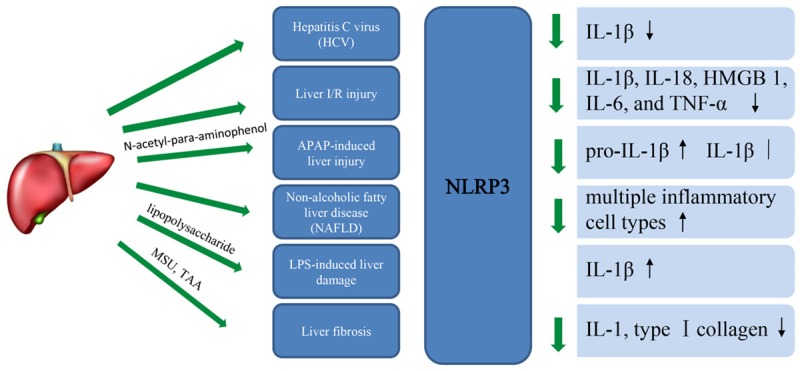
Activation of inflammatory signaling pathways is of central importance in the pathogenesis of alcoholic liver disease (ALD) and nonalcoholic steatohepatitis (NASH). Nod-like receptors (NLRs) are intracellular innate immune sensors of microbes and danger signals that control multiple aspects of inflammatory responses. Recent studies demonstrated that NLRs are expressed and activated in innate immune cells as well as in parenchymal cells in the liver. For example, NLRP3 signaling is involved in liver ischemia-reperfusion (I/R) injury and silencing of NLRP3 can protect the liver from I/R injury. In this article, we review the evidence that highlights the critical importance of NLRs in the prevalent liver diseases. The significance of NLR-induced intracellular signaling pathways and cytokine production is also evaluated.
Keywords: NLRP3; Nod-like receptors (NLRs); liver diseases.
Conflict of interest statement
None.
Figures

References
-
- Kern M, Popov A, Scholz K, Schumak B, Djandji D, Limmer A, Eggle D, Sacher T, Zawatzky R, Holtappels R, Reddehase MJ, Hartmann G, Debey-Pascher S, Diehl L, Kalinke U, Koszinowski U, Schultze J, Knolle PA. Virally infected mouse liver endothelial cells trigger CD8+ T-cell immunity. Gastroenterology. 2010;138:336–346. - PubMed
-
- Knolle PA, Gerken G. Local control of the immune response in the liver. Immunol Rev. 2000;174:21–34. - PubMed
-
- Knolle PA, Limmer A. Neighborhood politics: the immunoregulatory function of organ-resident liver endothelial cells. Trends Immunol. 2001;22:432–437. - PubMed
Publication types
LinkOut - more resources
Full Text Sources