


CPS-referred mothers' psychophysiological responses to own versus other child predict sensitivity to child distress
- PMID: 29595312
- PMCID: PMC6019158
- DOI: 10.1037/dev0000508
CPS-referred mothers' psychophysiological responses to own versus other child predict sensitivity to child distress
Abstract
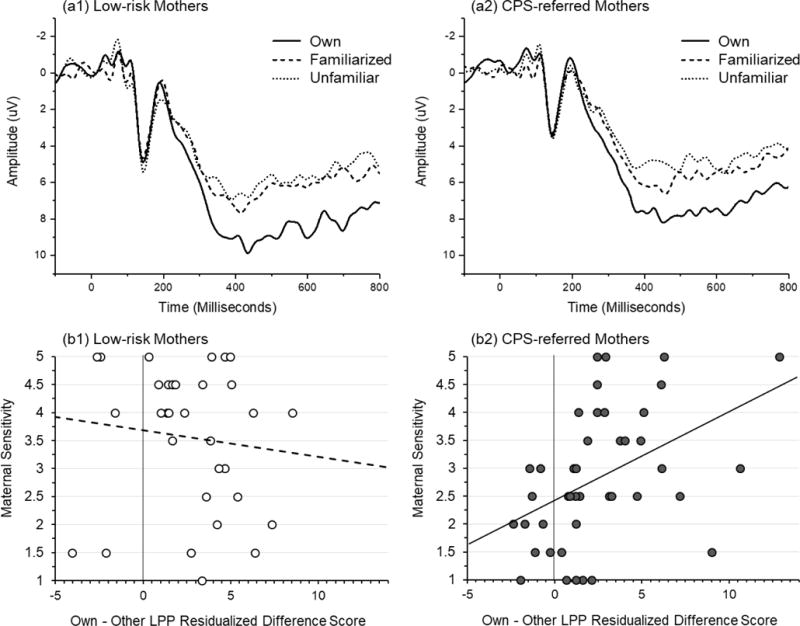
Maltreating mothers often struggle to respond sensitively to their children's distress. Examining psychophysiological processing of own child cues may offer insight into neurobiological mechanisms that promote sensitive parenting among high-risk mothers. The current study used event-related potential (ERP) methodology to examine associations between mothers' neural responses to their own child versus other children and observed sensitivity to distress. Participants included 73 mothers: 42 with histories of child protective services (CPS) involvement and 31 low-risk comparison mothers. Maternal sensitivity to child distress was coded from observations of children's blood sample collection. Late positive potential (LPP) ERP responses, which reflect sustained attention to emotionally salient stimuli, were measured when mothers viewed photos of their own child and other children. An own-other LPP difference score (own-other LPP) was computed by regressing the mean amplitude of mothers' LPP to their own child on the mean amplitude of mothers' LPP to other children. CPS-referred mothers and low-risk mothers did not differ in their LPP responses to own child, other children, or the own-other LPP. However, there was a significant interaction between group (CPS-referred vs. low-risk) and own-other LPP in predicting maternal sensitivity. Among the CPS-referred mothers, own-other LPP was significantly correlated with maternal sensitivity, with greater LPP amplitude to own versus other child associated with higher maternal sensitivity. In contrast, among the low-risk group, own-other LPP was not significantly correlated with maternal sensitivity. Findings add to our understanding of the neurobiology of sensitive parenting among high-risk mothers. (PsycINFO Database Record
(c) 2018 APA, all rights reserved).
Figures
References
-
- Afonso VM, Sison M, Lovic V, Fleming AS. Medial prefrontal cortex lesions in the female rat affect sexual and maternal behavior and their sequential organization. Behavioral Neuroscience. 2007;121(3):515–26. https://doi.org/10.1037/0735-7044.121.3.515. - DOI - PubMed
-
- Ainsworth MDS. Infancy in Uganda: Infant care and growth of love. Baltimore, MD: Johns Hopkins Press; 1967.
-
- Ainsworth MDS. Patterns of attachment : a psychological study of the strange situation. Lawrence Erlbaum Associates; 1978.
-
- Appleyard K, Egeland B, van Dulmen MHM, Sroufe LA. When more is not better: the role of cumulative risk in child behavior outcomes. Journal of Child Psychology and Psychiatry, and Allied Disciplines. 2005;46(3):235–45. https://doi.org/10.1111/j.1469-7610.2004.00351.x. - DOI - PubMed
-
- Asok A, Bernard K, Roth TL, Rosen JB, Dozier M. Parental responsiveness moderates the association between early-life stress and reduced telomere length. Development and Psychopathology. 2013;25:577–585. https://doi.org/10.1017/S0954579413000011. - DOI - PMC - PubMed
MeSH terms
Grants and funding
LinkOut - more resources
Full Text Sources
Other Literature Sources
