. 2018 Mar 29;19(4):1023.
doi: 10.3390/ijms19041023.

Preconditioning-Like Properties of Short-Term Hypothermia in Isolated Perfused Rat Liver (IPRL) System

Affiliations

Preconditioning-Like Properties of Short-Term Hypothermia in Isolated Perfused Rat Liver (IPRL) System

Norma Alva et al. Int J Mol Sci. .

Abstract

Hypothermia may attenuate the progression of ischemia-induced damage in liver. Here, we determined the effects of a brief cycle of hypothermic preconditioning applied before an ischemic/reperfusion (I/R) episode in isolated perfused rat liver (IPRL) on tissue damage and oxidative stress. Rats (male, 200-250 g) were anaesthetised with sodium pentobarbital (60 mg·kg-1 i.p) and underwent laparatomy. The liver was removed and perfused in a temperature-regulated non-recirculating system. Livers were randomly divided into two groups (n = 6 each group). In the hypothermia-preconditioned group, livers were perfused with hypothermic buffer (cycle of 10 min at 22 °C plus 10 min at 37 °C) and the other group was perfused at 37 °C. Both groups were then submitted to 40 min of warm ischemia and 20 min of warm reperfusion. The level of tissue-damage indicators (alanine amino transferase, ALT; lactate dehydrogenase, LDH; and proteins), oxidative stress markers (thiobarbituric acid-reactive substances, TBARS; advanced oxidation protein products, AOPP; and glutathione, GSH) were measured in aliquots of perfusate sampled at different time intervals. Histological determinations and oxidative stress biomarkers in homogenized liver (AOPP; TBARS; nitric oxide derivatives, NOx; GSH and glutathione disulphide, GSSG) were also made in the tissue at the end. Results showed that both damage and oxidant indicators significantly decreased while antioxidant increased in hypothermic preconditioned livers. In addition, homogenized liver determinations and histological observations at the end of the protocol corroborate the results in the perfusate, confirming the utility of the perfusate as a non-invasive method. In conclusion, hypothermic preconditioning attenuates oxidative damage and appears to be a promising strategy to protect the liver against IR injury.

Keywords: glutathione; hypothermic preconditioning; ischemia/reperfusion injury; lipid peroxidation.


Conflict of interest statement

The authors declare no conflict of interest.

Figures
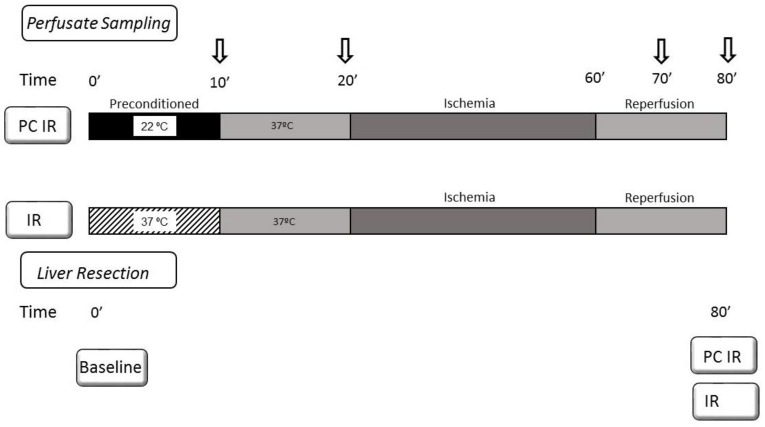
Figure 1
Figure 1
Schematic representation of experimental design. The IPR livers were randomly treated with hypothermic perfusion (22 °C) during 10 min (PC IR group) or perfused at 37 °C (IR group). Both groups were then submitted to 10 min at 37 °C. The perfusion was conducted under temperature-controlled conditions. The liver, kept moist in KHB solution, was placed in a temperature-controlled box, surrounded by a continuously stirred buffer at the set temperature (37 °C or 22 °C). Control of liver temperature was carried out with a thermocouple located at the catheter in the thoracic inferior vena cava. After the preconditioning period (20 min), ischemia (40 min) was induced by stopping the perfusion machine while keeping the liver-containing device surrounded by warm water to avoid cooling. Reperfusion was initiated by turning on the perfusion machine, circulating with warm buffer at 37 °C. Perfusate was sampled at different time intervals: after preconditioning (10 min), before ischemia (20 min), after ischemia/reperfusion (70 min) and at the end of reperfusion (80 min). At the end, liver extracts were also analysed to be compared to fresh resected livers.
Figure 2
Figure 2
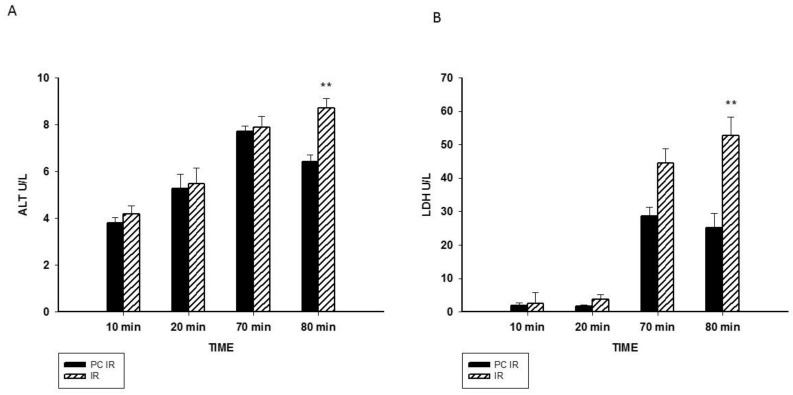
Effect of hypothermic perfusion on cellular integrity. (A) Alanine aminotransferase (ALT) in the perfusate; and (B) lactate dehydrogenase (LDH) in the perfusate. Data is mean ± SEM of six animals. Significantly different from corresponding PC IR values by Student’s t test: ** p < 0.01.
Figure 3
Figure 3
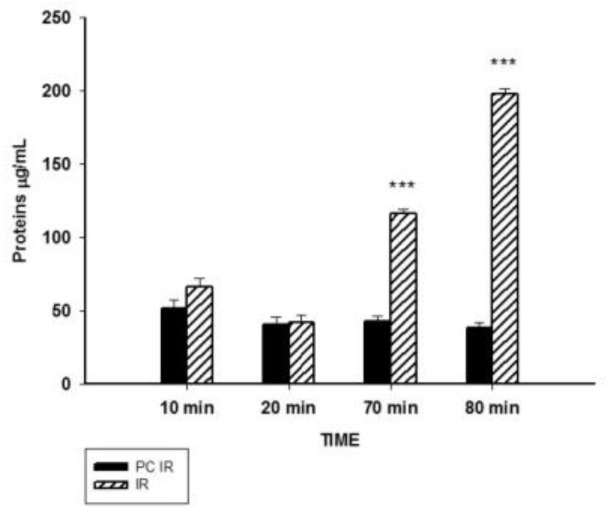
Effect of hypothermic perfusion on cellular integrity. Total protein content in the perfusate. Data is mean ± SEM of six animals. Significantly different from corresponding PC IR values by Student’s t test: *** p < 0.001.
Figure 4
Figure 4
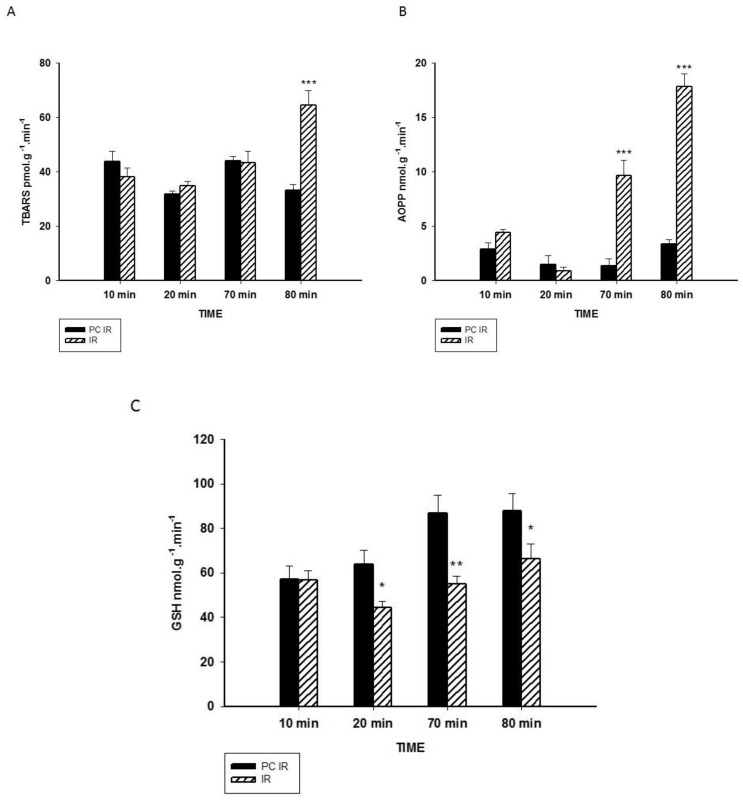
Effect of hypothermic perfusion on biomarkers of oxidative stress in the perfusate. (A) Lipid peroxidation (TBARS) (B) Advanced oxidation protein products (AOPP) and (C) GSH levels in the perfusate. Data is mean ± SEM of six animals. Significantly different from corresponding PC IR values by Student’s t test: * p < 0.05, ** p < 0.01 and *** p < 0.001.
Figure 5
Figure 5
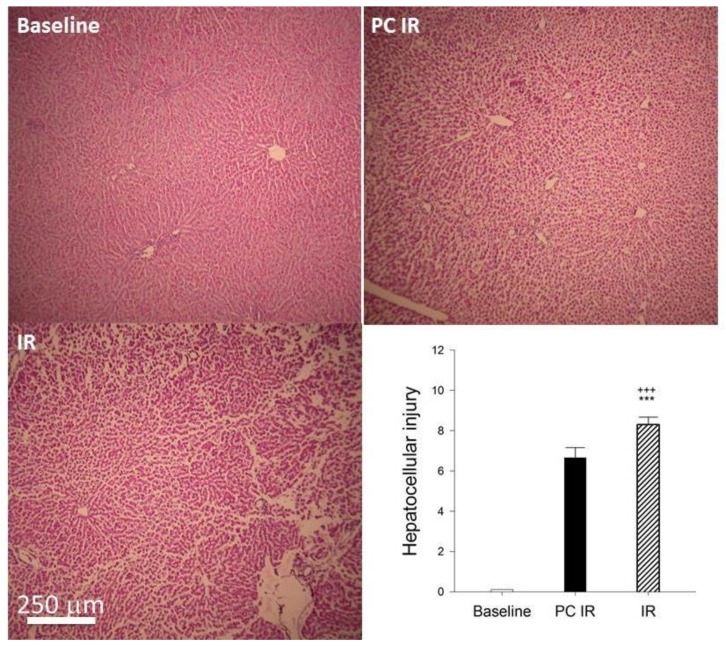
Histology hematoxylin-eosin staining. Photomicrographs at 10× magnification. Baseline: Fresh resected livers; PC IR: livers were preconditioned with hypothermic perfusion (22 °C) for 10 min and 10 min of normothermia previous to 40 min of ischemia and 20 min of reperfusion. IR: livers were perfused at normothermia, 37 °C for 20 min and then submitted to 40 min of ischemia and 20 min of reperfusion. Liver sections were stained with hematoxylin and eosin according to standard procedures. Scale bar, 250 µm. Tissue injury was scored as described in the Material and Methods section. Significantly different from corresponding Baseline values: +++ p < 0.001. Significantly different from corresponding PC IR values: *** p < 0.001.

References

    1. Iniguez M., Dotor J., Feijoo E., Goni S., Prieto J., Berasain C., Avila M.A. Novel pharmacologic strategies to protect the liver from ischemia-reperfusion injury. Recent Pat. Cardiovasc. Drug Discov. 2008;3:9–18. - PubMed
    1. Zaouali M.A., Abdennebi H.B., Padrissa-Altés S., Mahfoudh-Boussaid A., Roselló-Catafau J. Pharmacological strategies against cold ischemia reperfusion injury. Expert Opin. Pharmacother. 2010;11:537–555. doi: 10.1517/14656560903547836. - DOI - PubMed
    1. Zhai Y., Petrowsky H., Hong J.C., Busuttil R.W., Kupiec-Weglinski W.J. Ischaemia-reperfusion injury in liver transplantation—From bench to bedside. Nat. Rev. Gastroenterol. Hepatol. 2013;10:79–89. doi: 10.1038/nrgastro.2012.225. - DOI - PMC - PubMed
    1. Dutkowski P., Krug A., Krysiak M., Dünschede F., Seifert J.K., Junginger T. Detection of mitochondrial electron chain carrier redox status by transhepatic light intensity during rat liver reperfusion. Cryobiology. 2003;47:125–142. doi: 10.1016/j.cryobiol.2003.08.004. - DOI - PubMed
    1. Zaouali M.A., Panisello-roselló A., Lopez A., Benítez C.C., Folch-puy E., García-gil A., Carbonell T., Adam R., Roselló-catafau J., Zaouali M.A., et al. Relevance of proteolysis and proteasome activation in fatty liver graft preservation : An Institut Georges Lopez-1 vs University of Wisconsin appraisal. World J. Gastroenterol. 2017;23:4211–4221. doi: 10.3748/wjg.v23.i23.4211. - DOI - PMC - PubMed