. 2018 Mar 29;19(4):1028.
doi: 10.3390/ijms19041028.

Genome-Wide Analyses of the NAC Transcription Factor Gene Family in Pepper (Capsicum annuum L.): Chromosome Location, Phylogeny, Structure, Expression Patterns, Cis-Elements in the Promoter, and Interaction Network

Affiliations

Genome-Wide Analyses of the NAC Transcription Factor Gene Family in Pepper (Capsicum annuum L.): Chromosome Location, Phylogeny, Structure, Expression Patterns, Cis-Elements in the Promoter, and Interaction Network

Weiping Diao et al. Int J Mol Sci. .

Abstract

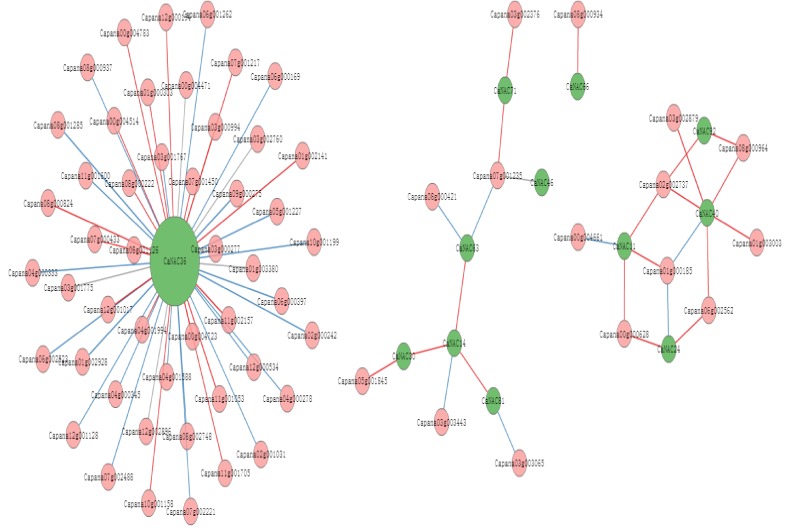
The NAM, ATAF1/2, and CUC2 (NAC) transcription factors form a large plant-specific gene family, which is involved in the regulation of tissue development in response to biotic and abiotic stress. To date, there have been no comprehensive studies investigating chromosomal location, gene structure, gene phylogeny, conserved motifs, or gene expression of NAC in pepper (Capsicum annuum L.). The recent release of the complete genome sequence of pepper allowed us to perform a genome-wide investigation of Capsicum annuum L. NAC (CaNAC) proteins. In the present study, a comprehensive analysis of the CaNAC gene family in pepper was performed, and a total of 104 CaNAC genes were identified. Genome mapping analysis revealed that CaNAC genes were enriched on four chromosomes (chromosomes 1, 2, 3, and 6). In addition, phylogenetic analysis of the NAC domains from pepper, potato, Arabidopsis, and rice showed that CaNAC genes could be clustered into three groups (I, II, and III). Group III, which contained 24 CaNAC genes, was exclusive to the Solanaceae plant family. Gene structure and protein motif analyses showed that these genes were relatively conserved within each subgroup. The number of introns in CaNAC genes varied from 0 to 8, with 83 (78.9%) of CaNAC genes containing two or less introns. Promoter analysis confirmed that CaNAC genes are involved in pepper growth, development, and biotic or abiotic stress responses. Further, the expression of 22 selected CaNAC genes in response to seven different biotic and abiotic stresses [salt, heat shock, drought, Phytophthora capsici, abscisic acid, salicylic acid (SA), and methyl jasmonate (MeJA)] was evaluated by quantitative RT-PCR to determine their stress-related expression patterns. Several putative stress-responsive CaNAC genes, including CaNAC72 and CaNAC27, which are orthologs of the known stress-responsive Arabidopsis gene ANAC055 and potato gene StNAC30, respectively, were highly regulated by treatment with different types of stress. Our results also showed that CaNAC36 plays an important role in the interaction network, interacting with 48 genes. Most of these genes are in the mitogen-activated protein kinase (MAPK) family. Taken together, our results provide a platform for further studies to identify the biological functions of CaNAC genes.

Keywords: NAC family; gene expression; interaction network; pepper; phylogenetic; transcription factor.


Conflict of interest statement

The authors declare no conflict of interest.

Figures
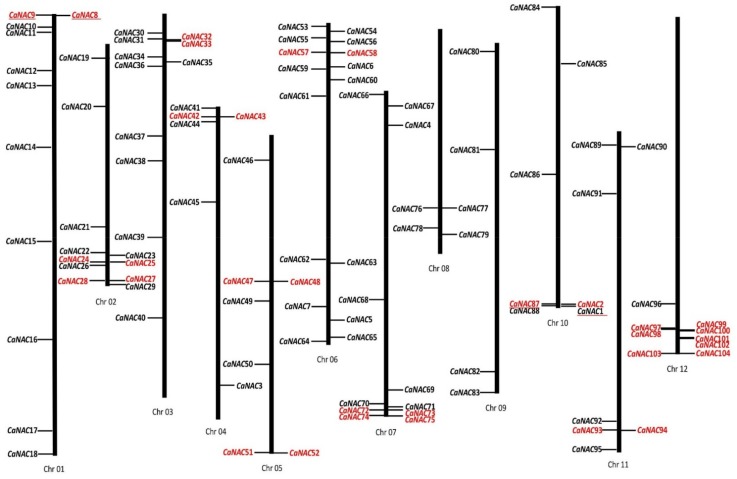
Figure 1
Figure 1
Mapping of the NAC gene family on Capsicum annuum L. chromosomes. The size of each chromosome is indicated by its relative length. Tandemly duplicated genes are indicated in red. Segmental duplicated genes are underlined.
Figure 2
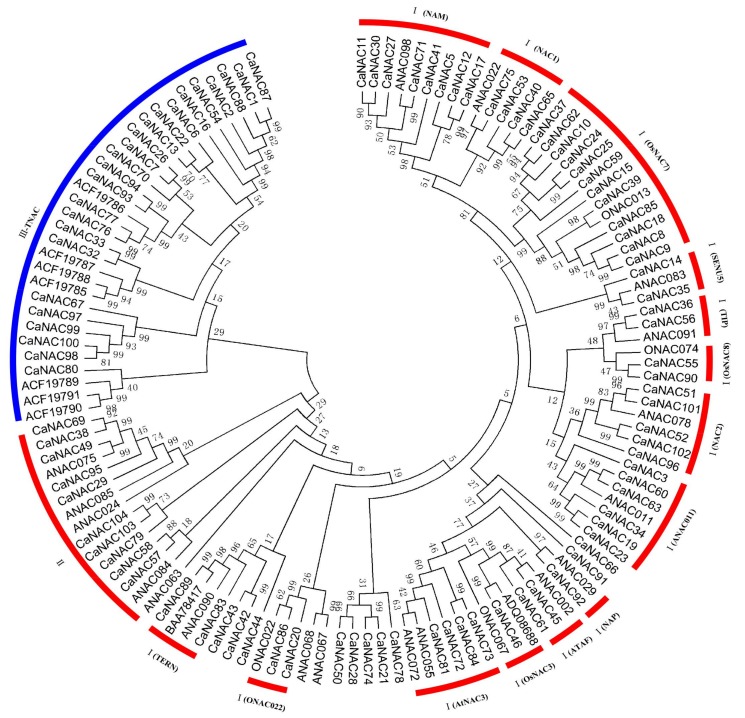
Figure 2
Unrooted phylogenetic tree representing the relationships among the NAC domains of pepper, potato, rice, and Arabidopsis. The amino acid sequences of all NAC domains were aligned with Clustal W (University College Dublin, Belfield, Dublin, Ireland), and the phylogenetics tree was constructed using the neighbor-joining method in MEGA 6.06 (Tokyo Metropolitan University, Hachioji, Tokyo, Japan). The red arcs indicate different groups or subgroups of NAC domains.
Figure 3
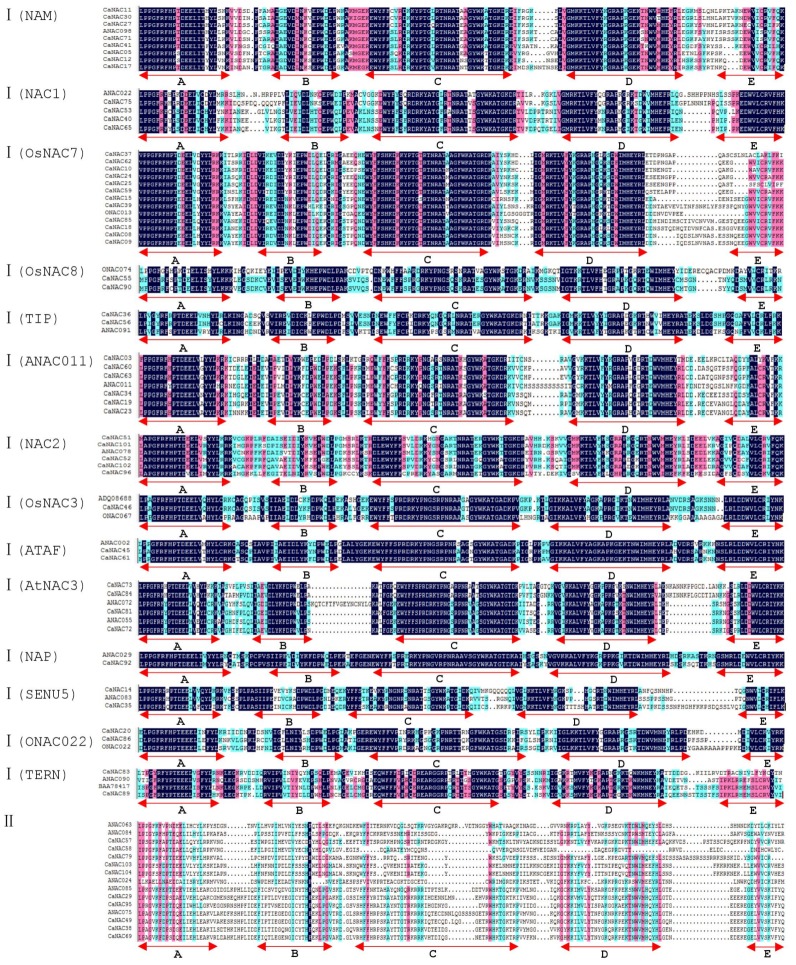
Figure 3
Sequence alignment of two groups of CaNAC domains amino acid sequences. Subdomains A to E are shown by arrows above the sequences. Amino acids in the consensus sequences that are common to all groups are shown in black (=100%). Amino acids in the consensus sequences that are common to 20–25 subgroups (≥75%) are shown in blue, and those common to 13–19 (≥50%) are shown in green.
Figure 4
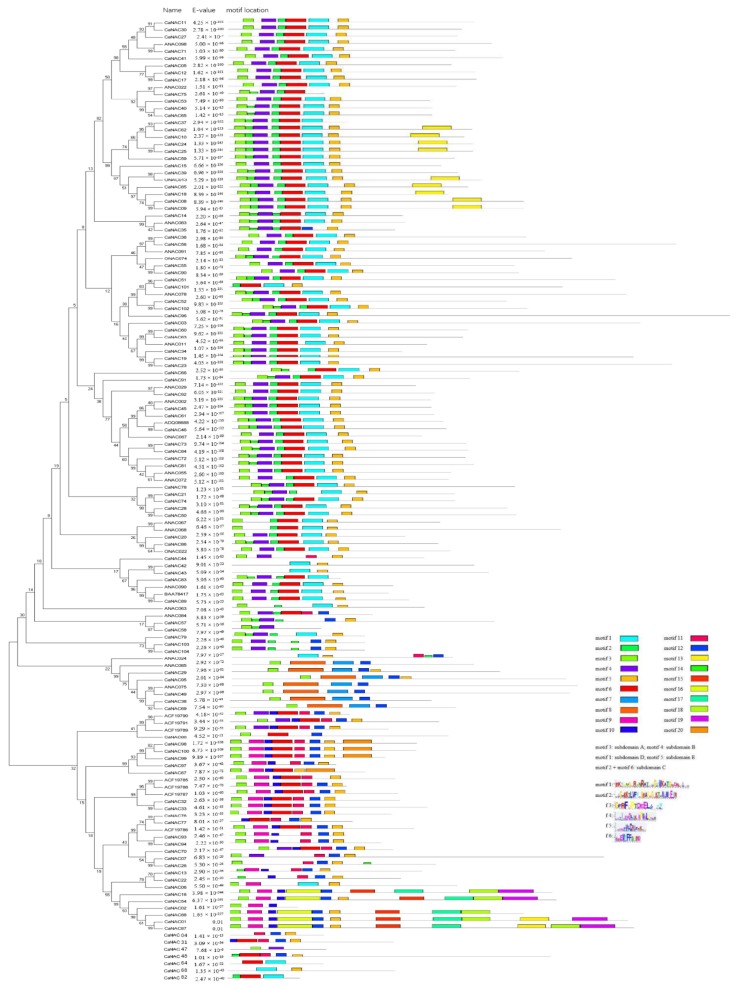
Figure 4
Alignment of multiple CaNAC and selected ONAC, ANAC domain amino acid sequences, schematic diagram of amino acid motifs of CaNAC and ONAC, ANAC protein groups or subgroups. Motif analysis was performed using Meme 4.12.0 online software (Available online: http://meme-suite.org/tools/meme) as described in the methods. The NAC proteins are listed on the left. The different-colored boxes represent different motifs and their position in each NAC sequence. The sequences of key motifs (motif 1, motif 2, motif 3, motif 4, motif 5, and motif 6) are shown on the bottom right of the figure. A detailed motif introduction for all CaNAC protein is shown in File S2.
Figure 5
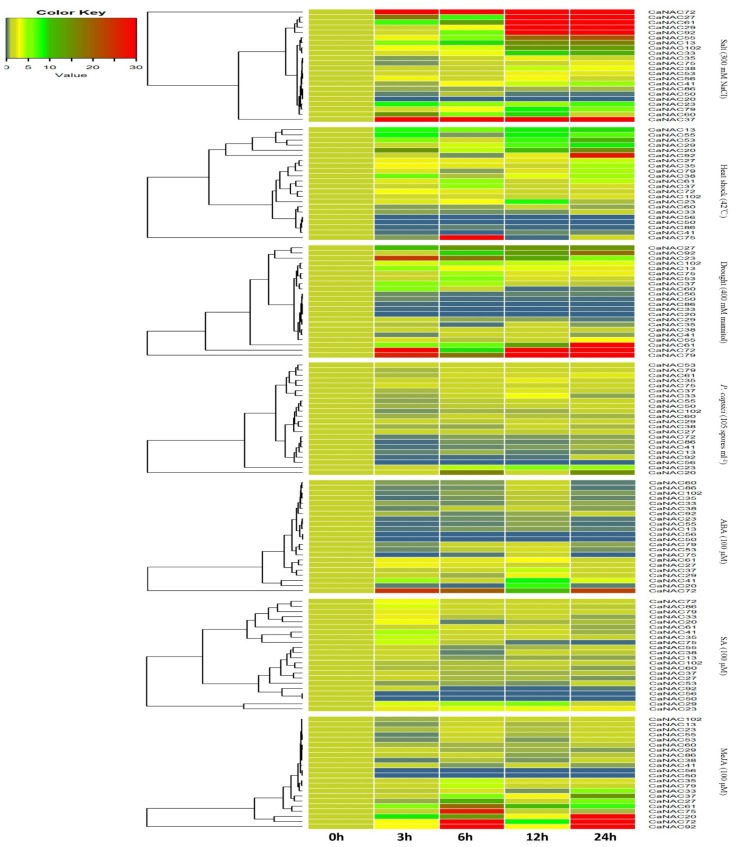
Figure 5
Heat map showing CaNAC genes expression pattern in pepper under seven different types of stress. The leaves or roots of the seedlings (six true leaves) were used to test the changes of CaNAC gene expression levels using real-time PCR at different timepoints (0, 3, 6, 12 and 24 h) with salt, heat shock, abscisic acid (ABA), salicylic acid (SA), methyl jasmonate (MeJA), drought, and Phytophthora capsici treatment, respectively. Actin1 was used as an internal control. qRT-PCR data are shown relative to 0 h. The relative expression levels were calculated using the 2(−∆Ct) method. The heat map was created using R language.
Figure 6
Figure 6
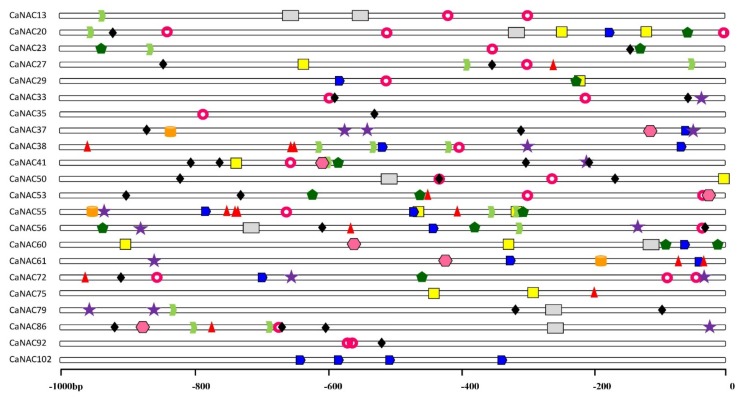
Predicted cis-elements in the promoter regions of CaNAC genes. The promoter sequences (−1000 bp) of 22 CaNAC genes were analyzed. The names of the CaNAC genes are shown on the left side of the figure. The number at the bottom indicates the number of the nucleotides to the translation initiation codon, ATG. The elements are identified as follows: green dovetail for the CGTCA element, red triangle for the ABRE element, yellow square for the W-box element, purple five-pointed star for the TCA element, black diamond for the TC-rich repeats element, dark green pentagon for the MBS element, orange oval for the WUN element, blue pentagon for the GARE element, pink circular crown for the HSEs element, the grey rectangle for the ERE element, the rose red hexagon for the LTR element.
Figure 7
Figure 7
The interaction network of CaNAC genes in pepper according to the orthologs in Arabidopsis. The green circles represent the CaNAC genes, and the pink circles represent the pepper genes interacting with CaNAC genes. The red lines correspond to PCC > 0 (Pearson Correlation Coefficient), the blue lines mean PCC < 0, and the gray lines indicate that the PCC is unknown.

Similar articles

Cited by

References

    1. Puranik S., Sahu P.P., Srivastava P.S., Prasad M. NAC proteins: Regulation and role in stress tolerance. Trends Plant Sci. 2012;17:369–381. doi: 10.1016/j.tplants.2012.02.004. - DOI - PubMed
    1. Banerjee A., Roychoudhury A. WRKY Proteins: Signaling and regulation of expression during abiotic stress responses. Sci. World J. 2015;2015:807560. doi: 10.1155/2015/807560. - DOI - PMC - PubMed
    1. Hisako O., Kouji S., Koji D., Toshifumi N., Yasuhiro O., Kazuo M., Kenichi M., Naoki O., Jun K., Piero C., et al. Comprehensive analysis of NAC family genes in Oryza sativa and Arabidopsis thaliana. DNA Res. 2003;10:239–247. - PubMed
    1. Souer E., Houwelingen A., Kloos D., Mol J., Koes R. The No Apical Meristem gene of Petunia is required for pattern formation in embryos and flowers and is expressed at meristem and primordia boundaries. Cell. 1996;85:159–170. doi: 10.1016/S0092-8674(00)81093-4. - DOI - PubMed
    1. Aida M., Ishida T., Fukaki H., Fujisawa H., Tasaka M. Genes involved in organ separation in Arabidopsis: An analysis of the cup-shaped cotyledon mutant. Plant Cell. 1997;9:841–857. doi: 10.1105/tpc.9.6.841. - DOI - PMC - PubMed

MeSH terms

LinkOut - more resources