Occurrence of Functional Molecules in the Flowers of Tea (Camellia sinensis) Plants: Evidence for a Second Resource
- PMID: 29596355
- PMCID: PMC6017242
- DOI: 10.3390/molecules23040790
Occurrence of Functional Molecules in the Flowers of Tea (Camellia sinensis) Plants: Evidence for a Second Resource
Abstract
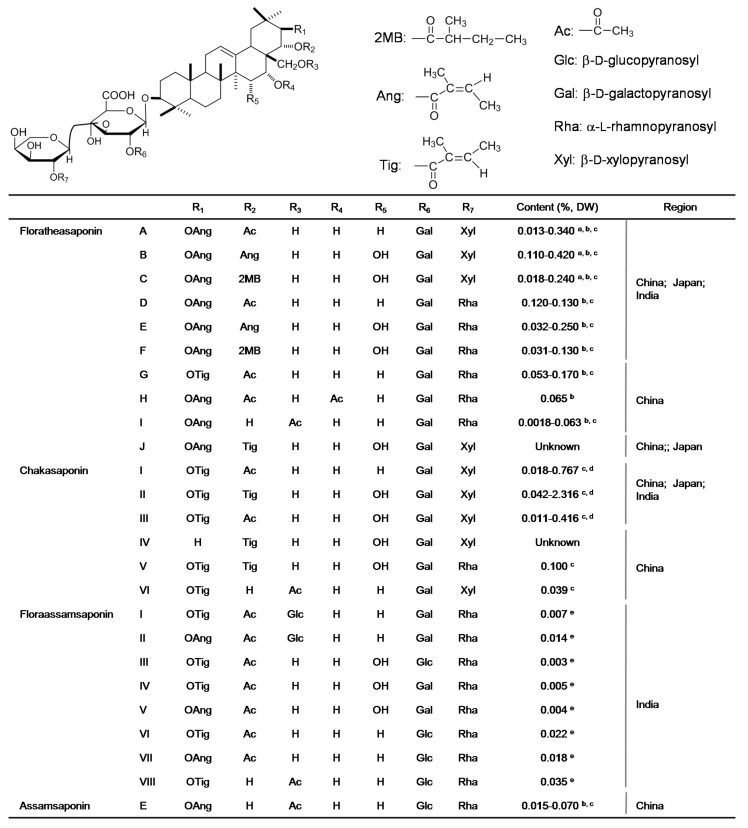
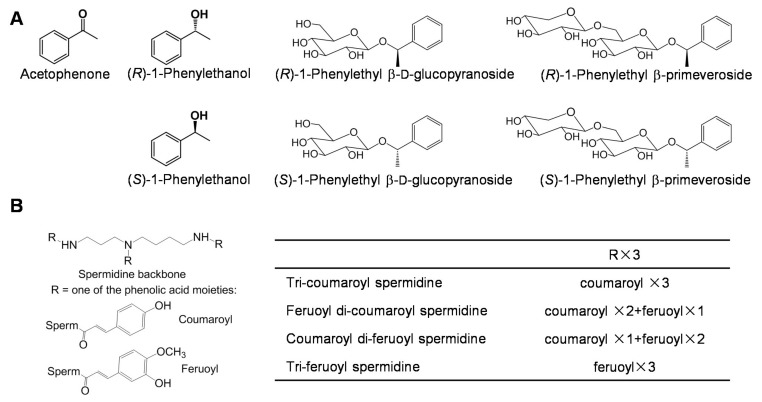
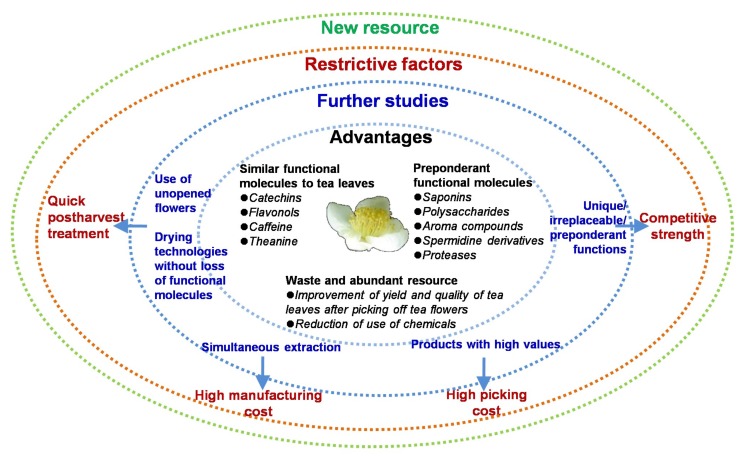
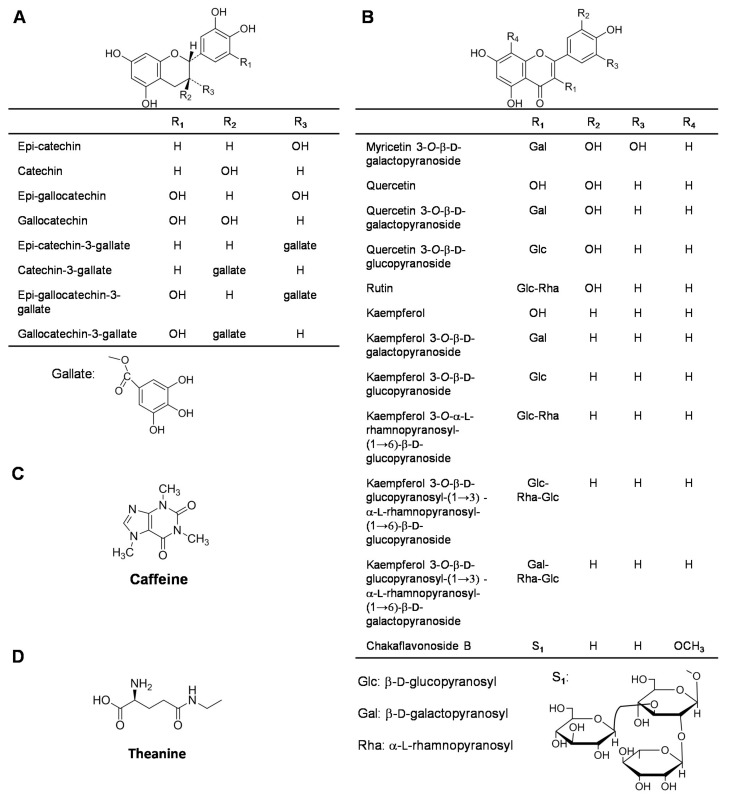
Tea (Camellia sinensis) is an important crop, and its leaves are used to make the most widely consumed beverage, aside from water. People have been using leaves from tea plants to make teas for a long time. However, less attention has been paid to the flowers of tea plants, which is a waste of an abundant resource. In the past 15 years, researchers have attempted to discover, identify, and evaluate functional molecules from tea flowers, and have made insightful and useful discoveries. Here, we summarize the recent investigations into these functional molecules in tea flowers, including functional molecules similar to those in tea leaves, as well as the preponderant functional molecules in tea flowers. Tea flowers contain representative metabolites similar to those of tea leaves, such as catechins, flavonols, caffeine, and amino acids. The preponderant functional molecules in tea flowers include saponins, polysaccharides, aromatic compounds, spermidine derivatives, and functional proteins. We also review the safety and biological functions of tea flowers. Tea flower extracts are proposed to be of no toxicological concern based on evidence from the evaluation of mutagenicity, and acute and subchronic toxicity in rats. The presence of many functional metabolites in tea flowers indicates that tea flowers possess diverse biological functions, which are mostly related to catechins, polysaccharides, and saponins. Finally, we discuss the potential for, and challenges facing, future applications of tea flowers as a second resource from tea plants.
Keywords: Camellia sinensis; amino acid; aroma; polysaccharide; saponin; tea flower.
Conflict of interest statement
The authors declare no conflict of interest.
Figures
Similar articles
-
Physiological genetics, chemical composition, health benefits and toxicology of tea (Camellia sinensis L.) flower: A review.Food Res Int. 2020 Nov;137:109584. doi: 10.1016/j.foodres.2020.109584. Epub 2020 Jul 24. Food Res Int. 2020. PMID: 33233193 Review.
-
Determination of tea polyphenols and caffeine in tea flowers (Camellia sinensis) and their hydroxyl radical scavenging and nitric oxide suppressing effects.J Agric Food Chem. 2003 Feb 12;51(4):975-80. doi: 10.1021/jf020870v. J Agric Food Chem. 2003. PMID: 12568558
-
Analytical strategy coupled to chemometrics to differentiate Camellia sinensis tea types based on phenolic composition, alkaloids, and amino acids.J Food Sci. 2020 Oct;85(10):3253-3263. doi: 10.1111/1750-3841.15390. Epub 2020 Aug 27. J Food Sci. 2020. PMID: 32856300
-
Transcriptomic and phytochemical analysis of the biosynthesis of characteristic constituents in tea (Camellia sinensis) compared with oil tea (Camellia oleifera).BMC Plant Biol. 2015 Aug 7;15:190. doi: 10.1186/s12870-015-0574-6. BMC Plant Biol. 2015. PMID: 26245644 Free PMC article.
-
Regulation of biosynthesis of the main flavor-contributing metabolites in tea plant (Camellia sinensis): A review.Crit Rev Food Sci Nutr. 2023;63(30):10520-10535. doi: 10.1080/10408398.2022.2078787. Epub 2022 May 24. Crit Rev Food Sci Nutr. 2023. PMID: 35608014 Review.
Cited by
-
Preparation of Zn-Gly and Se-Gly and Their Effects on the Nutritional Quality of Tea (Camellia sinensis).Plants (Basel). 2023 Feb 25;12(5):1049. doi: 10.3390/plants12051049. Plants (Basel). 2023. PMID: 36903910 Free PMC article.
-
Comparative Analysis of the Polyphenols, Caffeine, and Antioxidant Activities of Green Tea, White Tea, and Flowers from Azorean Camellia sinensis Varieties Affected by Different Harvested and Processing Conditions.Antioxidants (Basel). 2021 Jan 27;10(2):183. doi: 10.3390/antiox10020183. Antioxidants (Basel). 2021. PMID: 33514043 Free PMC article.
-
Integrating metabolite and transcriptome analysis revealed the different mechanisms of characteristic compound biosynthesis and transcriptional regulation in tea flowers.Front Plant Sci. 2022 Sep 29;13:1016692. doi: 10.3389/fpls.2022.1016692. eCollection 2022. Front Plant Sci. 2022. PMID: 36247612 Free PMC article.
-
Analysis of Terpene Synthase Family Genes in Camellia sinensis with an Emphasis on Abiotic Stress Conditions.Sci Rep. 2020 Jan 22;10(1):933. doi: 10.1038/s41598-020-57805-1. Sci Rep. 2020. PMID: 31969641 Free PMC article.
-
Metabolomics Reveals Distinctive Metabolic Profiles and Marker Compounds of Camellia (Camellia sinensis L.) Bee Pollen.Foods. 2023 Jul 11;12(14):2661. doi: 10.3390/foods12142661. Foods. 2023. PMID: 37509753 Free PMC article.
References
-
- Wan X.C. Tea Biochemistry. 3rd ed. China Agriculture Press; Beijing, China: 2003. pp. 8–67. (In Chinese)
Publication types
MeSH terms
Substances
LinkOut - more resources
Full Text Sources
Other Literature Sources
Medical
Miscellaneous