. 2018 Mar 29;5(2):38.
doi: 10.3390/vetsci5020038.

Enteric Virus Diversity Examined by Molecular Methods in Brazilian Poultry Flocks

Affiliations

Enteric Virus Diversity Examined by Molecular Methods in Brazilian Poultry Flocks

David I De la Torre et al. Vet Sci. .

Abstract

Enteric viruses play an important role in the Brazilian poultry industry due to the economic impact of resulting low yields of broilers, layers, and breeders. The most common enteric viruses affecting commercial flocks in Brazil include Fowl Adenovirus of group I (FAdV-I), Chicken Parvovirus (ChPV), Chicken Astrovirus (CAstV), Avian Nephritis Virus (ANV), Infectious Bronchitis Virus (IBV), Avian Reovirus (AReo), and Avian Rotavirus (ARtV). The aim of this study was to identify single and multiple infections using data obtained from 270 samples from eleven Brazilian states, corresponding to the period between 2010 and 2017. This was accompanied by an analysis of the relationship between the age of birds, clinical signs, and geographical distribution, using Polymerase Chain Reaction (PCR) and Reverse Transcription-PCR (RT-PCR) techniques. Twenty-five profiles of virus combinations were detected. Single infections were encountered in 86.3% of samples, and multiple infections were present in the remaining 13.7%. Both single and multiple infections affected all kinds of commercial chickens with digestive problems, stunting syndrome, decreases in egg and meat production, increased mortality, and respiratory signs. FAdV-I, ChPV, CAstV, ANV, and ARtV were mostly detected in young broilers, in contrast with IBV, which was detected in hens from one to greater than 51 weeks of age. These results exhibit the complexity of enteric diseases and the still poorly understood role of each pathogen as a unique etiological agent.

Keywords: astrovirus; avian nephritis virus; chicken; enteric virus; fowl adenovirus; infectious bronchitis virus; reovirus; rotavirus.


Conflict of interest statement

The authors declare that they have no conflict of interest.

Figures
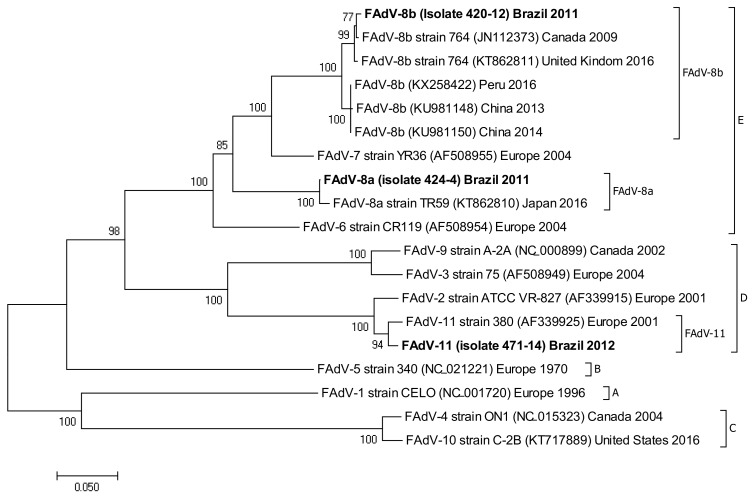
Figure 1
Figure 1
Phylogenetic tree for FAdV-I strains, was inferred with the neighbor-joining statistical method and based on the partial sequence of the Hexon gene. Numbers along the branches refer to bootstrap values for 1000 replicates. The five species of FAdV-I are grouped and identified with letters A–E.
Figure 2
Figure 2
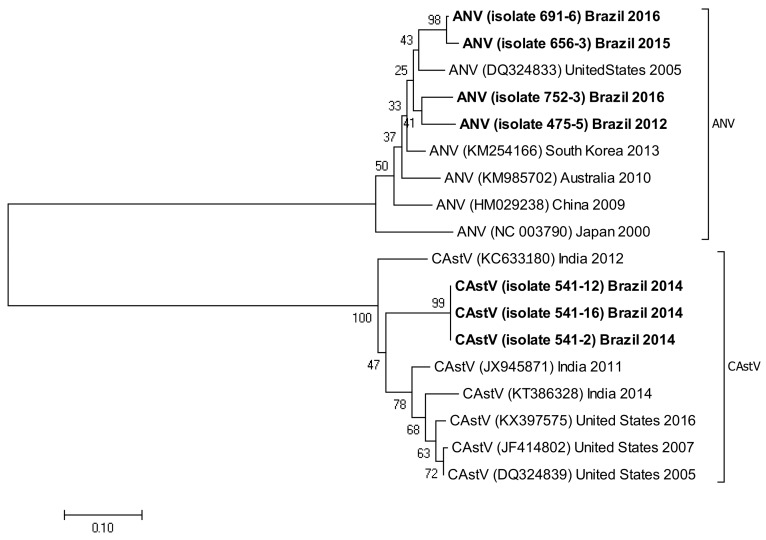
Phylogenetic tree for ANV and CAstV strains, was inferred with the neighbor-joining statistical method and based on the partial sequence of the ORF-1b gene in both of them. Numbers along the branches refer to bootstrap values for 1000 replicates.
Figure 3
Figure 3
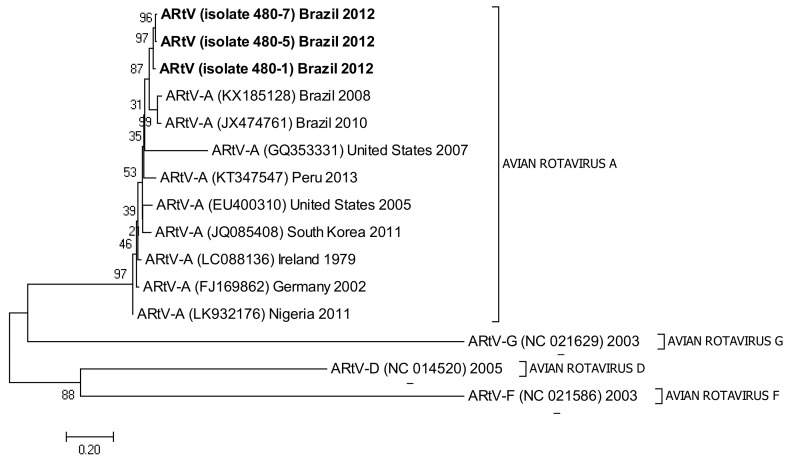
Phylogenetic tree for ARtV strains, was inferred with the neighbor-joining statistical method and based on the partial sequence of the NSP4 gene. Numbers along the branches refer to bootstrap values for 1000 replicates. Sequences of ARtV G, D, and F were used as out-group controls.
Figure 4
Figure 4
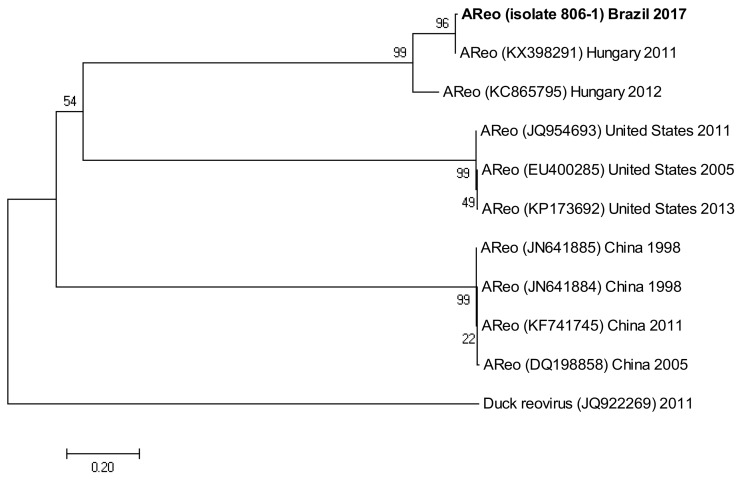
Phylogenetic tree for AReo strains, was inferred with the neighbor-joining statistical method and based on the partial sequence of segment S4. Numbers along the branches refer to bootstrap values for 1000 replicates. Sequence of Duck Reovirus was used as out-group control.
Figure 5
Figure 5
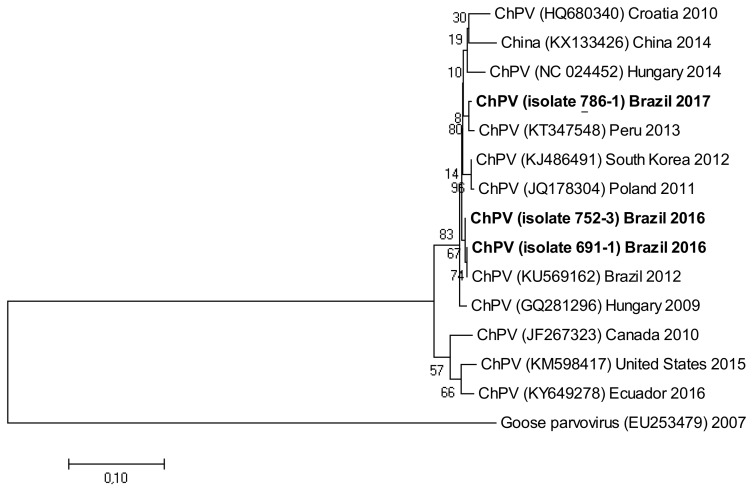
Phylogenetic tree for ChPV strains, was inferred with the neighbor-joining statistical method and based on the partial sequence of NS gene. Numbers along the branches refer to bootstrap values for 1000 replicates. Sequence of Goose parvovirus was used as out-group control.

References

    1. Otto P., Liebler-Tenorio E.M., Elschner M., Reetz J., Löhren U., Diller R. Detection of rotaviruses and intestinal lesions in broiler chicks from flocks with runting and stunting syndrome (RSS) Avian Dis. 2006;50:411–418. doi: 10.1637/7511-020106R.1. - DOI - PubMed
    1. Kang K.I., El-Gazzar M., Sellers H.S., Dorea F., Susan M., Kim T., Collett S., Mundt E. Investigation into the aetiology of runting and stunting syndrome in chickens. Avian Pathol. 2012;41:41–50. doi: 10.1080/03079457.2011.632402. - DOI - PubMed
    1. Devaney R., Trudgett J., Trudgett A., Meharg C., Smyth V. A metagenomic comparison of endemic viruses from broiler chickens with runting stunting syndrome and from normal birds. Avian Pathol. 2016;45:616–629. doi: 10.1080/03079457.2016.1193123. - DOI - PMC - PubMed
    1. Nuñez L.F.N., Parra S.H.S., Astolfi-Ferreira C.S., Carranza C., Torre D.I., Pedroso A.C., Ferreira A.J.P. Detection of enteric viruses in pancreas and spleen of broilers with runting-stunting syndrome (RSS) Pesq. Vet. Bras. 2016;36:595–599. doi: 10.1590/S0100-736X2016000700006. - DOI
    1. Jindal N., Patnayak D.P., Ziegler A.F., Lago A., Goyal S.M. A retrospective study on poult enteritis syndrome in Minnesota. Avian Dis. 2009;53:268–275. doi: 10.1637/8513-110308-Reg.1. - DOI - PubMed

LinkOut - more resources