


Anaerobic metabolism induces greater total energy expenditure during exercise with blood flow restriction
- PMID: 29596452
- PMCID: PMC5875813
- DOI: 10.1371/journal.pone.0194776
Anaerobic metabolism induces greater total energy expenditure during exercise with blood flow restriction
Abstract
Purpose: We investigated the energy system contributions and total energy expenditure during low intensity endurance exercise associated with blood flow restriction (LIE-BFR) and without blood flow restriction (LIE).
Methods: Twelve males participated in a contra-balanced, cross-over design in which subjects completed a bout of low-intensity endurance exercise (30min cycling at 40% of [Formula: see text]) with or without BFR, separated by at least 72 hours of recovery. Blood lactate accumulation and oxygen uptake during and after exercise were used to estimate the anaerobic lactic metabolism, aerobic metabolism, and anaerobic alactic metabolism contributions, respectively.
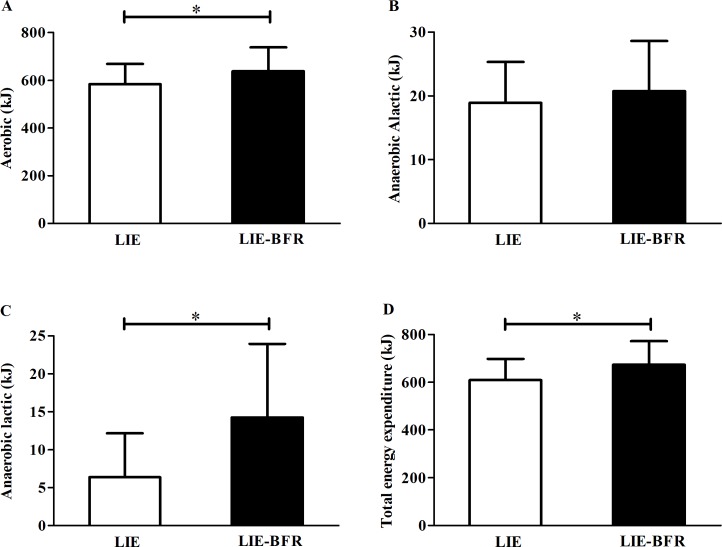
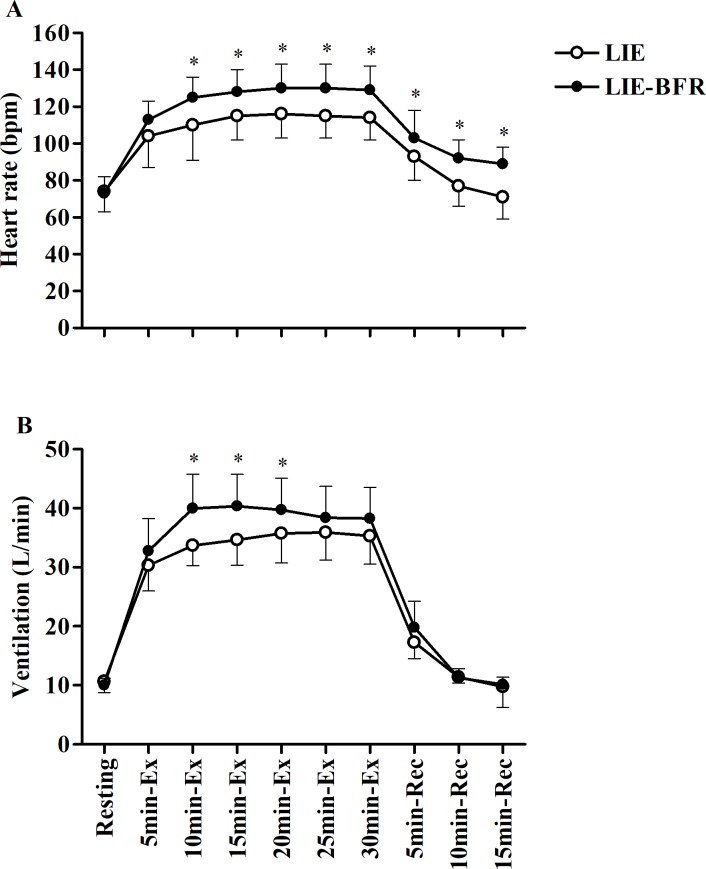
Results: There were significant increases in the anaerobic lactic metabolism (P = 0.008), aerobic metabolism (P = 0.020), and total energy expenditure (P = 0.008) in the LIE-BFR. No significant differences between conditions for the anaerobic alactic metabolism were found (P = 0.582). Plasma lactate concentration was significantly higher in the LIE-BFR at 15min and peak post-exercise (all P≤0.008). Heart rate was significantly higher in the LIE-BFR at 10, 15, 20, 25, and 30min during exercise, and 5, 10, and 15min after exercise (all P≤0.03). Ventilation was significantly higher in the LIE-BFR at 10, 15, and 20min during exercise (all P≤0.003).
Conclusion: Low-intensity endurance exercise performed with blood flow restriction increases the anaerobic lactic and aerobic metabolisms, total energy expenditure, and cardiorespiratory responses.
Conflict of interest statement
Figures
References
-
- ACSM. American College of Sports Medicine position stand. Quantity and quality of exercise for developing and maintaining cardiorespiratory, musculoskeletal, and neuromotor fitness in apparently healthy adults: guidance for prescribing exercise. Med Sci Sports Exerc. 2011;43(7):1334–59. doi: 10.1249/MSS.0b013e318213fefb . - DOI - PubMed
-
- Swain DP, Franklin BA. VO(2) reserve and the minimal intensity for improving cardiorespiratory fitness. Med Sci Sports Exerc. 2002;34(1):152–7. . - PubMed
-
- Park S, Kim JK, Choi HM, Kim HG, Beekley MD, Nho H. Increase in maximal oxygen uptake following 2-week walk training with blood flow occlusion in athletes. Eur J Appl Physiol. 2010;109(4):591–600. doi: 10.1007/s00421-010-1377-y . - DOI - PubMed
-
- Mouser JG, Laurentino GC, Dankel SJ, Buckner SL, Jessee MB, Counts BR, et al. Blood flow in humans following low-load exercise with and without blood flow restriction. Appl Physiol Nutr Metab. 2017;42(11):1165–71. doi: 10.1139/apnm-2017-0102 . - DOI - PubMed
Publication types
MeSH terms
Substances
LinkOut - more resources
Full Text Sources
Other Literature Sources
Medical
