. 2018 Mar 29;13(3):e0195126.
doi: 10.1371/journal.pone.0195126. eCollection 2018.

A Boolean network of the crosstalk between IGF and Wnt signaling in aging satellite cells

Affiliations

A Boolean network of the crosstalk between IGF and Wnt signaling in aging satellite cells

Lea Siegle et al. PLoS One. .

Abstract

Aging is a complex biological process, which determines the life span of an organism. Insulin-like growth factor (IGF) and Wnt signaling pathways govern the process of aging. Both pathways share common downstream targets that allow competitive crosstalk between these branches. Of note, a shift from IGF to Wnt signaling has been observed during aging of satellite cells. Biological regulatory networks necessary to recreate aging have not yet been discovered. Here, we established a mathematical in silico model that robustly recapitulates the crosstalk between IGF and Wnt signaling. Strikingly, it predicts critical nodes following a shift from IGF to Wnt signaling. These findings indicate that this shift might cause age-related diseases.


Conflict of interest statement

Competing Interests: The authors have declared that no competing interests exist.

Figures

Fig 1
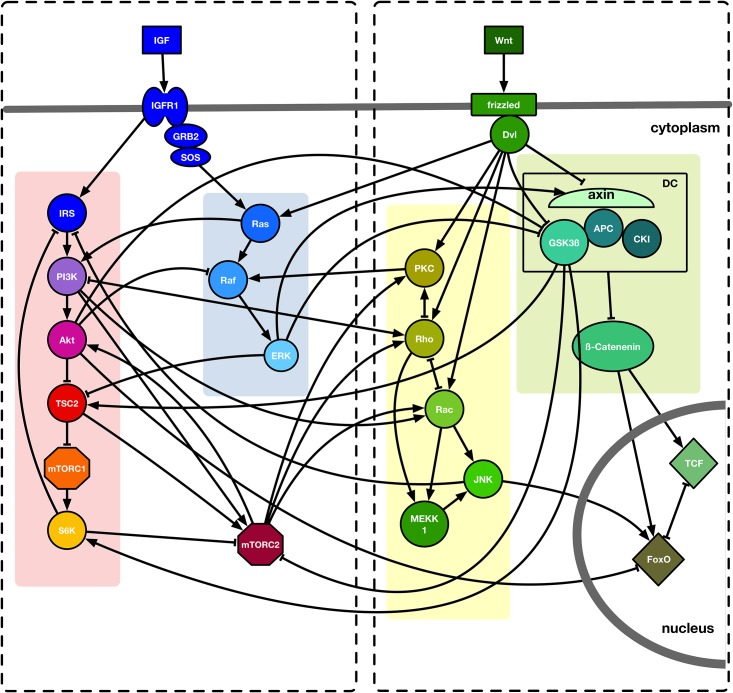
Fig 1. Crosstalk of IGF and Wnt signaling.
IGF and Wnt signaling are simplified and reduced to their most important nodes. Signaling pathways are highlighted in different colors and the IGF and Wnt sub-networks are depicted by the dashed boxes. Interactions between two molecules are symbolized as black lines. Activation is represented by arrowheads, inhibition by bar-headed arrows. Cellular compartments are separated by grey bars.
Fig 2
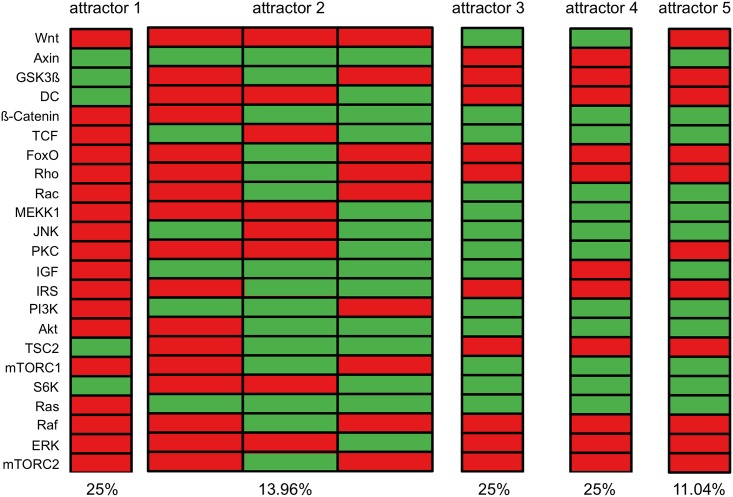
Fig 2. Attractors of the IGF/Wnt crosstalk model.
Exhaustive attractor search of the IGF/Wnt crosstalk model yielded four single state attractors and one three-states attractor. The frequency of occurrence of each attractor is given as percentage below each column. Each block represents an attractor. The nodes are listed on the y-axis. Each rectangle symbolizes the state of a node: red stands for inactive, green for active.
Fig 3
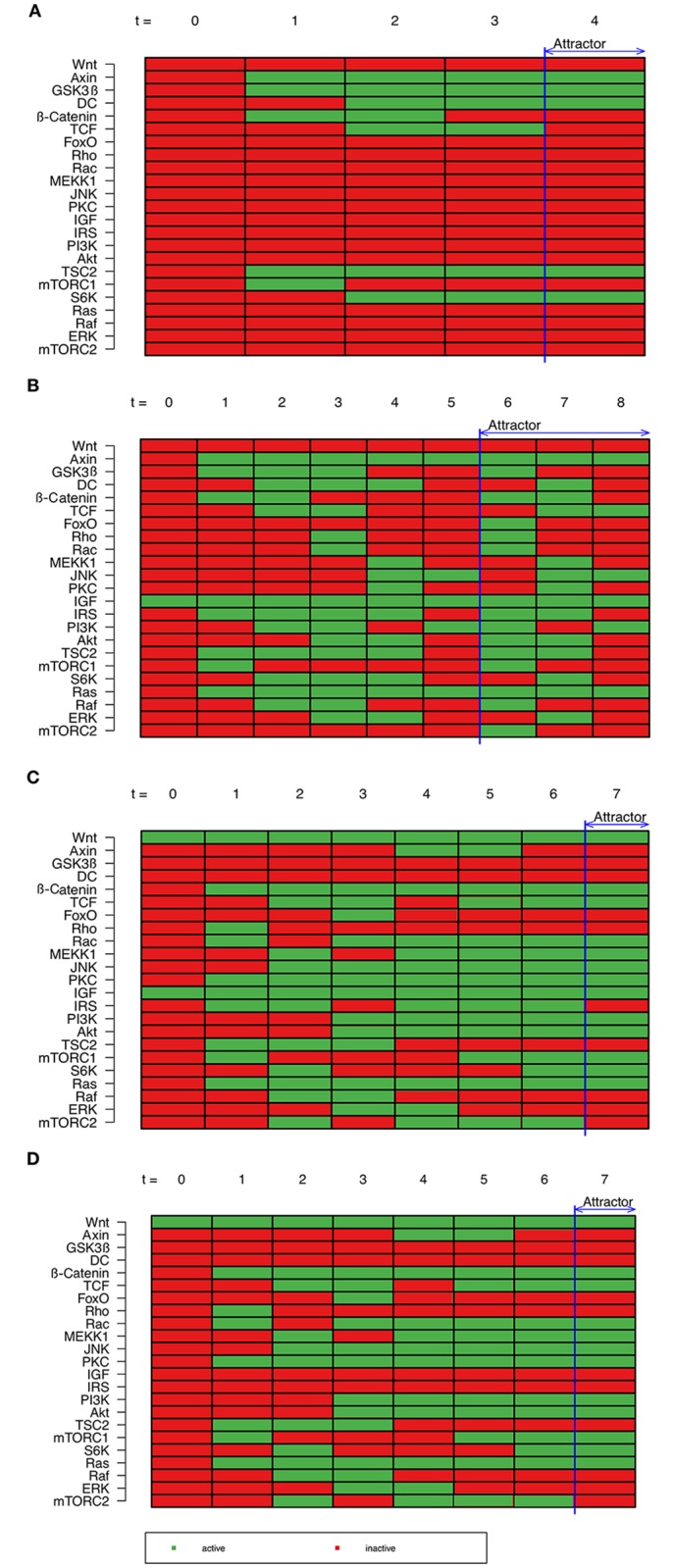
Fig 3. Effects of input factors in signaling cascade.
(A) Based on an initial state where all nodes are inactive, a simulation of a signaling cascade was performed. The model results in an attractor representing an un-stimulated cell. (B) Simulation from an initial state with IGF as single active node results in an attractor representing the young phenotype. (C) In contrast, a simulation of signaling cascade with IGF and Wnt as single active nodes results in an attractor representing a mid-aged phenotype. (D) Simulation of the signaling cascade with Wnt as single active node results in an attractor representing an aged phenotype. Nodes are listed on the y-axis. Time is plotted on the x-axis. Every rectangle represents the state of a node at a specific time: red stands for inactive, green for active.
Fig 4
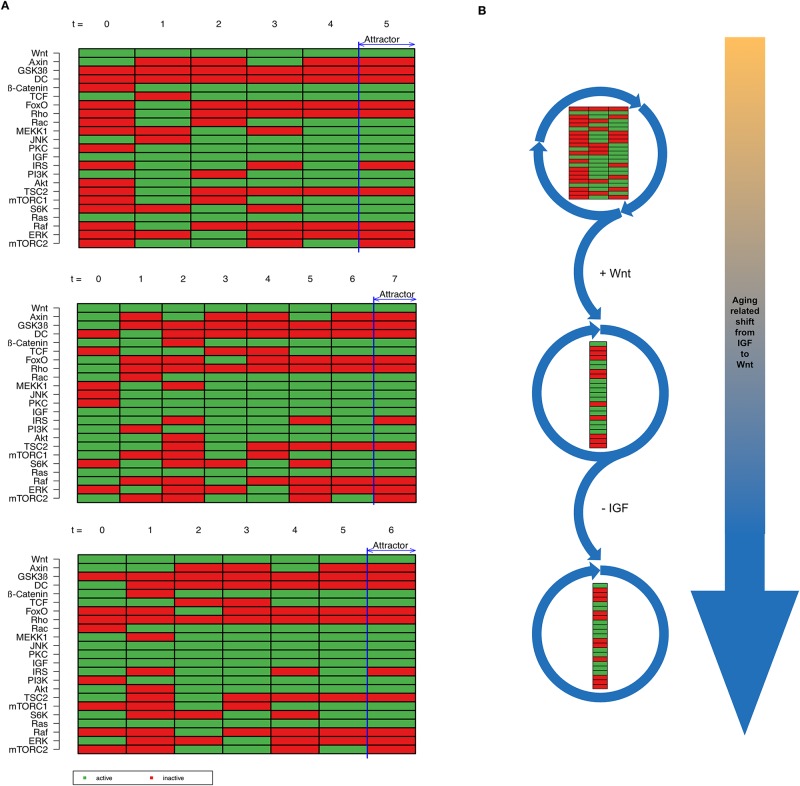
Fig 4. Age-related shift from IGF to Wnt signaling.
(A) The age-related shift from IGF to Wnt happens stepwise. At the beginning of this shift both signals are active and the temporal sequence simulation results in a single state attractor. (B) Passing the life span of an organism, initially IGF as external signal is active, resulting in a three-state attractor. Then, a slow shift from IGF to Wnt takes place. At the beginning both input factors are active, whereas at the end Wnt as single external input is active, resulting in a single-state attractor.
Fig 5
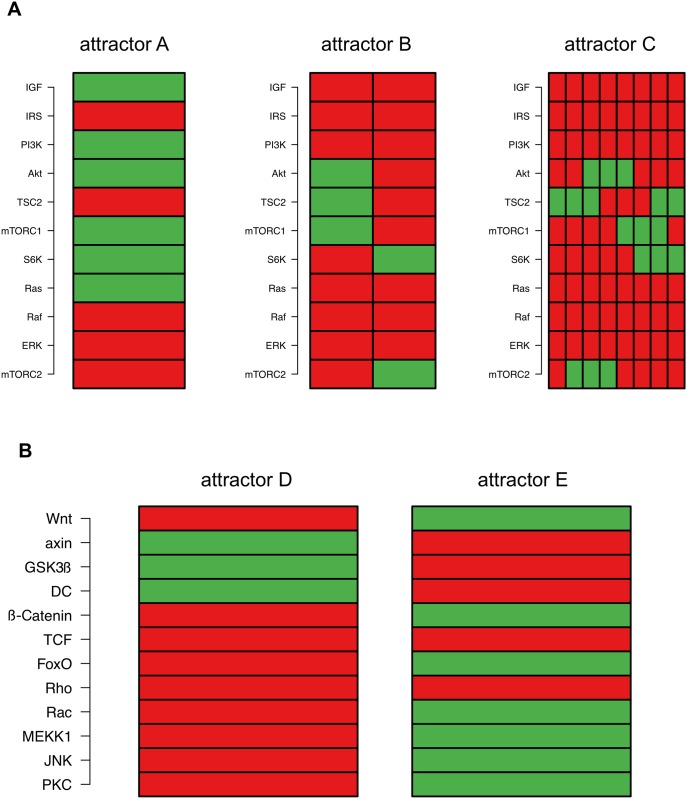
Fig 5. Attractors of the sub-networks.
(A) Simulation of the IGF sub-network lead to attractors A, B and C, the first of which could be matched to attractors 3 and 5 of the complete crosstalk model (see Fig 2). (B) Attractors D and E were found while simulating the Wnt sub-network. Here, attractor D could be matched to attractor 1. Each block represents an attractor. The regulatory factors are listed on the y-axis. Each rectangle symbolizes the state of such a factor: red stands for inactive, green for active.
Fig 6
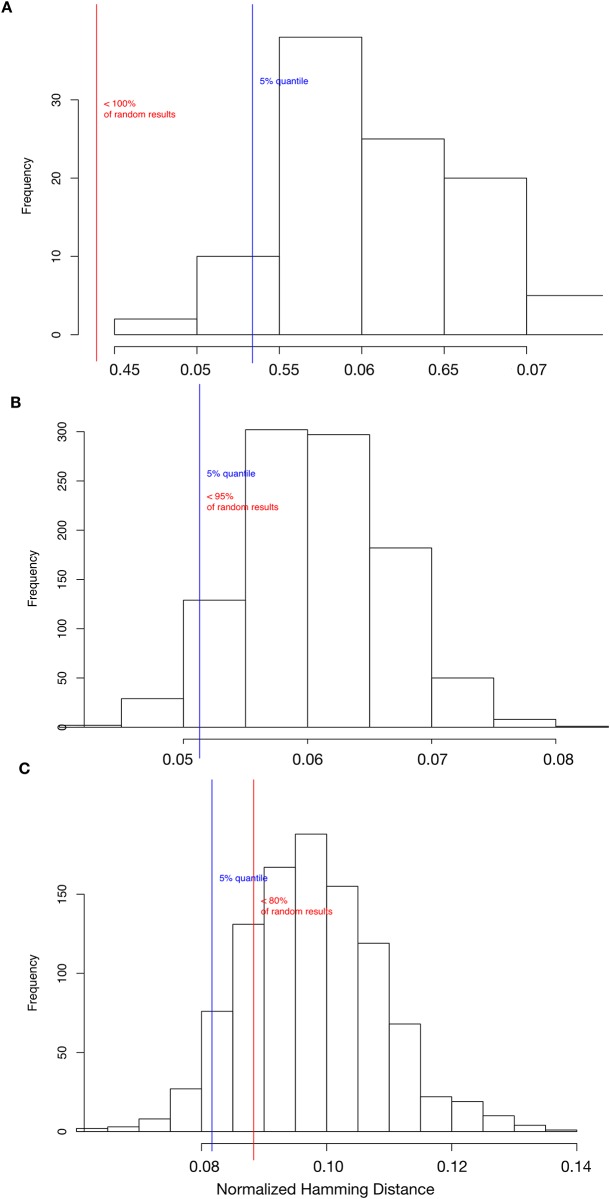
Fig 6. Transition robustness.
(A) 100 randomly drawn states of the IGF/Wnt model were mutated by bit flip (point mutation) and their successor states were computed. The successor states of the mutated and the original states were then compared using the normalized Hamming distance (red line). The same was done for 100 randomly generated networks of the same size (histogram). The blue line shows the 95% quantile. (B) shows the same test for the IGF sub-network and (C) for the Wnt sub-network.

References

    1. Shah AV, Bennett MR. DNA damage-dependent mechanisms of ageing and disease in the macro- and microvasculature. Eur J Pharmacol. 2017. April 24; - PubMed
    1. Ganguly G, Chakrabarti S, Chatterjee U, Saso L. Proteinopathy, oxidative stress and mitochondrial dysfunction: cross talk in Alzheimer’s disease and Parkinson’s disease. Drug Des Develoopment Ther. 2017;11. - PMC - PubMed
    1. Zs-Nagy I, Cutler RG, Semsei I. Dysdifferentiation hypothesis of aging and cancer: a comparison with the membrane hypothesis of aging. Ann N Y Acad Sci. 1988;521:215–25. - PubMed
    1. Florian MC, Geiger H. Concise Review: Polarity in Stem Cells, Disease, and Aging. Stem Cells. 2010;28(9):1623–9. doi: 10.1002/stem.481 - DOI - PMC - PubMed
    1. Brack AS, Conboy MJ, Roy S, Lee M, Kuo CJ, Keller C, et al. Increased Wnt signaling during aging alters muscle stem cell fate and increases fibrosis. Science. 2007;317(5839):807–810. doi: 10.1126/science.1144090 - DOI - PubMed

Publication types

Substances