


Midlife Predictors of Health-Related Quality of Life in Older Women
- PMID: 29596565
- PMCID: PMC6175022
- DOI: 10.1093/gerona/gly062
Midlife Predictors of Health-Related Quality of Life in Older Women
Abstract
Background: Midlife represents an important time to evaluate health status and health behaviors that may affect health-related quality of life (HRQL) in later years. This study examines change in women's HRQL over 11 years from ages 47-59 to 57-69 and identifies midlife characteristics that predict HRQL at older ages.
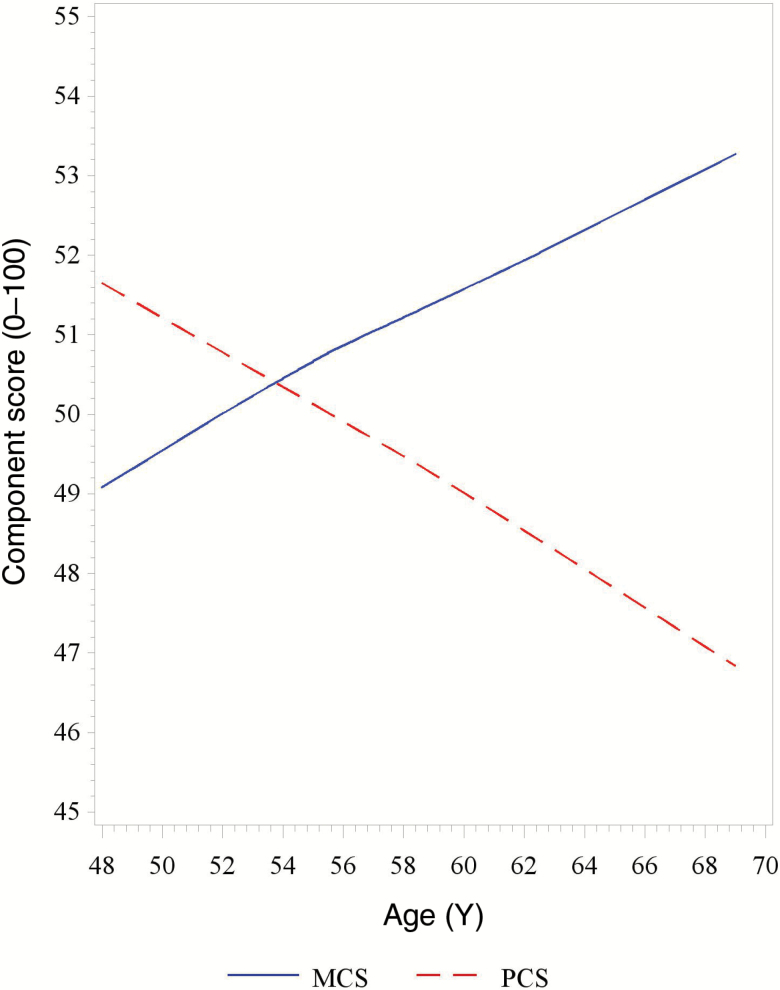
Methods: Physical (PCS) and mental component summaries (MCS) of the SF-36 were used to assess HRQL from 2002 to 2013 in 2,614 women from the Study of Women's Health Across the Nation (SWAN), a multiethnic/racial cohort study. We used locally weighted scatterplot smoothing (LOESS) models to obtain unadjusted predicted mean trajectories of PCS and MCS as a function of age.
Results: LOESS predicted PCS declined from 51.6 to 47.1, whereas MCS increased from 49.2 to 53.1. In multivariable models, controlling for baseline PCS, higher baseline physical activity (p = .002) and increase in physical activity from baseline (p < .0001) predicted better PCS. Time since baseline (ie, aging; p < .001), higher baseline body mass index (p < .0001), increased body mass index over time (p < .0001), smoking (p < .05), two or more medical conditions (p < .0001), sleep problems (p < .0001), and urinary incontinence (p < .0001) were related to lower PCS. Early (p = .004) and late postmenopause (p = .001; vs. premenopause) and aging (p = .05) predicted higher MCS. Predictors of lower MCS were less than very good health (p < .0001), sleep problems (p < .0001), stressful life events (p < .0001), higher perceived stress (p < .0001), and higher trait anxiety (p = .004). Race/ethnicity was related to MCS, but not PCS.
Conclusions: Several potentially modifiable midlife factors, such as improved sleep hygiene, physical activity, and body mass index, might improve HRQL for older women.
Figures
References
-
- Centers for Disease Control and Prevention. The State of Aging and Health in America 2013. Atlanta, GA: US Department of Health and Human Services; 2013. https://www.cdc.gov/aging/agingdata/data-portal/state-aging-health.html.
-
- Cleary P, Wilson I, Fowler F. A theoretical framework for assessing and analyzing health-related quality of life. In: Albrecht GL, Fitzpatrick R, eds. Advances in Medical Sociology. Vol V. Quality of Life in Health Care. Greenwich, CT: JAI Press; 1994: 23–41.
-
- Otero-Rodríguez A, León-Muñoz LM, Balboa-Castillo T, Banegas JR, Rodríguez-Artalejo F, Guallar-Castillón P. Change in health-related quality of life as a predictor of mortality in the older adults. Qual Life Res. 2010;19:15–23. doi:10.1007/s11136-009-9561-4 - PubMed
-
- Tsai SY, Chi LY, Lee CH, Chou P. Health-related quality of life as a predictor of mortality among community-dwelling older persons. Eur J Epidemiol. 2007;22:19–26. doi:10.1007/s10654-006-9092-z - PubMed
Publication types
MeSH terms
Grants and funding
LinkOut - more resources
Full Text Sources
Other Literature Sources
Medical
