


The world's largest High Arctic lake responds rapidly to climate warming
- PMID: 29599477
- PMCID: PMC5876346
- DOI: 10.1038/s41467-018-03685-z
The world's largest High Arctic lake responds rapidly to climate warming
Abstract
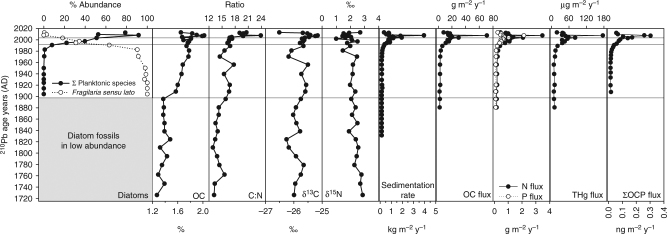
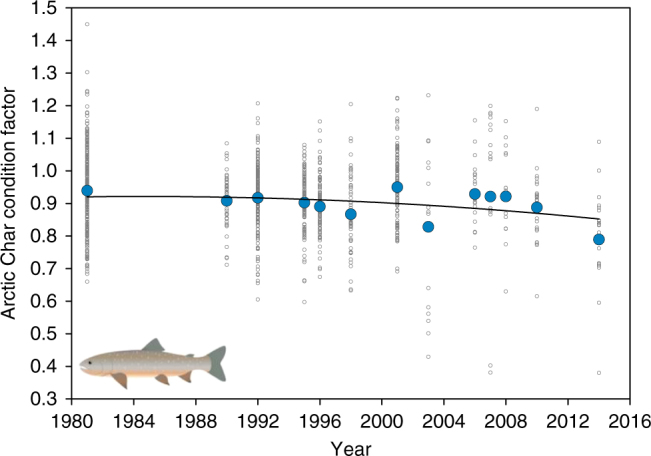
Using a whole-watershed approach and a combination of historical, contemporary, modeled and paleolimnological datasets, we show that the High Arctic's largest lake by volume (Lake Hazen) has succumbed to climate warming with only a ~1 °C relative increase in summer air temperatures. This warming deepened the soil active layer and triggered large mass losses from the watershed's glaciers, resulting in a ~10 times increase in delivery of glacial meltwaters, sediment, organic carbon and legacy contaminants to Lake Hazen, a >70% decrease in lake water residence time, and near certainty of summer ice-free conditions. Concomitantly, the community assemblage of diatom primary producers in the lake shifted dramatically with declining ice cover, from shoreline benthic to open-water planktonic species, and the physiological condition of the only fish species in the lake, Arctic Char, declined significantly. Collectively, these changes place Lake Hazen in a biogeochemical, limnological and ecological regime unprecedented within the past ~300 years.
Conflict of interest statement
The authors declare no competing interests.
Figures
References
-
- Serreze MC, Barry RG. Processes and impacts of Arctic amplification: a research synthesis. Glob. Planet. Change. 2011;77:85–96. doi: 10.1016/j.gloplacha.2011.03.004. - DOI
-
- Taylor KE, Stouffer RJ, Meehl GA. An overview of CMIP5 and the experiment design. Bull. Am. Meteorol. Soc. 2012;93:485–498. doi: 10.1175/BAMS-D-11-00094.1. - DOI
-
- van Oldenborgh, G. J. KNMI Climate Explorer (Koninklijk Netherlands Meteorologisch Institut (KNMI), De Bilt, The Netherlands, 1999).
-
- Prowse T, et al. Arctic freshwater synthesis: summary of key emerging issues. J. J. Geophys. Res. Biogeosci. 2015;120:1887–1893. doi: 10.1002/2015JG003128. - DOI
-
- Laudon H, et al. Save northern high-latitude catchments. Nat. Geosci. 2017;10:324–325. doi: 10.1038/ngeo2947. - DOI
Publication types
LinkOut - more resources
Full Text Sources
Other Literature Sources
Miscellaneous
