


Fungal spore diversity reflects substrate-specific deposition challenges
- PMID: 29599480
- PMCID: PMC5876365
- DOI: 10.1038/s41598-018-23292-8
Fungal spore diversity reflects substrate-specific deposition challenges
Abstract
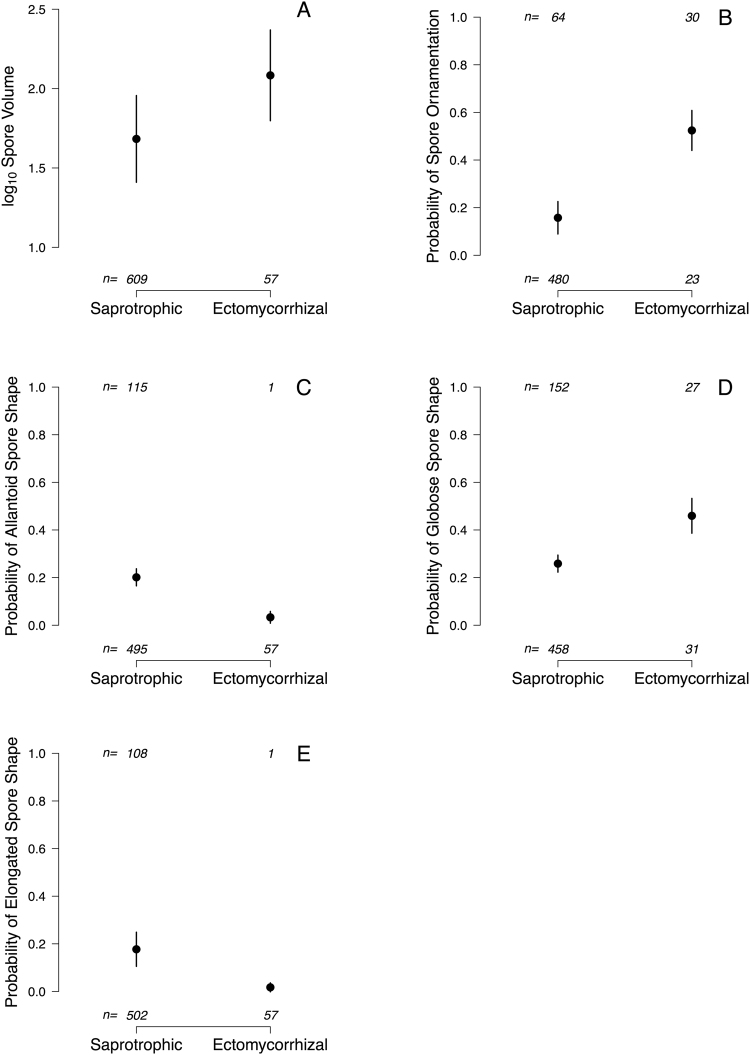
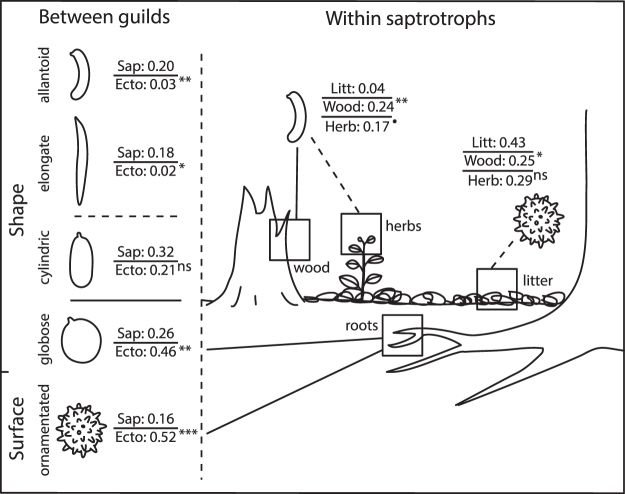
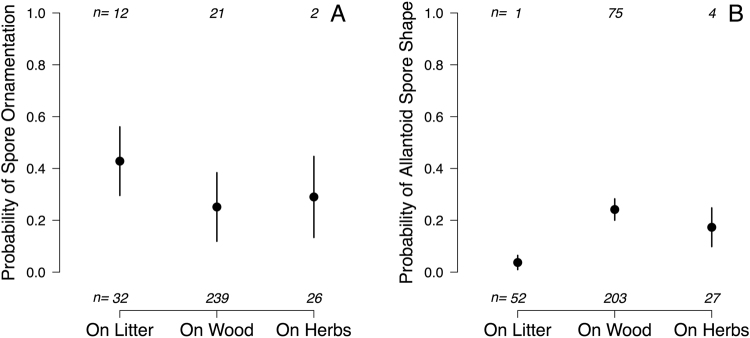
Sexual spores are important for the dispersal and population dynamics of fungi. They show remarkable morphological diversity, but the underlying forces driving spore evolution are poorly known. We investigated whether trophic status and substrate associations are associated with morphology in 787 macrofungal genera. We show that both spore size and ornamentation are associated with trophic specialization, so that large and ornamented spores are more probable in ectomycorrhizal than in saprotrophic genera. This suggests that spore ornamentation facilitates attachment to arthropod vectors, which ectomycorrhizal species may need to reach lower soil layers. Elongated spore shapes are more common in saprotrophic taxa, and genera associated with above ground substrates are more likely to have allantoid (curved elongated) spores, probably to lower the risk of wash out by precipitation. Overall, our results suggest that safe arrival on specific substrates is a more important driver of evolution in spore morphology than dispersal per se.
Conflict of interest statement
The authors declare no competing interests.
Figures
References
-
- Ingold, C. T. Fungal spores: their liberation and dispersal. Oxford University Press (1971).
-
- Culley TM, Weller SG, Sakai AK. The evolution of wind pollination in angiosperms. Trends in Ecology and Evolution. 2002;17:361–369. doi: 10.1016/S0169-5347(02)02540-5. - DOI
-
- Kuparinen A, Markkanen T, Riikonen H, Vesala T. Modeling air-mediated dispersal of spores, pollen and seeds in forested areas. Ecological Modelling. 2007;208:177–188. doi: 10.1016/j.ecolmodel.2007.05.023. - DOI
Publication types
MeSH terms
LinkOut - more resources
Full Text Sources
Other Literature Sources
