Review
. 2018 Mar 27;10(3):352-370.
doi: 10.4254/wjh.v10.i3.352.

Reactivation of hepatitis B after liver transplantation: Current knowledge, molecular mechanisms and implications in management

Affiliations
Review

Reactivation of hepatitis B after liver transplantation: Current knowledge, molecular mechanisms and implications in management

Ranjit Chauhan et al. World J Hepatol. .

Abstract

Chronic hepatitis B (CHB) is a major global health problem affecting an estimated 350 million people with more than 786000 individuals dying annually due to complications, such as cirrhosis, liver failure and hepatocellular carcinoma (HCC). Liver transplantation (LT) is considered gold standard for treatment of hepatitis B virus (HBV)-related liver failure and HCC. However, post-transplant viral reactivation can be detrimental to allograft function, leading to poor survival. Prophylaxis with high-dose hepatitis B immunoglobulin (HBIG) and anti-viral drugs have achieved remarkable progress in LT by suppressing viral replication and improving long-term survival. The combination of lamivudine (LAM) plus HBIG has been for many years the most widely used. However, life-long HBIG use is both cumbersome and costly, whereas long-term use of LAM results in resistant virus. Recently, in an effort to develop HBIG-free protocols, high potency nucleos(t)ide analogues, such as Entecavir or Tenofovir, have been tried either as monotherapy or in combination with low-dose HBIG with excellent results. Current focus is on novel antiviral targets, especially for covalently closed circular DNA (cccDNA), in an effort to eradicate HBV infection instead of viral suppression. However, there are several other molecular mechanisms through which HBV may reactivate and need equal attention. The purpose of this review is to address post-LT HBV reactivation, its risk factors, underlying molecular mechanisms, and recent advancements and future of anti-viral therapy.

Keywords: Antivirals; Hepatitis B immunoglobulin; Hepatitis B virus; Liver transplantation; Prophylaxis; Reactivation; Recurrence.


Conflict of interest statement

Conflict-of-interest statement: All authors declare no potential conflicts of interest related to this manuscript. This manuscript is not supported by any grants/funding.

Figures
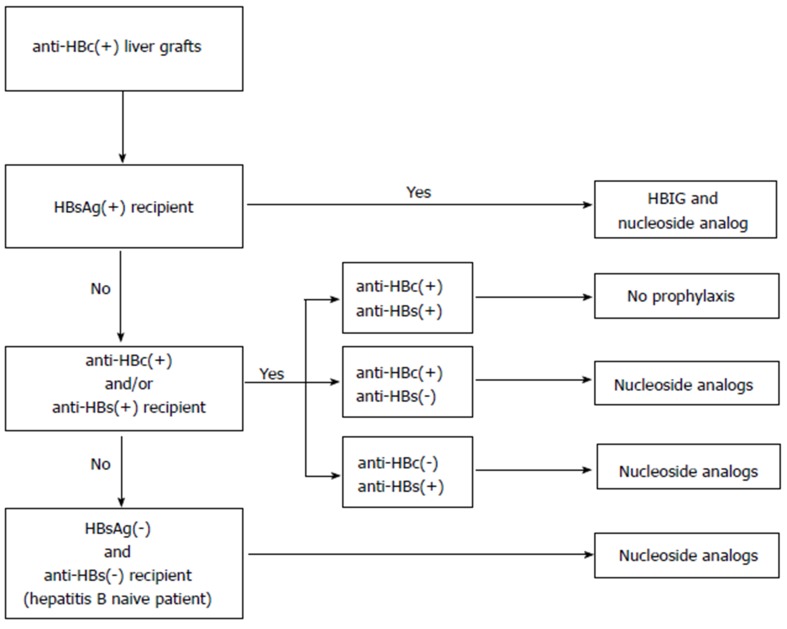
Figure 1
Figure 1
Stepwise approach of anti-hepatitis B core positive grafts allocated to recipients based on their hepatitis B serology. In chronic hepatitis B patients with HBsAg positive and who receive Anti-HBc positive liver grafts should be treated with HBIG and nucleoside analogs. If the recipient is HBsAg negative and Anti-HBc positive and/or anti HBs positive, NA is used for prophylaxis based on anti HBc and anti HBs serologies. No prophylaxis is recommended for anti-HBc positive and anti-HBs positive liver in LT recipient without HBsAg positive serology. These patients should be followed with periodic HBV DNA level guided by ALT to monitor for any relapse. In Hepatitis B naïve patients, NA is recommended for prophylaxis. HBIG: Hepatitis B Immunoglobulin; HBsAg: Hepatitis B surface antigen; Anti-HBs: Hepatitis B surface antibody; Anti-HBc: Hepatitis B core antibody.
Figure 2
Figure 2
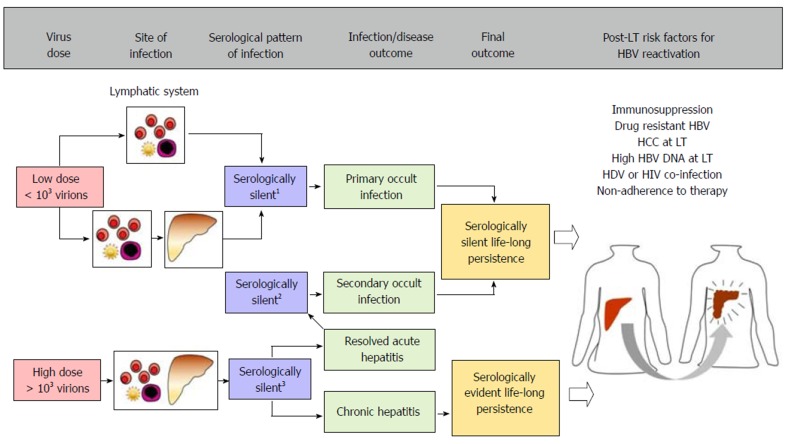
Generalized concept of overt and occult hepatitis B virus infections based on the data from the woodchuck model of hepatitis B, their long-term outcomes, and associated risk factors for hepatitis B virus reactivation following liver transplant. Based on experimental infection in the woodchuck model (Mulrooney-Cousins PM, Michalak TI, 2015[92]). 1Serologically silent infection: HBsAg, anti-HBc and anti-HBs negative; HBV DNA positive; 2Serologically silent infection: HBsAg negative, anti-HBc positive, anti-HBs positive or negative; HBV DNA positive; 3Serologically evident infection: HBsAg and anti-HBc positive, anti-HBs negative. HBV DNA positive. SOI: Secondary occult infection; POI: Primary occult infection; LT: Liver transplant; HCC: Hepatocellular carcinoma; HBV: Hepatitis B virus; HDV: Hepatitis D virus; HBsAg: HBV surface antigen; anti-HBc: Antibodies to HBV core antigen; anti-HBs: Antibodies to HBV surface antigen.
Figure 3
Figure 3
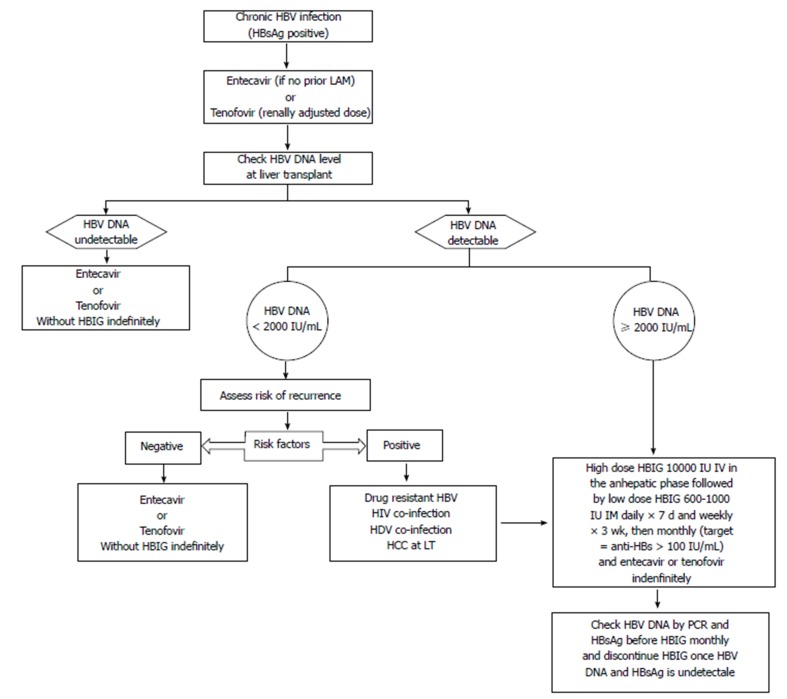
Proposed algorithm for hepatitis B prophylaxis in liver transplant patients. In chronic hepatitis B patients Entecavir (if no prior Lamivudine therapy) or Tenofovir (adjusted to renal function) is recommended as the first line therapy. Based on HBV DNA level at the time of transplant and risk factors, HIBG should be initiated, if associated risk factors for HBV recurrence post LT. High risk patients include drug resistant HBV, HIV co-infection, HDV co-infection, HCC. This group of patients receive high dose IV HBIG 10000 IU given during the anhepatic phase followed by low dose HBIG to achieve target anti HBs > 100 IU/mL along with NAs. HBIG is discontinued once HBV DNA is undetectable and loss of HBsAg is achieved. HBIG: Hepatitis B immunoglobulin; HBV: Hepatitis B virus; HBsAg: Hepatitis B surface antigen; HCC: Hepatocellular carcinoma; HIV: Human immunodeficiency virus; HDV: Hepatitis delta virus; LAM: Lamivudine; LT: Liver transplantation.
Figure 4
Figure 4
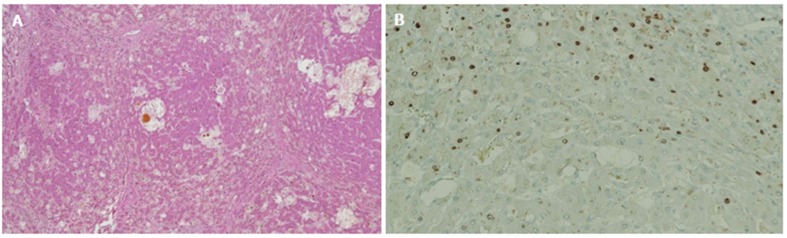
Immunostaining. A: Recurrent hepatitis B virus infection leading to cirrhosis in a post-liver transplantation patient. Figure shows cirrhotic nodules with cholestasis but no appreciable inflammation; B: Immunostaining for hepatitis B core antigen shows strong nuclear accumulation of antigen in a small proportion of hepatocytes indicating active virus propagation.

References

    1. El-Serag HB. Epidemiology of viral hepatitis and hepatocellular carcinoma. Gastroenterology. 2012;142:1264–1273.e1. - PMC - PubMed
    1. Durantel D, Zoulim F. New antiviral targets for innovative treatment concepts for hepatitis B virus and hepatitis delta virus. J Hepatol. 2016;64:S117–S131. - PubMed
    1. Ryerson AB, Eheman CR, Altekruse SF, Ward JW, Jemal A, Sherman RL, Henley SJ, Holtzman D, Lake A, Noone AM, et al. Annual Report to the Nation on the Status of Cancer, 1975-2012, featuring the increasing incidence of liver cancer. Cancer. 2016;122:1312–1337. - PMC - PubMed
    1. Song GW, Ahn CS, Lee SG, Hwang S, Kim KH, Moon DB, Ha TY, Jung DH, Park GC, Kang SH, et al. Correlation between risk of hepatitis B virus recurrence and tissue expression of covalently closed circular DNA in living donor liver transplant recipients treated with high-dose hepatitis B immunoglobulin. Transplant Proc. 2014;46:3548–3553. - PubMed
    1. Wu D, Ning Q. Toward a Cure for Hepatitis B Virus Infection: Combination Therapy Involving Viral Suppression and Immune Modulation and Long-term Outcome. J Infect Dis. 2017;216:S771–S777. - PubMed

LinkOut - more resources