


Myocardial infarction remodeling that progresses to heart failure: a signaling misunderstanding
- PMID: 29600895
- PMCID: PMC6087773
- DOI: 10.1152/ajpheart.00131.2018
Myocardial infarction remodeling that progresses to heart failure: a signaling misunderstanding
Abstract
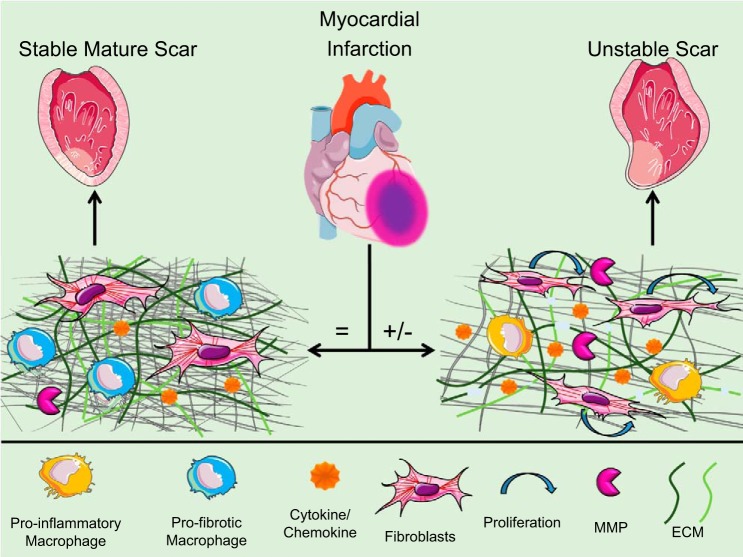
After myocardial infarction, remodeling of the left ventricle involves a wound-healing orchestra involving a variety of cell types. In order for wound healing to be optimal, appropriate communication must occur; these cells all need to come in at the right time, be activated at the right time in the right amount, and know when to exit at the right time. When this occurs, a new homeostasis is obtained within the infarct, such that infarct scar size and quality are sufficient to maintain left ventricular size and shape. The ideal scenario does not always occur in reality. Often, miscommunication can occur between infarct and remote spaces, across the temporal wound-healing spectrum, and across organs. When miscommunication occurs, adverse remodeling can progress to heart failure. This review discusses current knowledge gaps and recent development of the roles of inflammation and the extracellular matrix in myocardial infarction remodeling. In particular, the macrophage is one cell type that provides direct and indirect regulation of both the inflammatory and scar-forming responses. We summarize current research efforts focused on identifying biomarker indicators that reflect the status of each component of the wound-healing process to better predict outcomes.
Keywords: extracellular matrix; fibroblast; inflammation; macrophage; proteomics; scar; systems biology.
Figures
References
-
- Arslan F, Smeets MB, Riem Vis PW, Karper JC, Quax PH, Bongartz LG, Peters JH, Hoefer IE, Doevendans PA, Pasterkamp G, de Kleijn DP. Lack of fibronectin-EDA promotes survival and prevents adverse remodeling and heart function deterioration after myocardial infarction. Circ Res 108: 582–592, 2011. doi: 10.1161/CIRCRESAHA.110.224428. - DOI - PubMed
-
- Boufenzer A, Lemarié J, Simon T, Derive M, Bouazza Y, Tran N, Maskali F, Groubatch F, Bonnin P, Bastien C, Bruneval P, Marie PY, Cohen R, Danchin N, Silvestre JS, Ait-Oufella H, Gibot S. TREM-1 mediates inflammatory injury and cardiac remodeling following myocardial infarction. Circ Res 116: 1772–1782, 2015. doi: 10.1161/CIRCRESAHA.116.305628. - DOI - PubMed
-
- Cavusoglu E, Ruwende C, Chopra V, Yanamadala S, Eng C, Clark LT, Pinsky DJ, Marmur JD. Tissue inhibitor of metalloproteinase-1 (TIMP-1) is an independent predictor of all-cause mortality, cardiac mortality, and myocardial infarction. Am Heart J 151: 1101.e1–1101.e8, 2006. doi: 10.1016/j.ahj.2006.02.029. - DOI - PubMed
Publication types
MeSH terms
Grants and funding
LinkOut - more resources
Full Text Sources
Other Literature Sources
Medical
