Revealing Neurocomputational Mechanisms of Reinforcement Learning and Decision-Making With the hBayesDM Package
- PMID: 29601060
- PMCID: PMC5869013
- DOI: 10.1162/CPSY_a_00002
Revealing Neurocomputational Mechanisms of Reinforcement Learning and Decision-Making With the hBayesDM Package
Abstract
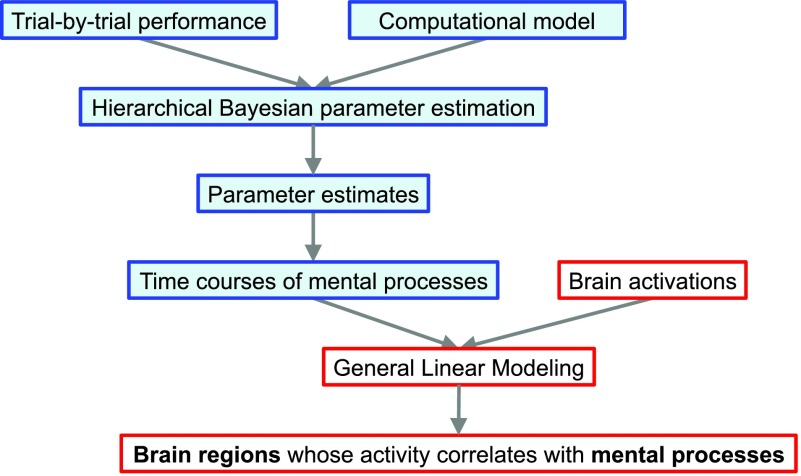
Reinforcement learning and decision-making (RLDM) provide a quantitative framework and computational theories with which we can disentangle psychiatric conditions into the basic dimensions of neurocognitive functioning. RLDM offer a novel approach to assessing and potentially diagnosing psychiatric patients, and there is growing enthusiasm for both RLDM and computational psychiatry among clinical researchers. Such a framework can also provide insights into the brain substrates of particular RLDM processes, as exemplified by model-based analysis of data from functional magnetic resonance imaging (fMRI) or electroencephalography (EEG). However, researchers often find the approach too technical and have difficulty adopting it for their research. Thus, a critical need remains to develop a user-friendly tool for the wide dissemination of computational psychiatric methods. We introduce an R package called hBayesDM (hierarchical Bayesian modeling of Decision-Making tasks), which offers computational modeling of an array of RLDM tasks and social exchange games. The hBayesDM package offers state-of-the-art hierarchical Bayesian modeling, in which both individual and group parameters (i.e., posterior distributions) are estimated simultaneously in a mutually constraining fashion. At the same time, the package is extremely user-friendly: users can perform computational modeling, output visualization, and Bayesian model comparisons, each with a single line of coding. Users can also extract the trial-by-trial latent variables (e.g., prediction errors) required for model-based fMRI/EEG. With the hBayesDM package, we anticipate that anyone with minimal knowledge of programming can take advantage of cutting-edge computational-modeling approaches to investigate the underlying processes of and interactions between multiple decision-making (e.g., goal-directed, habitual, and Pavlovian) systems. In this way, we expect that the hBayesDM package will contribute to the dissemination of advanced modeling approaches and enable a wide range of researchers to easily perform computational psychiatric research within different populations.
Keywords: decision-making; hierarchical Bayesian modeling; model-based fMRI; reinforcement learning.
Conflict of interest statement
Competing Interests: The author declares no conflict of interest
Figures
References
-
- Agay N., Kron S., Carmel Z., Mendlovic S., & Levkovitz Y. (2008). Ultimatum bargaining behavior of people affected by schizophrenia. Psychiatry Research, 157, 39–46. doi:10.1016/j.psychres.2006.03.026 - DOI - PubMed
-
- Ahn W.-Y., & Busemeyer J. R. (2016). Challenges and promises for translating computational tools into clinical practice. Current Opinion in Behavioral Sciences, 11, 1–7. doi:10.1016/j.cobeha.2016.02.001 - DOI - PMC - PubMed
-
- Ahn W.-Y., Busemeyer J. R., Wagenmakers E. J., & Stout J. C. (2008). Comparison of decision learning models using the generalization criterion method. Cognitive Science, 32, 1376–1402. doi:10.1080/03640210802352992 - DOI - PubMed
-
- Ahn W.-Y., Krawitz A., Kim W., Busemeyer J. R., & Brown J. W. (2011). A model-based fMRI analysis with hierarchical Bayesian parameter estimation. Journal of Neuroscience, Psychology, and Economics, 4, 95–110. doi:10.1037/a0020684 - DOI - PMC - PubMed
-
- Ahn W.-Y., Ramesh D., Moeller F. G., & Vassileva J. (2016). Utility of machine-learning approaches to identify behavioral markers for substance use disorders: Impulsivity dimensions as predictors of present cocaine dependence. Frontiers in Psychiatry, 7, 290. doi:10.3389/fpsyt.2016.00034 - DOI - PMC - PubMed
LinkOut - more resources
Full Text Sources
Other Literature Sources
Molecular Biology Databases