. 2018 Apr 17;90(8):4940-4945.
doi: 10.1021/acs.analchem.8b00237. Epub 2018 Apr 5.

Sniffing Entrapped Humans with Sensor Arrays

Affiliations

Sniffing Entrapped Humans with Sensor Arrays

Andreas T Güntner et al. Anal Chem. .

Abstract

Earthquakes are lethal natural disasters frequently burying people alive under collapsed buildings. Tracking entrapped humans from their unique volatile chemical signature with hand-held devices would accelerate urban search and rescue (USaR) efforts. Here, a pilot study is presented with compact and orthogonal sensor arrays to detect the breath- and skin-emitted metabolic tracers acetone, ammonia, isoprene, CO2, and relative humidity (RH), all together serving as sign of life. It consists of three nanostructured metal-oxide sensors (Si-doped WO3, Si-doped MoO3, and Ti-doped ZnO), each specifically tailored at the nanoscale for highly sensitive and selective tracer detection along with commercial CO2 and humidity sensors. When tested on humans enclosed in plethysmography chambers to simulate entrapment, this sensor array rapidly detected sub-ppm acetone, ammonia, and isoprene concentrations with high accuracies (19, 21, and 3 ppb, respectively) and precision, unprecedented by portable sensors but required for USaR. These results were in good agreement (Pearson's correlation coefficients ≥0.9) with benchtop selective reagent ionization time-of-flight mass spectrometry (SRI-TOF-MS). As a result, an inexpensive sensor array is presented that can be integrated readily into hand-held or even drone-carried detectors for first responders to rapidly screen affected terrain.


Conflict of interest statement

The authors declare no competing financial interest.

Figures
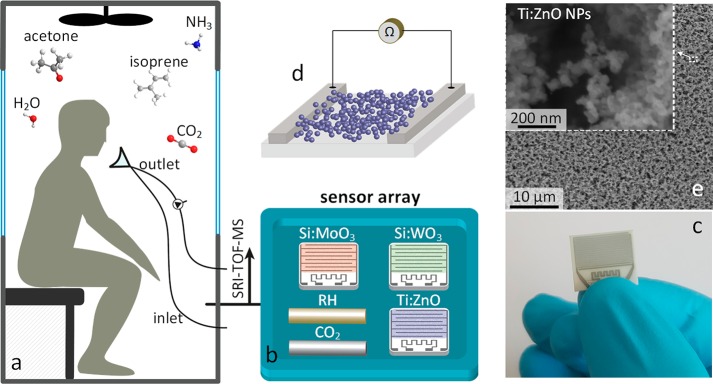
Figure 1
Figure 1
Experimental setup: (a) skin- and breath-borne volatiles of entrapped volunteers accumulate in a plethysmographic chamber. (b) The sensor array consists of three chemoresistive sensors, Si-doped MoO3, Si-doped WO3, and Ti-doped ZnO to monitor ammonia, acetone, and isoprene, respectively, together with commercial humidity and CO2 sensors. Simultaneous SRI-TOF-MS measurements were used for cross-validation. (c) Image of a single sensor. (d) The sensing elements consist of highly porous and semiconductive films formed by direct flame deposition of agglomerated/aggregated metal-oxide nanoparticles, as shown by (e) top-view scanning electron microscopy exemplarily for Ti-doped ZnO.
Figure 2
Figure 2
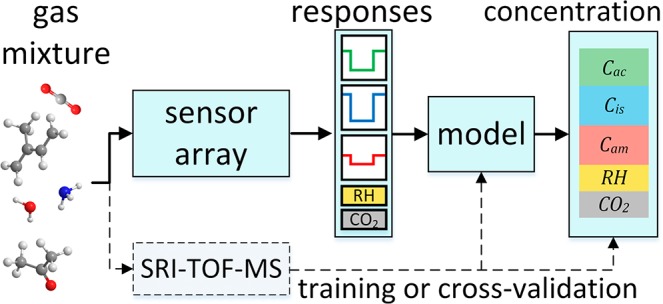
Sensor array concept: Gas mixtures containing the breath and skin emitted tracers are analyzed by each sensor individually and their signals are converted by a statistical model to analyte concentrations. This model is initially “trained” with data of four volunteers and tested on five volunteers.
Figure 3
Figure 3
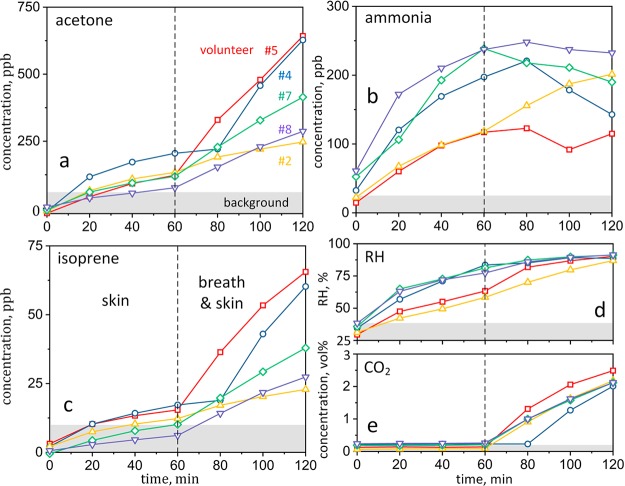
Sensor array measurements of acetone (a), ammonia (b), isoprene (c), RH (d), and CO2 (e) concentrations of five volunteers as a function of entrapment time. Skin only (0–60 min) followed by skin and breath (60–120 min) emissions were studied separately. In the case of volunteer no. 4 (circles), skin (only) emissions lasted accidentally for 80 min. Room air (background) concentrations are indicated in gray.
Figure 4
Figure 4
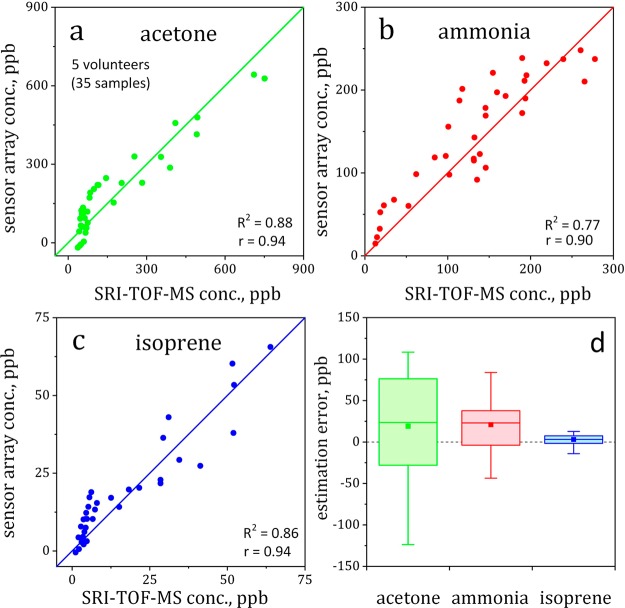
Scatter plots indicating correlations between sensor array and SRI-TOF-MS for acetone (a), ammonia (b), and isoprene (c) along with their corresponding Pearson’s correlation coefficients (r) and coefficients of determination (R2). (d) Box-and-whisker plot of sensor array estimation errors. Medians and means are shown as lines and squares, respectively. The boxes represent the first and third quartiles and whiskers indicate the full ranges.
Figure 5
Figure 5
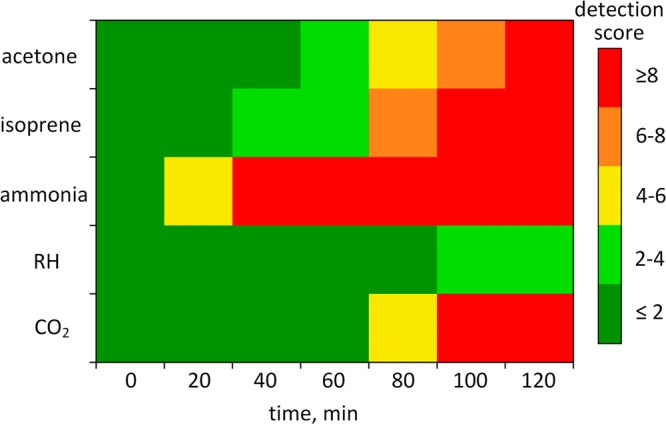
Color map indicating human detection by their skin (0–60 min) followed by breath and skin (60–120 min) emissions. For each analyte, a detection score (cc/cb) is calculated representing the ratio of average concentration in the background (cb) and chamber air (cc) in the presence of five volunteers.

References

    1. Bartels S. A.; VanRooyen M. J. Lancet 2012, 379 (9817), 748–757. 10.1016/S0140-6736(11)60887-8. - DOI - PubMed
    1. Schultz C. H.; Koenig K. L.; Noji E. K. N. Engl. J. Med. 1996, 334 (7), 438–444. 10.1056/NEJM199602153340706. - DOI - PubMed
    1. Wong J.; Robinson C.. Urban Search and Rescue Technology Needs: Identification of Needs. Federal Emergency Management Agency (FEMA) and the National Institute of Justice (NIJ), 2004.
    1. PROEYE System 951-S model 2010, http://www.ads.com.tr/safety/en/sar/proeye/sys951.htm, accessed November 2017.
    1. Agapiou A.; Amann A.; Mochalski P.; Statheropoulos M.; Thomas C. L. P. TrAC, Trends Anal. Chem. 2015, 66, 158–175. 10.1016/j.trac.2014.11.018. - DOI

Publication types

MeSH terms