


Dietary Patterns of Children and Adolescents from High, Medium and Low Human Development Countries and Associated Socioeconomic Factors: A Systematic Review
- PMID: 29601553
- PMCID: PMC5946221
- DOI: 10.3390/nu10040436
Dietary Patterns of Children and Adolescents from High, Medium and Low Human Development Countries and Associated Socioeconomic Factors: A Systematic Review
Abstract
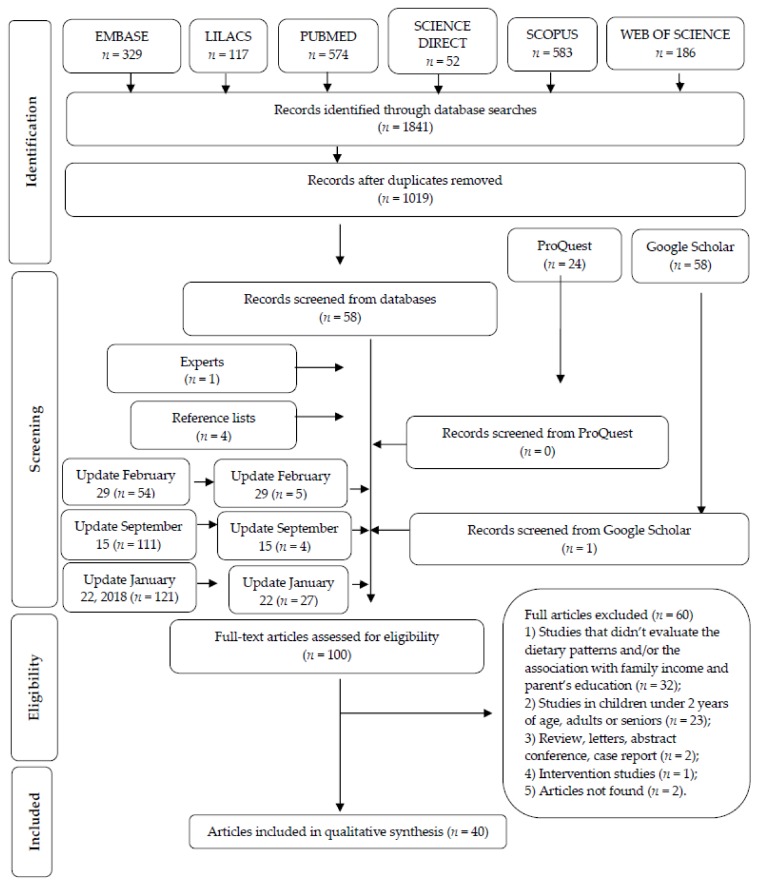
The purpose of this systematic review is to assess the associations among education, income and dietary pattern (DP) in children and adolescents from high, medium and low human development countries (HHDC, MHDC and LHDC, respectively). Observational studies that evaluated the association between family income or education with the DP are obtained through electronic database searches. Forty articles are selected for review. In HHDC, education is inversely associated with "unhealthy" DP and positively associated with "healthy" DP. In cross-sectional studies from HHDC, higher income is negatively associated with "unhealthy" DP. In MHDC, there is no association between the socioeconomic variables (SE) and the DPs, although, in some studies, the unhealthy diet is positively associated with SE. Only one study conducted in LHDC showed an inverse association between income/education with "unhealthy" DP and there is no association between the SE and "healthy" DP. In conclusion, children and adolescents living in HHDC with high parental education tend to have a healthier diet. In MHDC, although an unhealthy diet is found among the high-income and educated population, the associations are not clear. Additional research is needed to clarify the associations between income and education with "unhealthy" and "healthy" DPs in MHDC and LHDC.
Keywords: adolescent; child; dietary patterns analysis; socioeconomic factors; systematic review.
Conflict of interest statement
The authors declare no conflict of interest.
Figures
References
Publication types
MeSH terms
LinkOut - more resources
Full Text Sources
Other Literature Sources
Medical
