


Genome-wide analysis of adolescent psychotic-like experiences shows genetic overlap with psychiatric disorders
- PMID: 29603866
- PMCID: PMC6001485
- DOI: 10.1002/ajmg.b.32630
Genome-wide analysis of adolescent psychotic-like experiences shows genetic overlap with psychiatric disorders
Abstract
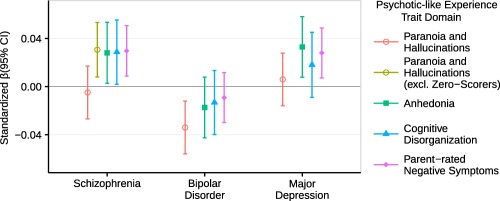
This study aimed to test for overlap in genetic influences between psychotic-like experience traits shown by adolescents in the community, and clinically-recognized psychiatric disorders in adulthood, specifically schizophrenia, bipolar disorder, and major depression. The full spectra of psychotic-like experience domains, both in terms of their severity and type (positive, cognitive, and negative), were assessed using self- and parent-ratings in three European community samples aged 15-19 years (Final N incl. siblings = 6,297-10,098). A mega-genome-wide association study (mega-GWAS) for each psychotic-like experience domain was performed. Single nucleotide polymorphism (SNP)-heritability of each psychotic-like experience domain was estimated using genomic-relatedness-based restricted maximum-likelihood (GREML) and linkage disequilibrium- (LD-) score regression. Genetic overlap between specific psychotic-like experience domains and schizophrenia, bipolar disorder, and major depression was assessed using polygenic risk score (PRS) and LD-score regression. GREML returned SNP-heritability estimates of 3-9% for psychotic-like experience trait domains, with higher estimates for less skewed traits (Anhedonia, Cognitive Disorganization) than for more skewed traits (Paranoia and Hallucinations, Parent-rated Negative Symptoms). Mega-GWAS analysis identified one genome-wide significant association for Anhedonia within IDO2 but which did not replicate in an independent sample. PRS analysis revealed that the schizophrenia PRS significantly predicted all adolescent psychotic-like experience trait domains (Paranoia and Hallucinations only in non-zero scorers). The major depression PRS significantly predicted Anhedonia and Parent-rated Negative Symptoms in adolescence. Psychotic-like experiences during adolescence in the community show additive genetic effects and partly share genetic influences with clinically-recognized psychiatric disorders, specifically schizophrenia and major depression.
Keywords: ALSPAC; GWAS; adolescence; psychotic-like experiences; schizophrenia.
© 2018 The Authors. American Journal of Medical Genetics Part B: Neuropsychiatric Genetics Published by Wiley Periodicals, Inc.
Figures
References
-
- Ahmed, A. O. , Buckley, P. F. , & Mabe, P. A. (2012). Latent structure of psychotic experiences in the general population. Acta Psychiatrica Scandinavica, 125(1), 54–65. - PubMed
-
- Alemany, S. , Goldberg, X. , van Winkel, R. , Gastó, C. , Peralta, V. , & Fañanás, L. (2013). Childhood adversity and psychosis: Examining whether the association is due to genetic confounding using a monozygotic twin differences approach. European Psychiatry: The Journal of the Association of European Psychiatrists, 28(4), 207–212. - PubMed
-
- Anckarsäter, H. , Lundström, S. , Kollberg, L. , Kerekes, N. , Palm, C. , Carlström, E. , … Bölte, S. (2011). The child and adolescent twin study in Sweden (CATSS). Twin Research and Human Genetics: The Official Journal of the International Society for Twin Studies, 14(6), 495–508. - PubMed
Publication types
MeSH terms
Grants and funding
LinkOut - more resources
Full Text Sources
Other Literature Sources
Medical
Research Materials
