. 2018 Apr 19;70(2):287-296.e6.
doi: 10.1016/j.molcel.2018.02.029. Epub 2018 Mar 29.

Visualization of Transvection in Living Drosophila Embryos

Affiliations

Visualization of Transvection in Living Drosophila Embryos

Bomyi Lim et al. Mol Cell. .

Abstract

How remote enhancers interact with appropriate target genes persists as a central mystery in gene regulation. Here, we exploit the properties of transvection to explore enhancer-promoter communication between homologous chromosomes in living Drosophila embryos. We successfully visualized the activation of an MS2-tagged reporter gene by a defined developmental enhancer located in trans on the other homolog. This trans-homolog activation depends on insulator DNAs, which increase the stability-but not the frequency-of homolog pairing. A pair of heterotypic insulators failed to mediate transvection, raising the possibility that insulator specificity underlies the formation of chromosomal loop domains. Moreover, we found that a shared enhancer co-activates separate PP7 and MS2 reporter genes incis and intrans. Transvecting alleles weakly compete with one another, raising the possibility that they share a common pool of the transcription machinery. We propose that transvecting alleles form a trans-homolog "hub," which serves as a scaffold for the accumulation of transcription complexes.

Keywords: Drosophila embryos; TADs; chromosomal loop domains; enhancers; insulators; live imaging; transcription; transvection.


Conflict of interest statement

Declaration of Interests

The authors declare no competing interests.

Figures

Figure 1
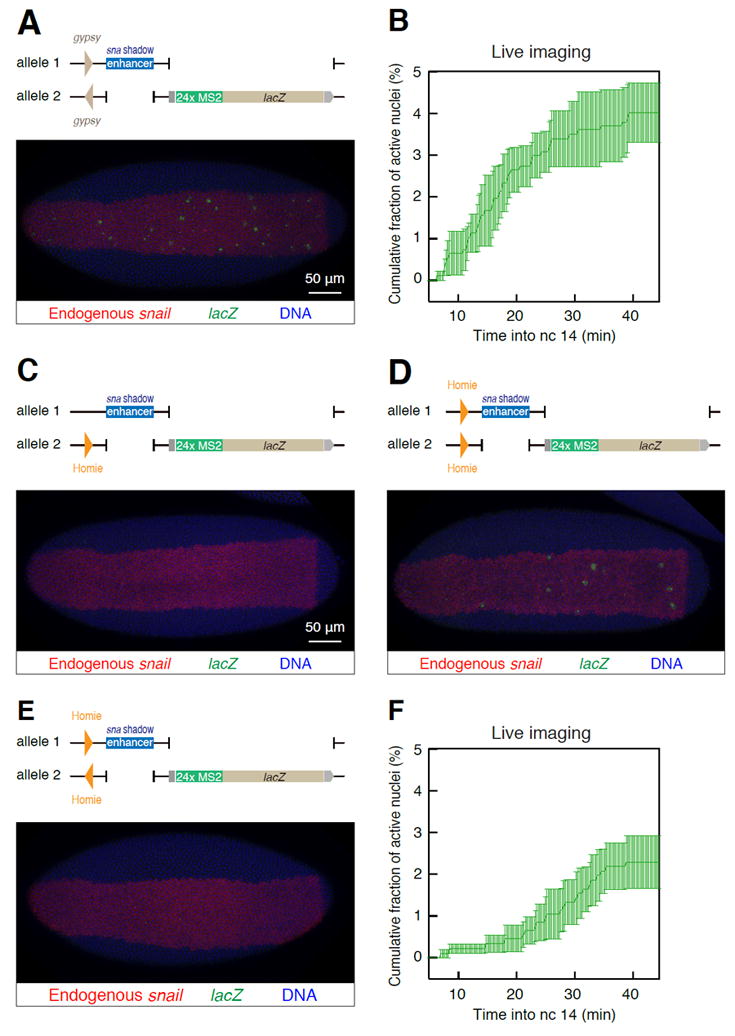
Figure 1. A pair of gypsy insulators mediates transvection
(A-C) Double fluorescent in situ hybridizations of lacZ (green) and endogenous sna (red). The lacZ reporter gene contains the 100-bp minimal eve promoter and 24x MS2 RNA stem loops within the 5′ UTR. Embryos at late nc 14 are shown. Images were rotated to align embryos (anterior to the left and posterior to the right). (A) sna shadow enhancer is not sufficient to activate lacZ transcription in trans. Scale bar represents 50 μm. (B) A single gypsy insulator cannot mediate trans-activation of the lacZ reporter. (C) Insertion of gypsy insulators on both alleles facilitates trans-activation of lacZ transcription. (D) Cumulative fraction of transvecting nuclei in the presumptive mesoderm cells. Trans-activation of MS2-lacZ reporter gene was visualized with MCP-GFP fusion protein in living embryos. gypsy insulators are positioned in the same orientation as shown in (C). A total of 1151 (1119 inactive, 32 active) nuclei from three independent embryos were analyzed. Error bars represent ± the standard error of the mean of three independent embryos. See also Figure S1.
Figure 2
Figure 2. Orientation-dependent and -independent insulator pairing
(A) Insertion of gypsy insulators in the opposite orientation can facilitate trans-activation of the lacZ reporter. Scale bar represents 50 μm. (B) Cumulative fraction of transvecting nuclei in the presumptive mesoderm cells. gypsy insulators are positioned in the opposite orientation as shown in (A). A total of 916 (879 inactive, 37 active) nuclei from three independent embryos were analyzed. Error bars represent the ± standard error of the mean of three independent embryos. (C) A single Homie insulator cannot mediate trans-activation of the lacZ reporter. Scale bar represents 50 μm. (D) Homie insulators on both homologs positioned in the same orientation facilitates trans-activation of the lacZ reporter. (E) A pair of Homie insulators positioned in the opposite orientation fails to mediate trans-activation of the lacZ reporter. (F) Cumulative fraction of transvecting nuclei in the presumptive mesoderm cells. Homie insulators are positioned in the same orientation as shown in (D). A total of 980 (958 inactive, 22 active) nuclei from three independent embryos were analyzed. Error bars represent ± the standard error of the mean of three independent embryos. See also Figure S2.
Figure 3
Figure 3. gypsy insulators foster stable homolog pairing
(A) Schematic representation of the lacZ reporter genes containing the 100-bp minimal eve promoter, the 1.5-kb sna shadow enhancer, the 432-bp gypsy insulator and 24x MS2 or 24x PP7 RNA stem loops within the 5′ UTR. (B) 3D tracking of MS2-lacZ (green) and PP7-lacZ (red) transcription foci in a nucleus that exhibits allelic separation throughout nc 14. An ellipsoid with 4 μm short-axis radius and 7 μm long-axis radius was plotted as a proxy for the shape of the nucleus at mid nc 14. Location of MS2 and PP7 alleles are indicated as spheres with 0.5 μm radii to represent uncertainty in the spatial resolution in the z-axis. (C, D) Cumulative traces of MS2-lacZ (green) and PP7-lacZ (red) transcription foci during early (5 min to 29.9 min; C) and late nc 14 (30.1 min to 54.6 min; D) in the nucleus shown in (B). (E) 3D tracking of MS2-lacZ (green) and PP7-lacZ (red) transcription foci in a nucleus that undergoes stable homolog pairing at the midpoint of nc 14. Note the association of the two alleles during later stages of nc 14. (F, G) Cumulative traces of MS2-lacZ (green) and PP7-lacZ (red) transcription foci during early phases of nc 14 when the two alleles are unpaired (5.0 min to 29.5min; F) and later stages when paired (29.7 min to 54.6 min; G) in the nucleus shown in (E). (H, I) The pairing efficiency across nuclei (H) and the distribution of the duration of homolog pairing in those nuclei exhibiting pairing (I). The most salient impact of two copies of gypsy is the doubling in the frequency of the most stably paired alleles (from ~4% in controls to ~9% with a pair of gypsy insulators). A total of 1135 and 936 nuclei from three independent embryos were analyzed for single gypsy and two gypsy, respectively. Error bars represent ± the standard error of the mean of three independent embryos. See also Figure S3.
Figure 4
Figure 4. A shared enhancer can co-activate two reporter genes in cis and trans
(A) Schematic representation of the transvection assay. The lacZ reporter gene contains the 100-bp minimal eve promoter and 24x MS2 or 24x PP7 RNA stem loops within the 5′ UTR. The 1.5-kb sna shadow enhancer was placed upstream of the PP7-lacZ reporter gene. The 432-bp minimal gypsy insulators were placed in both alleles to facilitate transvection. (B) Representative trajectories of MS2-lacZ (green) and PP7-lacZ (red) transcriptional activity in a nucleus that displays transvection. Another example is shown in Figure S4. (C) Snapshots of the maximum projected images of a representative transvecting nucleus within a living embryo. MS2 and PP7 activities were visualized with MCP-GFP (green) and mCherry-PCP (red). Nuclei were visualized with His2Av-eBFP2 (blue). Scale bar indicates 5 μm. The insets are magnifications of the transcription foci within the central nucleus. Images were processed to remove background fluorescence and enhance signals. Signal trajectories from the raw image are shown in (B). Minutes into nc 14 are indicated above each panel. (D) 3D tracking of MS2-lacZ (green) and PP7-lacZ (red) transcription foci in the transvecting nucleus shown in (B, C). (E) Cumulative traces of MS2-lacZ (green) and PP7-lacZ (red) transcription foci during transvection in the nucleus shown in (B-D). The plot spans from 24.5 min to 39.9 min. There is stable association of the two alleles during transvection. See also Figure S4, Figure S5 and Figure S6.
Figure 5
Figure 5. Coordinated transcription across homologous chromosomes
(A) Schematic representation of the MS2-lacZ and PP7-lacZ reporter genes containing gypsy insulators. Only the PP7-lacZ reporter gene contains the sna shadow enhancer. (B) Representative trajectory of MS2-lacZ (green) and PP7-lacZ (red) transcriptional activity. These reporters were placed under the control of a shared enhancer as shown in (A). (C) Schematic representation of the MS2-lacZ and PP7-lacZ reporter genes containing gypsy insulators and separate sna shadow enhancers. (D) Representative trajectory of MS2-lacZ (green) and PP7-lacZ (red) transcriptional activity. These reporter genes were placed under the control of separate enhancers as shown in (C). (E) The distribution of correlation coefficients between MS2-lacZ and PP7-lacZ transcription activities during transvection (red) or under the control of separate enhancers (blue). A total of 99 and 883 nuclei from four and three independent embryos were analyzed, respectively. Both histograms were plotted with a bin width of 0.1. These two distributions were found to be significantly different (p < 1.5 × 10⁻⁷, Mann-Whitney-U test). See also Figure S7.
Figure 6
Figure 6. Promoter competition attenuates the timing and the level of transvection
(A) Schematic representation of the transvection assay without a cis-linked PP7-lacZ reporter gene. MS2-lacZ reporter gene and sna shadow enhancer are located on separate alleles. gypsy insulators were placed in both alleles to facilitate transvection. Single-color live imaging was performed to visualize MS2-lacZ reporter gene. (B) Representative trajectory of MS2-lacZ transcriptional activity in the absence of cis-linked PP7-lacZ reporter gene. The first trans-activation can occur within first 10 min of nc 14. (C) Schematic representation of the transvection assay with a cis-linked PP7-lacZ reporter gene. (D) Representative trajectory of MS2-lacZ transcriptional activity in the presence of cis-linked PP7-lacZ reporter gene. There is a delay in the first MS2 burst, and the overall amplitudes of the bursts are lower as compared with the nucleus lacking the cis-linked PP7 reporter gene (B). (E) Cumulative fraction of nuclei expressing MS2-lacZ reporter gene in the presence (blue) or absence (green) of a cis-linked PP7-lacZ. A total of 1110 (1077 inactive, 33 active) and 1151 (1119 inactive, 32 active) nuclei from three independent embryos were analyzed, respectively. Error bars represent ± the standard error of the mean of three biological replicates. Plot shown as – cis-linked PP7-lacZ is identical to Figure 1D. (F) A close-up of the delay in trans-activation during the onset into nc 14 (5-15min) from the plot shown in (E). Error bars represent ± the standard error of the mean of three biological replicates. See also Figure S7.
Figure 7
Figure 7. A model for gene activation via formation of a transcription hub
A pair of insulators establishes a stable trans-homolog association. Subsequently, the transcription “hub” is assembled near the site of transcription by trapping transcription factors (yellow and orange ovals) and co-activators (pink oval) at enhancers as well as Pol II complexes (blue ovals) at promoters, leading to coordinated transcription activity of both reporter genes in cis and trans.

Comment in

References

    1. Abraham BJ, Hnisz D, Weintraub AS, Kwiatkowski N, Li CH, Li Z, Weichert-Leahey N, Rahman S, Liu Y, Etchin J, Li B, Shen S, Lee TI, Zhang J, Look AT, Mansour MR, Young RA. Small genomic insertions form enhancers that misregulate oncogenes. Nat Commun. 2017;8:14385. - PMC - PubMed
    1. Bateman JR, Johnson JE, Locke MN. Comparing enhancer action in cis and in trans. Genetics. 2012;191:1143–1155. - PMC - PubMed
    1. Belozerov VE, Majumder P, Shen P, Cai HN. A novel boundary element may facilitate independent gene regulation in the Antennapedia complex of Drosophila. EMBO J. 2003;22:3113–3121. - PMC - PubMed
    1. Bertrand E, Chartrand P, Schaefer M, Shenoy SM, Singer RH, Long RM. Localization of ASH1 mRNA particles in living yeast. Mol Cell. 1998;2:437–445. - PubMed
    1. Blick AJ, Mayer-Hirshfeld I, Malibiran BR, Cooper MA, Martino PA, Johnson JE, Bateman JR. The Capacity to Act in trans Varies Among Drosophila Enhancers. Genetics. 2016;203:203–218. - PMC - PubMed

Publication types

MeSH terms