


Silicone wristbands compared with traditional polycyclic aromatic hydrocarbon exposure assessment methods
- PMID: 29607448
- PMCID: PMC5910488
- DOI: 10.1007/s00216-018-0992-z
Silicone wristbands compared with traditional polycyclic aromatic hydrocarbon exposure assessment methods
Abstract
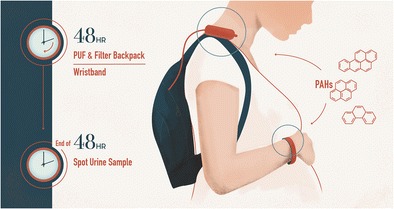
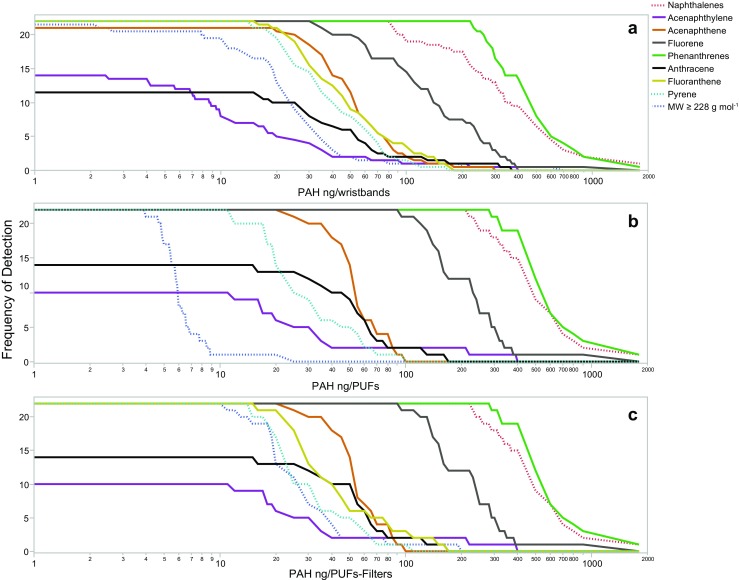
Currently there is a lack of inexpensive, easy-to-use technology to evaluate human exposure to environmental chemicals, including polycyclic aromatic hydrocarbons (PAHs). This is the first study in which silicone wristbands were deployed alongside two traditional personal PAH exposure assessment methods: active air monitoring with samplers (i.e., polyurethane foam (PUF) and filter) housed in backpacks, and biological sampling with urine. We demonstrate that wristbands worn for 48 h in a non-occupational setting recover semivolatile PAHs, and we compare levels of PAHs in wristbands to PAHs in PUFs-filters and to hydroxy-PAH (OH-PAH) biomarkers in urine. We deployed all samplers simultaneously for 48 h on 22 pregnant women in an established urban birth cohort. Each woman provided one spot urine sample at the end of the 48-h period. Wristbands recovered PAHs with similar detection frequencies to PUFs-filters. Of the 62 PAHs tested for in the 22 wristbands, 51 PAHs were detected in at least one wristband. In this cohort of pregnant women, we found more significant correlations between OH-PAHs and PAHs in wristbands than between OH-PAHs and PAHs in PUFs-filters. Only two comparisons between PAHs in PUFs-filters and OH-PAHs correlated significantly (rs = 0.53 and p = 0.01; rs = 0.44 and p = 0.04), whereas six comparisons between PAHs in wristbands and OH-PAHs correlated significantly (rs = 0.44 to 0.76 and p = 0.04 to <0.0001). These results support the utility of wristbands as a biologically relevant exposure assessment tool which can be easily integrated into environmental health studies. Graphical abstract PAHs detected in samples collected from urban pregnant women.
Keywords: Active sampling; Biomonitoring; Environmental toxicology; Exposome; Passive sampling; Personal monitoring.
Conflict of interest statement
Conflict of interest
Kim A. Anderson, an author of this research, discloses a financial interest in MyExposome, Inc., which is marketing products related to the research being reported. The terms of this arrangement have been reviewed and approved by Oregon State University in accordance with its policy on research conflicts of interest. The authors have no other conflict of interest disclosures.
Human study
We obtained informed consent from the study participants in agreement with the Columbia University Institutional Review Board (IRB approval number: AAAK6753), and this study has been performed in accordance with the IRB’s ethical standards. It was determined that the analysis of de-identified specimens by the Centers for Disease Control and Prevention laboratory did not constitute engagement in human subject research.
Figures
References
-
- Paulik LB, Anderson KA. Considerations for measuring exposure to chemical mixtures. In: Rider C, Simmons JE, editors. Chemical mixtures and combined chemical and nonchemical stressors: exposure, toxicity, analysis and risk. New York: Springer; 2018.
Publication types
MeSH terms
Substances
Grants and funding
LinkOut - more resources
Full Text Sources
Other Literature Sources
Medical
