


A Randomized Clinical Trial of the Effect of Continuous Glucose Monitoring on Nocturnal Hypoglycemia, Daytime Hypoglycemia, Glycemic Variability, and Hypoglycemia Confidence in Persons with Type 1 Diabetes Treated with Multiple Daily Insulin Injections (GOLD-3)
- PMID: 29608107
- PMCID: PMC5910048
- DOI: 10.1089/dia.2017.0363
A Randomized Clinical Trial of the Effect of Continuous Glucose Monitoring on Nocturnal Hypoglycemia, Daytime Hypoglycemia, Glycemic Variability, and Hypoglycemia Confidence in Persons with Type 1 Diabetes Treated with Multiple Daily Insulin Injections (GOLD-3)
Abstract
Background: To evaluate the effects of continuous glucose monitoring (CGM) on nocturnal and daytime hypoglycemia in persons with type 1 diabetes treated with multiple daily insulin injections (MDI); we also evaluated factors related to differences in hypoglycemia confidence in this population.
Methods: Evaluations were performed from the GOLD randomized trial, an open-label multicenter crossover randomized clinical trial (n = 161) over 69 weeks comparing CGM to self-measurement of blood glucose (SMBG) in persons with type 1 diabetes treated with MDI. Masked CGM and the hypoglycemia confidence questionnaire were used for evaluations.
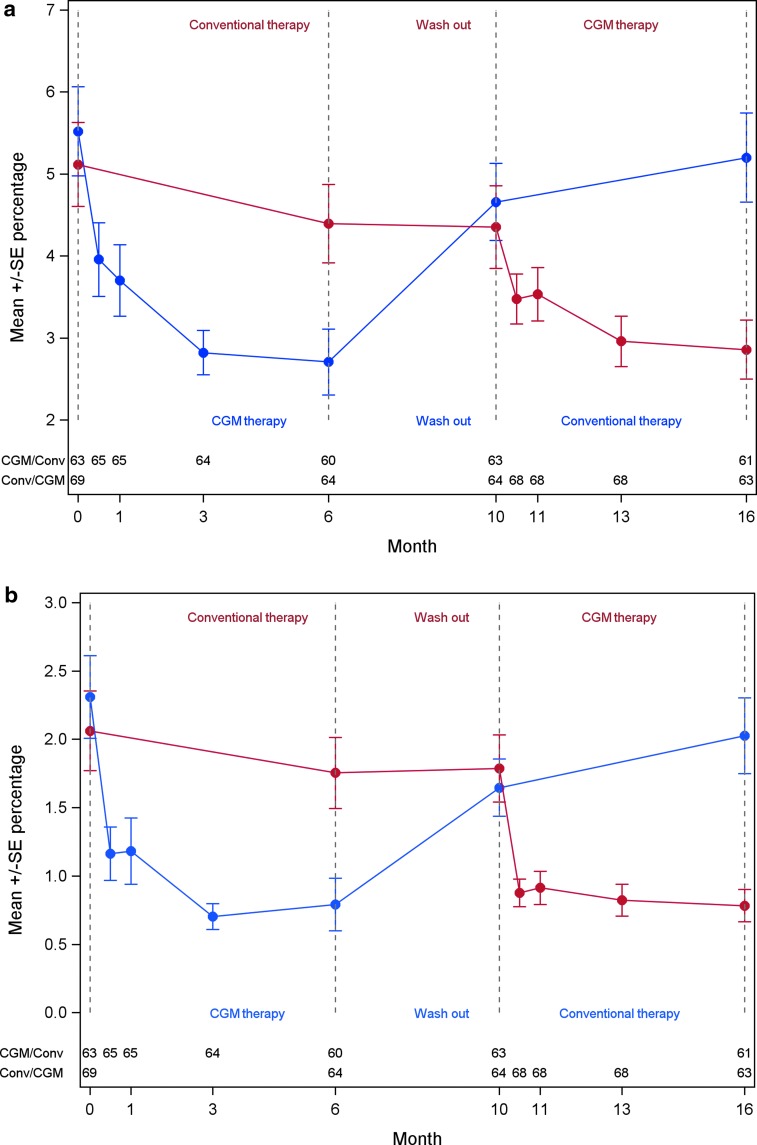
Results: Time with nocturnal hypoglycemia, glucose levels <70 mg/dL was reduced by 48% (10.2 vs. 19.6 min each night, P < 0.001) and glucose levels <54 mg/dL by 65%. (3.1 vs. 8.9 min, P < 0.001). For the corresponding glucose cutoffs, daytime hypoglycemia was reduced by 40% (29 vs. 49 min, P < 0.001) and 54% (8 vs. 18 min., P < 0.001), respectively. Compared with SMBG, CGM use improved hypoglycemia-related confidence in social situations (P = 0.016) and confidence in more broadly avoiding serious problems due to hypoglycemia (P = 0.0020). Persons also reported greater confidence in detecting and responding to decreasing blood glucose levels (thereby avoiding hypoglycemia) during CGM use (P = 0.0033) and indicated greater conviction that they could more freely live their lives despite the risk of hypoglycemia (P = 0.022).
Conclusion: CGM reduced time in both nocturnal and daytime hypoglycemia in persons with type 1 diabetes treated with MDI and improved hypoglycemia-related confidence, especially in social situations, thus contributing to greater well-being and quality of life.
Trial registration: ClinicalTrials.gov , number NCT02092051.
Keywords: Continuous glucose monitoring; Hypoglycemia; Hypoglycemia fear.; Randomized clinical trial; Type 1 diabetes mellitus.
Conflict of interest statement
W.P. has consulted for Dexcom and Abbott Diabetes Care. J.B. has served on advisory boards for Abbott Diabetes Care, Insulet Corporation, Integrity Applications, Novo Nordisk, and Sanofi-Aventis; has done lectures for Abbott Diabetes Care, Astra Zeneca, Novo Nordisk, and Sanofi-Aventis. I.B.H. has consulted for Abbott Diabetes Care, Roche, and Intarcia. T.N. has received unrestricted grants from Astra Zeneca and Novo Nordisk, and he has served on national advisory boards of Novo Nordisk, Sanofi-Aventis, Eli Lilly, and Boehringer Ingelheim. M.W. has served on advisory boards and/or lectured for MSD, Lilly, Novo Nordisk and Sanofi, and has organized a professional regional meeting sponsored by Lilly, Rubin Medical, Sanofi, Novartis and Novo Nordisk. T.H. has received grants from Adocia, Becton Dickinson, Astra Zeneca, Biocon, Boehringer Ingelheim, Dance Pharmaceuticals, Eli Lilly, Grünenthal, Gulf Pharmaceuticals, Johnson & Johnson, Marvel, Medimmune, Medtronic, Mylan, Novartis, Novo Nordisk, Roche Diagnostics, Sanofi, Senseonics, and Zealand Pharma. He also reports personal fees from Eli Lilly, Mylan, and Novo Nordisk. E.S. has done lectures for Novo Nordisk, Sanofi, and Eli Lilly. J.H. has served on advisory boards for Sanofi-Aventis, Lilly, Merck Sharp & Dohme, Jensen Cilag, Novo Nordisk, Astra Zeneca, Dexcom, and Abbott; has done lectures for Sanofi-Aventis, Boehringer-Ingelheim, Lilly, Merck Sharp & Dohme, Novo Nordisk, and Astra Zeneca. M.L. has received grants from Astra Zeneca, Dexcom, Novo Nordisk, been a consultant or received honoraria from Dexcom, Eli Lilly, Medtronic, Novo Nordisk, and Rubin Medical and participated in advisory boards for MSD and Novo Nordisk. A.F.O., S.D., and H.W. have nothing to disclose.
Figures
References
-
- DCCT Study Group: The Effect of intensive treatment of diabetes on the development and progression of long-term complications in insulin-dependent diabetes mellitus. N Engl J Med 1993;329:977–986 - PubMed
-
- Misso ML, Egberts KJ, Page M, et al. : Continuous subcutaneous insulin infusion (CSII) versus multiple insulin injections for type 1 diabetes mellitus. Cochrane Database Syst Rev 2010;1:CD005103 - PubMed
-
- Hansen MV, Pedersen-Bjergaard U, Heller SR, et al. : Frequency and motives of blood glucose self-monitoring in type 1 diabetes. Diabetes Res Clin Pract 2009;85:183–188 - PubMed
Publication types
MeSH terms
Substances
Associated data
LinkOut - more resources
Full Text Sources
Other Literature Sources
Medical
