


Effects of dialysate to serum sodium (Na+) alignment in chronic hemodialysis (HD) patients: retrospective cohort study from a quality improvement project
- PMID: 29609536
- PMCID: PMC5879548
- DOI: 10.1186/s12882-018-0870-0
Effects of dialysate to serum sodium (Na+) alignment in chronic hemodialysis (HD) patients: retrospective cohort study from a quality improvement project
Abstract
Background: Evidence indicates favorable effects of dialysate (DNa+) to serum sodium concentration (SNa+) alignment, however, results from larger sample populations are needed. For this reason, we conducted a retrospective propensity score-matched cohort study from a quality improvement project to investigate the effects of alignment on population of maintenance hemodialysis patients.
Methods: At 4 participating hemodialysis (HD) clinics, patients with SNa+ lower than the standard DNa+ of 137 mEq/L who received HD with DNa+ aligned to the average of the last 4 SNa+ measurements were evaluated (clinicaltrials.gov # NCT01825590 ). In this retrospective data analysis, an intention-to-treat (primary) and an as-treated "intervention" (secondary) cohort were created. "Aligned" patients from both cohorts (N = 163 for the primary and N = 137 for the secondary) were then propensity-score matched in a 1:1 fashion to "unaligned" patients from the Renal Research Institute database. The propensity score was generated based on age, gender, white race, Hispanic ethnicity, absence or presence of diabetes, hemodialysis vintage, interdialytic weight gain (IDWG; as a percentage of postdialysis body weight), catheter as primary dialysis access, predialysis systolic blood pressure, serum sodium concentration, hospitalization count during baseline. T-Test was employed for group comparisons of changes to the primary (volume-related and hemodynamic parameters) and tertiary outcomes. All-cause and fluid overload-related hospitalization admission rates were compared using Wilcoxon Rank Sum test and Cox regression analysis for repeated events.
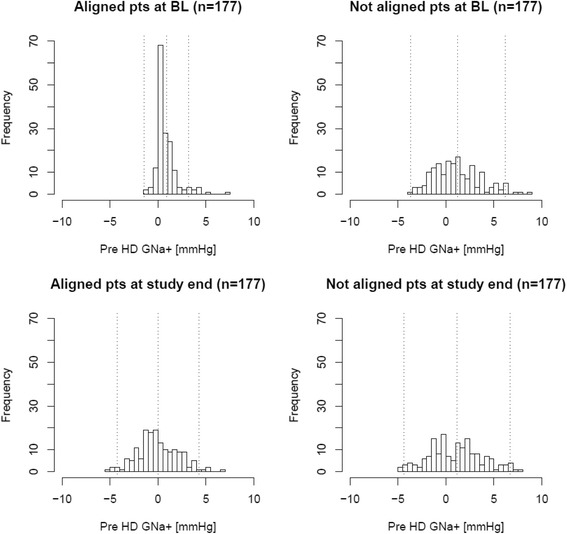
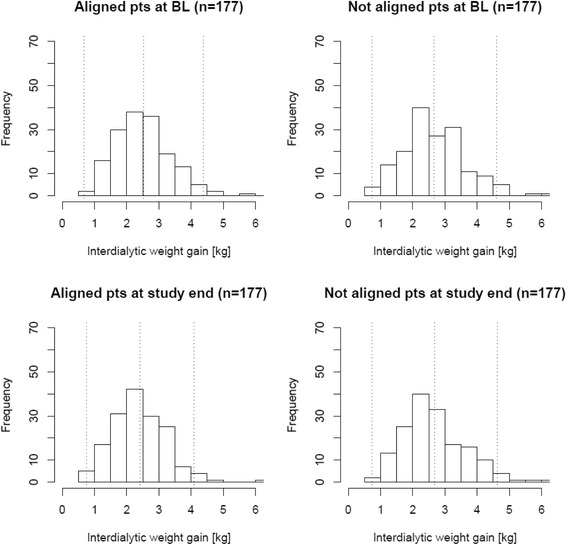
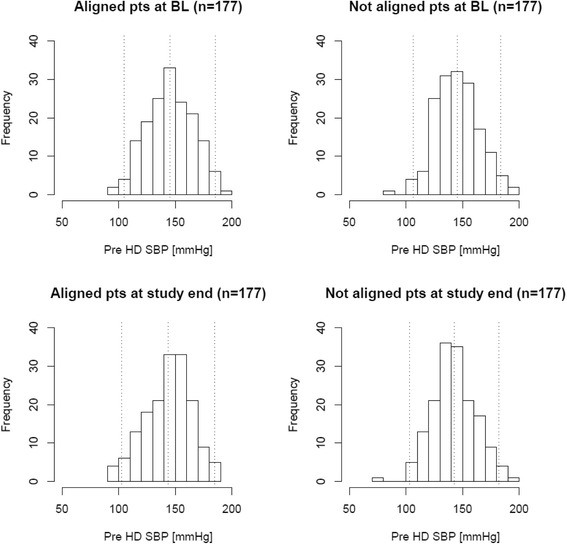
Results: In the primary analysis, aligned and unaligned subjects showed comparable demographics at baseline. Treatment effects were significant for IDWG [-0.12 (95% CI -0.24 to 0) L] and showed decreasing non-significant trends for pre-dialysis hemodynamic parameters. Count comparison and Cox regression analysis showed no clear advantage of alignment in terms of all-cause and fluid overload-related hospitalization.
Conclusions: Results from the largest sodium alignment program to date suggest positive treatment effects on volume-related and hemodynamic parameters, but no clear effect on risk of hospitalization. Well-matched control patients minimized confounding effects. Small effects and lack of significant differences may be explained by a low baseline DNa+ limiting the interventional change.
Keywords: Blood pressure; Dialysate to serum sodium alignment; Interdialytic weight gain; Sodium mass balance.
Conflict of interest statement
Ethics approval and consent to participate
This manuscript reports data from a retrospective analysis of a quality improvement project. The Renal Research Institute was formed as a joint-venture between Fresenius Medical Care North America and Beth Israel Medical Center (until 2010) and does not have an ethics committee. - Therefore the Institutional Review Board (IRB) at Beth Israel Medical Center acted as the local IRB for this study and has waived the need for review and determined this study as exempt under the provisions of 45 CFR 46 Section 101(b) as per the United States Health Insurance Portability and Accountability Act.
Consent for publication
Not applicable.
Competing interests
LHF and CM are employees of Fresenius Medical Care, North America. CM and PK hold stock in Fresenius Medical Care NA. All other authors have no relevant financial disclosures.
Publisher’s Note
Springer Nature remains neutral with regard to jurisdictional claims in published maps and institutional affiliations.
Figures
References
-
- Hecking M, Karaboyas A, Saran R, Sen A, Inaba M, Rayner H, Horl WH, Pisoni RL, Robinson BM, Sunder-Plassmann G, et al. Dialysate sodium concentration and the association with interdialytic weight gain, hospitalization, and mortality. Clin J Am Soc Nephrol. 2012;7(1):92–100. doi: 10.2215/CJN.05440611. - DOI - PMC - PubMed
Publication types
MeSH terms
Substances
Associated data
LinkOut - more resources
Full Text Sources
Other Literature Sources
Medical
Research Materials
