


A study on volatile organic compounds emitted by in-vitro lung cancer cultured cells using gas sensor array and SPME-GCMS
- PMID: 29609557
- PMCID: PMC5879746
- DOI: 10.1186/s12885-018-4235-7
A study on volatile organic compounds emitted by in-vitro lung cancer cultured cells using gas sensor array and SPME-GCMS
Abstract
Background: Volatile organic compounds (VOCs) emitted from exhaled breath from human bodies have been proven to be a useful source of information for early lung cancer diagnosis. To date, there are still arguable information on the production and origin of significant VOCs of cancer cells. Thus, this study aims to conduct in-vitro experiments involving related cell lines to verify the capability of VOCs in providing information of the cells.
Method: The performances of e-nose technology with different statistical methods to determine the best classifier were conducted and discussed. The gas sensor study has been complemented using solid phase micro-extraction-gas chromatography mass spectrometry. For this purpose, the lung cancer cells (A549 and Calu-3) and control cell lines, breast cancer cell (MCF7) and non-cancerous lung cell (WI38VA13) were cultured in growth medium.
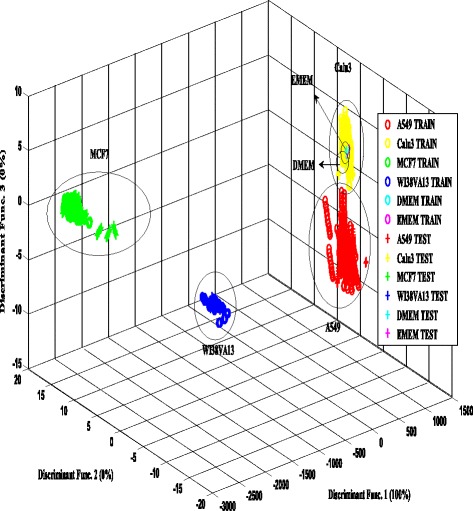
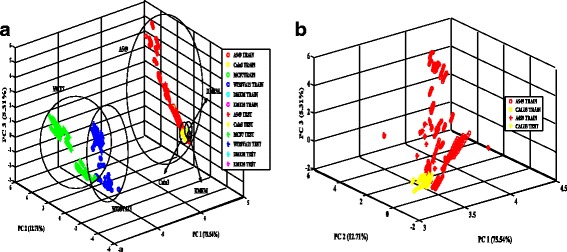
Results: This study successfully provided a list of possible volatile organic compounds that can be specific biomarkers for lung cancer, even at the 24th hour of cell growth. Also, the Linear Discriminant Analysis-based One versus All-Support Vector Machine classifier, is able to produce high performance in distinguishing lung cancer from breast cancer cells and normal lung cells.
Conclusion: The findings in this work conclude that the specific VOC released from the cancer cells can act as the odour signature and potentially to be used as non-invasive screening of lung cancer using gas array sensor devices.
Keywords: E-nose; GCMS-SPME; In-vitro; Lung cancer; VOCs.
Conflict of interest statement
Competing interest
The authors declare that they have no competing interests.
Ethics approval and consent to participate
Not applicable as there was no research involving human or animal subjects in the study. The cell lines used in this study are purchased from American Types Culture Collection (ATCC).
Consent for publication
Not applicable
Publisher’s Note
Springer Nature remains neutral with regard to jurisdictional claims in published maps and institutional affiliations.
Figures
References
-
- American Cancer Society. Cancer Facts & Figures 2017. Alanta: American Cancer Society; 2017.
-
- Types of Cancer. Natl. Cancer Soc. Malaysia. 2016. Retrieved from “www.cancer.org.my/national-cancer-society-malaysia-and-ibm-team-up-to-us...” at 23rd March 2016
-
- Hirsch FR, Franklin WA, Af G, PAJ B. Early detection of lung cancer: clinical perspectives of recent advances in biology and radiology. Clin Cancer Res. 2001;7:5–22. - PubMed
-
- Fossella FV, Komaki MR, Putnam MJB M., Jr . Lung cancer. Texas: Springer-Verlag New York; 2002.
Publication types
MeSH terms
Substances
LinkOut - more resources
Full Text Sources
Other Literature Sources
Medical
