


Subclinical atherosclerosis, cardiovascular health, and disease risk: is there a case for the Cardiovascular Health Index in the primary prevention population?
- PMID: 29609588
- PMCID: PMC5880087
- DOI: 10.1186/s12889-018-5263-6
Subclinical atherosclerosis, cardiovascular health, and disease risk: is there a case for the Cardiovascular Health Index in the primary prevention population?
Abstract
Background: Current primary prevention guidelines for cardiovascular disease (CVD) prioritize risk identification, risk stratification using clinical and risk scores, and risk reduction with lifestyle interventions and pharmacotherapy. Subclinical atherosclerosis is an early indicator of atherosclerotic burden and its timely recognition can slow or prevent progression to CVD. Thus, individuals with subclinical atherosclerosis are a priority for primary prevention. This study takes a practical approach to answering a challenge commonly faced by primary care practitioners: in patients with no known CVD, how can individuals likely to have subclinical atherosclerosis be easily identified using existing clinical data and/or information provided by the patient?
Methods: Using NHANES (1999-2004), 6091 men and women aged ≥40 years without any CVD comprised the primary prevention population for this study. Subclinical atherosclerosis was determined via ankle-brachial index (ABI) using established cutoffs (subclinical atherosclerosis defined as ABI (0.91-0.99); normal defined as ABI (1.00-1.30)). Three common scores were calculated: the Framingham Risk Score (FRS), the Metabolic Syndrome (MetS), and the Cardiovascular Health Index (CVHI). Logistic regression analysis assessed the association between these scores and subclinical atherosclerosis. The sensitively and specificity of these scores in identifying subclinical atherosclerosis was determined.
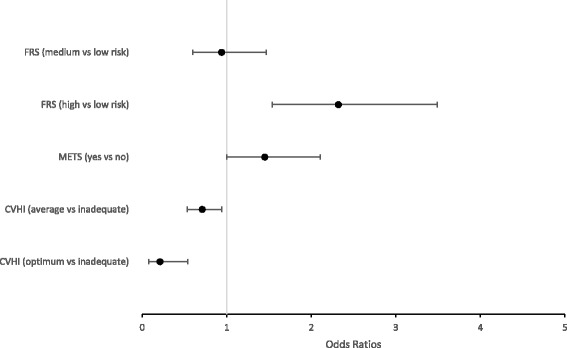
Results: In eligible participants, 3.8% had subclinical atherosclerosis. Optimum and average CVHI was associated with decreased odds for subclinical atherosclerosis. High, but not intermediate-risk, FRS was associated with increased odds for subclinical atherosclerosis. MetS was not associated with subclinical atherosclerosis. Of the 3 scores, CVHI was the most sensitive in identifying subclinical atherosclerosis and had the lowest number of missed cases. The FRS was the most specific but least sensitive of the 3 scores, and had almost 10-fold more missed cases vs. the CVHI. The MetS had "middle" sensitivity and specificity, and 10-fold more missed cases vs. the CVHI.
Conclusions: Results from this study suggest that routine administration of the CVHI in a primary prevention population would yield the benefits of identifying patients with existing subclinical CVD not identified through traditional CVD risk factors or scores, and bring physical activity and nutrition to the forefront of provider-patient discussions about lifestyle factors critical to maintaining and prolonging cardiovascular health.
Keywords: Ankle brachial index; Cardiovascular Health Index; Cardiovascular disease prevention; Cardiovascular risk factors; Framingham Risk Score; Metabolic syndrome; NHANES; Primary prevention; Subclinical atherosclerosis.
Conflict of interest statement
Ethics approval and consent to participate
All data used for this study were from obtained from publicly available datasets. This study was approved as exempt by the University of Western Ontario Research Ethics Board and as non-human subjects research by the West Virginia University Institutional Review Board.
Consent for publication
N/A
Competing interests
The authors declare that they have no competing interests.
Publisher’s Note
Springer Nature remains neutral with regard to jurisdictional claims in published maps and institutional affiliations.
Figures
References
-
- Stone NJ, Robinson JG, Lichtenstein AH, et al. 2013 ACC/AHA guideline on the treatment of blood cholesterol to reduce atherosclerotic cardiovascular risk in adults: a report of the American College of Cardiology/American Heart Association Task Force on Practice Guidelines. Circulation. 2014;129(25 Suppl 2):S1–45. doi: 10.1161/01.cir.0000437738.63853.7a. - DOI - PubMed
-
- Goff DC, Jr, Lloyd-Jones DM, Bennett G, et al. 2013 ACC/AHA guideline on the assessment of cardiovascular risk: a report of the American College of Cardiology/American Heart Association Task Force on Practice Guidelines. Circulation. 2014;129(25 Suppl 2):S49–S73. doi: 10.1161/01.cir.0000437741.48606.98. - DOI - PubMed
MeSH terms
LinkOut - more resources
Full Text Sources
Other Literature Sources
Medical
