Review
. 2018 Apr 2;6(1):64.
doi: 10.1186/s40168-018-0431-6.

Host-microbe interactions in octocoral holobionts - recent advances and perspectives

Affiliations
Review

Host-microbe interactions in octocoral holobionts - recent advances and perspectives

Jeroen A J M van de Water et al. Microbiome. .

Abstract

Octocorals are one of the most ubiquitous benthic organisms in marine ecosystems from the shallow tropics to the Antarctic deep sea, providing habitat for numerous organisms as well as ecosystem services for humans. In contrast to the holobionts of reef-building scleractinian corals, the holobionts of octocorals have received relatively little attention, despite the devastating effects of disease outbreaks on many populations. Recent advances have shown that octocorals possess remarkably stable bacterial communities on geographical and temporal scales as well as under environmental stress. This may be the result of their high capacity to regulate their microbiome through the production of antimicrobial and quorum-sensing interfering compounds. Despite decades of research relating to octocoral-microbe interactions, a synthesis of this expanding field has not been conducted to date. We therefore provide an urgently needed review on our current knowledge about octocoral holobionts. Specifically, we briefly introduce the ecological role of octocorals and the concept of holobiont before providing detailed overviews of (I) the symbiosis between octocorals and the algal symbiont Symbiodinium; (II) the main fungal, viral, and bacterial taxa associated with octocorals; (III) the dominance of the microbial assemblages by a few microbial species, the stability of these associations, and their evolutionary history with the host organism; (IV) octocoral diseases; (V) how octocorals use their immune system to fight pathogens; (VI) microbiome regulation by the octocoral and its associated microbes; and (VII) the discovery of natural products with microbiome regulatory activities. Finally, we present our perspectives on how the field of octocoral research should move forward, and the recognition that these organisms may be suitable model organisms to study coral-microbe symbioses.

Keywords: Bacteria; Fungi; Gorgonians; Holobiont; Immunity; Microbiome; Octocoral; Soft coral; Symbiodinium.


Conflict of interest statement

Ethics approval and consent to participate

Not applicable

Consent for publication

Not applicable

Competing interests

The authors declare that they have no competing interests.

Publisher’s Note

Springer Nature remains neutral with regard to jurisdictional claims in published maps and institutional affiliations.

Figures

Fig. 1
Fig. 1
Octocorals as habitat providers. ac Gorgonians form three-dimensional structures in a range of environments, such as a Leptogorgia sarmentosa on sandy bottoms, b Corallium rubrum on the walls and ceilings of caves and overhangs, and c Paramuricea clavata forming “marine animal forests” on rocky substrates. Close-up of the gorgonian colonies of d Paramuricea clavata with open (front) and retracted (back) polyps and e C. rubrum, showing their eightfold body symmetry. f Colonies can consist of thousands of polyps forming large three-dimensional structures. Together colonies can form vast “forests” providing refuge and habitat for numerous marine organisms (photos a and f by Eric Béraud and photos be by Sergio Rossi)
Fig. 2
Fig. 2
Relative abundance of octocorals harboring specific clades of Symbiodinium in different geographical areas. A large number of octocoral species is azooxanthellate and does not possess algal symbionts
Fig. 3
Fig. 3
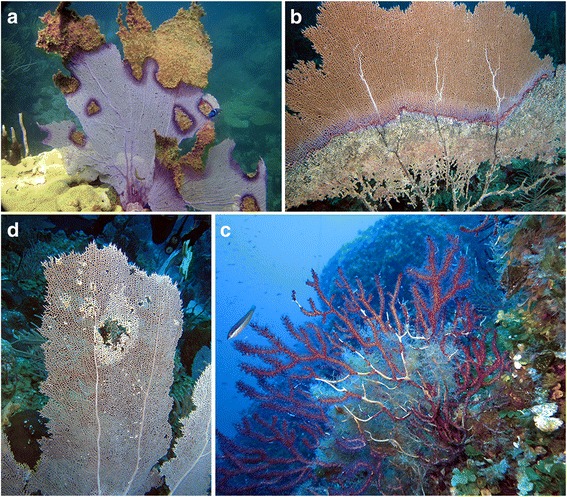
Octocoral diseases from the Caribbean and the Mediterranean Sea. a Aspergillosis, b Red Band Disease, c Octocoral Vibrio syndrome, and d Gorgonia Wasting Syndrome (photos a, b, and d by Ernesto Weil and photo c by Carlo Cerrano)
Fig. 4
Fig. 4
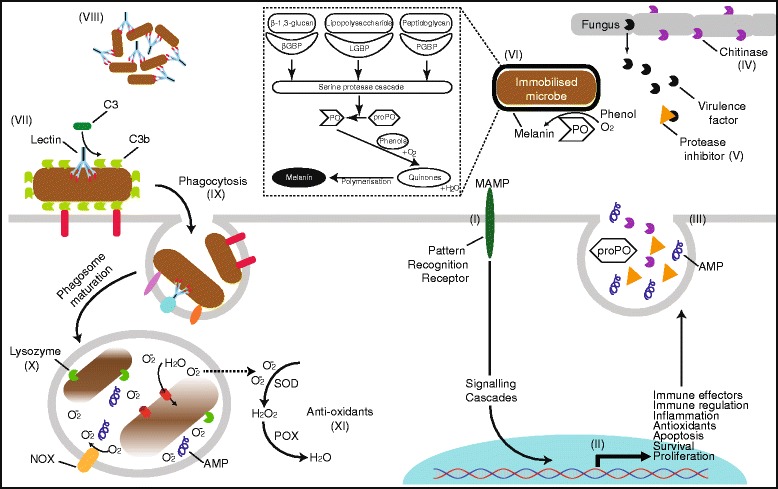
Current knowledge on the immune system of octocorals. (I) Microbe-associated molecular patterns (MAMP) are recognized by pattern recognition receptors (PRR), which subsequently activate signaling cascades that induce (II) expression of genes involved in the immune system. (III) Immune effector molecules are produced and secreted, including antimicrobial peptides (AMP). (IV) Chitinases degrade chitin, an important component of the cell wall of fungi. (V) The host also uses protease inhibitors to neutralize protease virulence factors secreted by pathogenic microbes. (VI) One of the main immune system components is the prophenoloxidase (proPO)-activating pathway. It is activated following the binding of MAMPs to their respective binding proteins (BP), leading to the activation of a protease cascade that ultimately cleaves proPO into PO. Subsequently, PO oxidizes phenolic compounds (e.g., dihydroxidephenylalanine) that undergo further non-enzymatic reactions to form a microbe-immobilizing barrier of melanin. Cytotoxic molecules are also formed during this process. Octocorals are also known to possess lectins, which can be used in (VII) the lectin-complement system that leads to the deposition of complement C3 on the target microbe, and/or to (VIII) aggregate microbes into large aggregates. Both systems facilitate (IX) the rapid phagocytosis of microbes following binding to lectin, C3-receptors or various scavenger PRRs. Once internalized, the phagosome matures and becomes microbicidal with (X) bacterial cell wall degrading lysozyme as well as AMPs and oxidative burst of reactive oxygen species (ROS). (XI) The ROS may be also damaging to the host cell and antioxidant enzymes, such as superoxide dismutase (SOD) and peroxidase (POX), are used to neutralize it
Fig. 5
Fig. 5
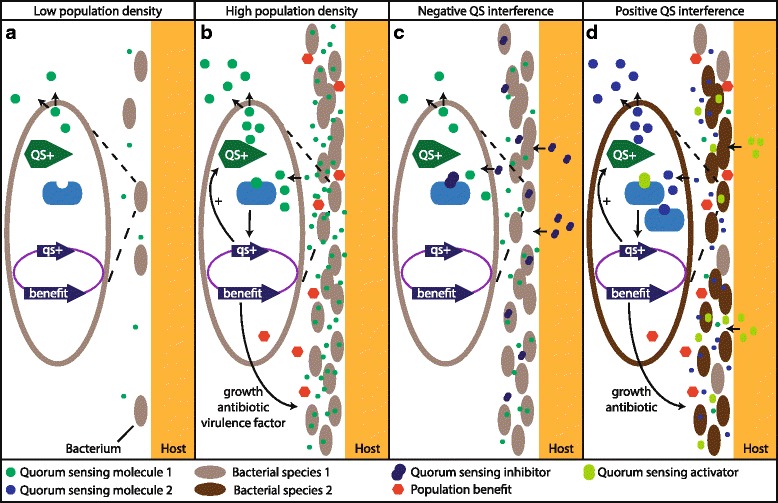
Quorum sensing and interference. a Bacteria produce quorum-sensing stimulating compounds (QS+), but due to low bacterial density and environmental conditions (e.g., diffusion, advection, degradation) the concentration does not reach levels sufficient to bind to the receptor. b At high population densities, the QS compounds reach sufficient levels to bind to its receptor leading to gene transcription and subsequently (1) increased production of QS+ signaling molecules and (2) population beneficial processes, such as cooperative growth and migration, secretion of antibiotics to reach effective concentrations for competition or in case of pathogens the production of virulence factors. cd Host organisms have the capacity to interfere with QS, possibly species specific. c By secreting QS inhibiting compounds, bacterial population benefits can be counteracted, thereby reducing bacterial growth and potentially inhibiting pathogen virulence. d Host-induced QS activation in specific bacterial species may provide a growth advantage, selecting for those species. A balance of negative and positive QS interference may allow the host to regulate its associated microbiota. Other than intended bacterial species may, however, cheat and benefit from QS by other species without investing in QS themselves

References

    1. McFadden CS, Sánchez JA, France SC. Molecular phylogenetic insights into the evolution of Octocorallia: a review. Integr Comp Biol. 2010;50(3):389–410. - PubMed
    1. Systematic list of valid octocoral genera. http://researcharchive.calacademy.org/research/izg/OCTOCLASS.htm. Accessed 12 Feb 2018.
    1. Ascione C. The art of coral: myth, history and manufacture from ancient times to the present. In: Cicogna F, Cattaneo-Vietti R, editors. Red coral in the Mediterranean sea: art, history and science. Rome: Ministero delle Risorse Agricole, Alimentari e Forestali; 1993. pp. 11–36.
    1. Pérez CD, de Moura Neves B, Cordeiro RT, Williams GC, Diversity CSD. Distribution of Octocorallia. In: Goffredo S, Dubinsky Z, editors. The Cnidaria, past, present and future: the world of Medusa and her sisters. Cham: Springer International Publishing; 2016. pp. 109–123.
    1. Yesson C, Taylor ML, Tittensor DP, Davies AJ, Guinotte J, Baco A, Black J, Hall-Spencer JM, Rogers AD. Global habitat suitability of cold-water octocorals. J Biogeogr. 2012;39(7):1278–1292.

Publication types

Substances

LinkOut - more resources