Associations Between Neuropsychological, Neurobehavioral and Emotional Functioning and Either Narcolepsy or Idiopathic Hypersomnia in Children and Adolescents
- PMID: 29609710
- PMCID: PMC5886444
- DOI: 10.5664/jcsm.7066
Associations Between Neuropsychological, Neurobehavioral and Emotional Functioning and Either Narcolepsy or Idiopathic Hypersomnia in Children and Adolescents
Abstract
Study objectives: Narcolepsy and idiopathic hypersomnia are chronic neurological sleep disorders characterized by hypersomnolence or excessive daytime sleepiness. This review aims to systematically examine the scientific literature on the associations between narcolepsy and idiopathic hypersomnia and their effect on intellectual functioning, academic achievement, behavior, and emotion.
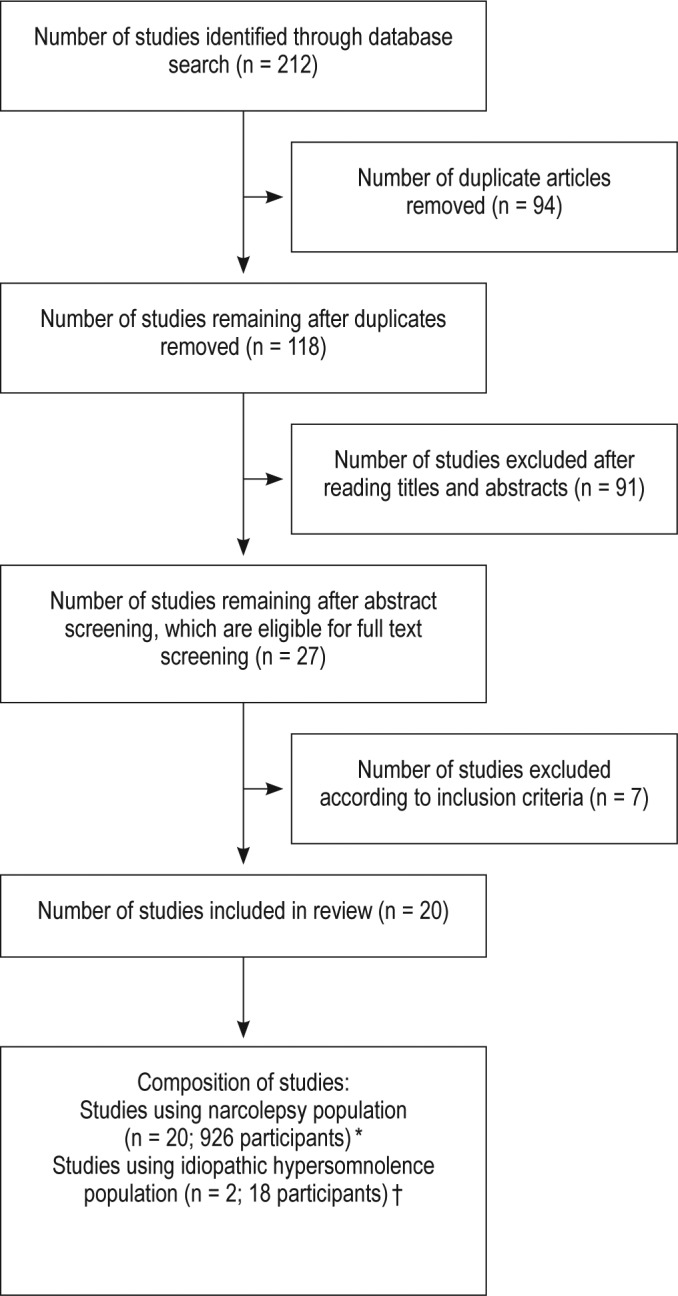
Methods: Published studies that examined those associations in children and adolescents were included. Studies in which children or adolescents received a clinical diagnosis, and in which the associated function was measured with at least one objective instrument were included. Twenty studies published between 1968 and 2017 were eligible for inclusion in this review.
Results: There does not appear to be a clear association between intellectual functioning and narcolepsy or idiopathic hypersomnia; however, limited research is an obstacle to obtaining generalizability. The variability in results from studies investigating associations between academic achievement and these two hypersomnolence disorders suggests that further research using standardized and validated assessment instruments is required to determine if there is an association. Behavior and emotion appear to be significantly affected by narcolepsy. Only two studies included populations of children and adolescents with idiopathic hypersomnia.
Conclusions: Further research using larger populations of children and adolescents with narcolepsy or idiopathic hypersomnia while utilizing standardized and validated instruments is required, because the effect of these conditions of hypersomnolence varies and is significant for each individual.
Keywords: academic achievement; behavior; emotion; excessive daytime sleepiness; hypersomnolence; idiopathic hypersomnolence; intellectual functioning; narcolepsy.
© 2018 American Academy of Sleep Medicine.
Figures
References
-
- Dewald JF, Meijer AM, Oort FJ, Kerkhof GA, Bogels SM. The influence of sleep quality, sleep duration and sleepiness on school performance in children and adolescents: A meta-analytic review. Sleep Med Rev. 2010;14(3):179–189. - PubMed
-
- Olaithe M, Nanthakumar S, Eastwood PR, Bucks RS. Cognitive and mood dysfunction in adult obstructive sleep apnoea (OSA): Implications for psychological research and practice. Translational Issues in Psychological Science. 2015;1(1):67–78.
-
- Dean B, Aguilar D, Shapiro CM, et al. Impaired health status, daily functioning, and work productivity in adults with excessive sleepiness. J Occup Environ Med. 2010;52(2):144–149. - PubMed
-
- American Academy of Sleep Medicine. International Classification of Sleep Disorders. 3rd ed. Darien, IL: American Academy of Sleep Medicine; 2014.
Publication types
MeSH terms
LinkOut - more resources
Full Text Sources
Other Literature Sources