Osteoimmunology
- PMID: 29610150
- PMCID: PMC6314075
- DOI: 10.1101/cshperspect.a031245
Osteoimmunology
Abstract
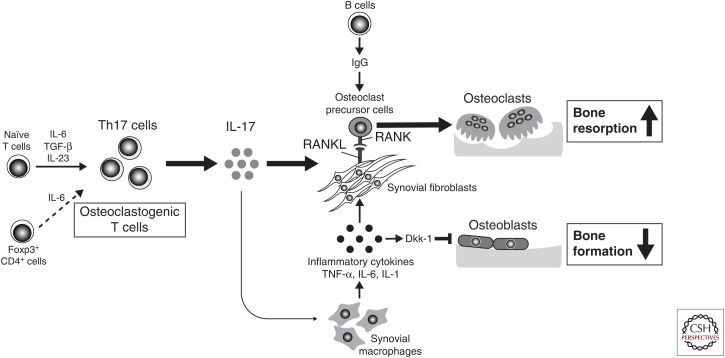
Bone is a crucial element of the skeletal-locomotor system, but also functions as an immunological organ that harbors hematopoietic stem cells (HSCs) and immune progenitor cells. Additionally, the skeletal and immune systems share a number of regulatory molecules, including cytokines and signaling molecules. Osteoimmunology was created as an interdisciplinary field to explore the shared molecules and interactions between the skeletal and immune systems. In particular, the importance of an inseparable link between the two systems has been highlighted by studies on the pathogenesis of rheumatoid arthritis (RA), in which pathogenic helper T cells induce the progressive destruction of multiple joints through aberrant expression of receptor activator of nuclear factor (NF)-κB ligand (RANKL). The conceptual bridge of osteoimmunology provides not only a novel framework for understanding these biological systems but also a molecular basis for the development of therapeutic approaches for diseases of bone and/or the immune system.
Copyright © 2019 Cold Spring Harbor Laboratory Press; all rights reserved.
Figures
References
-
- Adams GB, Chabner KT, Alley IR, Olson DP, Szczepiorkowski ZM, Poznansky MC, Kos CH, Pollak MR, Brown EM, Scadden DT. 2006. Stem cell engraftment at the endosteal niche is specified by the calcium-sensing receptor. Nature 439: 599–603. - PubMed
-
- Akiyama T, Shimo Y, Yanai H, Qin J, Ohshima D, Maruyama Y, Asaumi Y, Kitazawa J, Takayanagi H, Penninger JM, et al. 2008. The tumor necrosis factor family receptors RANK and CD40 cooperatively establish the thymic medullary microenvironment and self-tolerance. Immunity 29: 423–437. - PubMed
-
- Anderson G, Takahama Y. 2012. Thymic epithelial cells: Working class heroes for T cell development and repertoire selection. Trends Immunol 33: 256–263. - PubMed
-
- Anderson DM, Maraskovsky E, Billingsley WL, Dougall WC, Tometsko ME, Roux ER, Teepe MC, DuBose RF, Cosman D, Galibert L. 1997. A homologue of the TNF receptor and its ligand enhance T-cell growth and dendritic-cell function. Nature 390: 175–179. - PubMed
Publication types
MeSH terms
Substances
LinkOut - more resources
Full Text Sources
Other Literature Sources
Medical