. 2018 Jul;10(7):704-714.
doi: 10.1038/s41557-018-0033-8. Epub 2018 Apr 2.

Second-generation DNA-templated macrocycle libraries for the discovery of bioactive small molecules

Affiliations

Second-generation DNA-templated macrocycle libraries for the discovery of bioactive small molecules

Dmitry L Usanov et al. Nat Chem. 2018 Jul.

Erratum in

Abstract

DNA-encoded libraries have emerged as a widely used resource for the discovery of bioactive small molecules, and offer substantial advantages compared with conventional small-molecule libraries. Here, we have developed and streamlined multiple fundamental aspects of DNA-encoded and DNA-templated library synthesis methodology, including computational identification and experimental validation of a 20 × 20 × 20 × 80 set of orthogonal codons, chemical and computational tools for enhancing the structural diversity and drug-likeness of library members, a highly efficient polymerase-mediated template library assembly strategy, and library isolation and purification methods. We have integrated these improved methods to produce a second-generation DNA-templated library of 256,000 small-molecule macrocycles with improved drug-like physical properties. In vitro selection of this library for insulin-degrading enzyme affinity resulted in novel insulin-degrading enzyme inhibitors, including one of unusual potency and novel macrocycle stereochemistry (IC50 = 40 nM). Collectively, these developments enable DNA-templated small-molecule libraries to serve as more powerful, accessible, streamlined and cost-effective tools for bioactive small-molecule discovery.


Conflict of interest statement

Competing financial interests

The authors declare the following competing financial interest(s): the authors are inventors on patents and patent applications describing DNA-templated synthesis methods and applications.

Figures
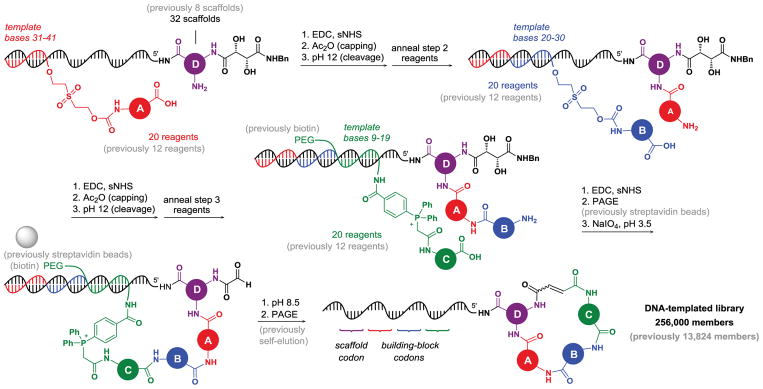
Figure 1
Figure 1. DNA-templated macrocycle library synthesis scheme
Key aspects of the previously described first-generation (grey) and second-generation (black, color) library syntheses are shown. In the first step, scaffold building block D attached to 5′ end of the template undergoes coupling with building block A, which is initially attached to the corresponding “anticodon” DNA via a cleavable bis(2-(succinimidooxycarbonyloxy)ethyl) sulfone (BSOCOES) linker. Unreacted templates are capped with acetic anhydride. The linker is cleaved at high pH, liberating the amino group of building block A, which subsequently undergoes the step 2 coupling with building block B followed by capping and linker cleavage. After coupling to biotin- or PEG-labeled Wittig reagent building block C, pulldown with streptavidin-tagged beads (first-generation procedure) or gel purification (second-generation procedure) enables isolation of those templates that successfully reacted at all three steps. Periodate treatment cleaves the diol fragment of the tartaramide moiety to furnish a glyoxyloyl group, which undergoes Wittig cyclization under mildly basic conditions. Successfully cyclized products are eluted off the beads on cyclization (first-generation procedure) or are purified on a polyacrylamide gel (second-generation procedure).
Figure 2
Figure 2. Identification of an orthogonal codon set for second-generation DNA-templated libraries
a, General architecture of second-generation template libraries. Consecutive Ns do not represent randomized sequences but indicate the location of individual codons. b, The coding system for the second-generation library. c, Proposed model of DNA templates used to calculate an orthogonal codon set. d, The ideal outcome of DNA-templated synthesis codon reactivity tables (1). Numbers represent apparent conversions of reactions between the corresponding DNA templates (horizontal) and DNA-linked reagents (vertical). Green and purple fields represent apparent conversions and annealing factors, respectively, that are acceptable because they correspond to mismatched reactivity below the 7% threshold. e, Deconvolution approach based on the model of additive annealing factors (7): experimentally obtained reactivity tables (3) are converted into anticipated affinity tables (4), which are refined with additional DTS reactions (5). Geometrical shapes represent various codons and anticodons; equations 2 and 5 denote apparent conversions of the corresponding DTS reactions (α, β, γ). See the Supplementary Information for details of the deconvolution process leading to the final codon set.
Figure 3
Figure 3. Building blocks for the second-generation DNA-templated macrocycle library
a, Synthetic routes enabling incorporation of new scaffold structures into DNA templates, exemplified with scaffolds 4I and 4L. b, Scaffolds validated and used in the second-generation library of macrocycles. Red and green spheres represent connectivity with building blocks 1 and 3, respectively. Scaffolds 4A4H (dashed boxes) were used in the first-generation library. c, Iteratively selected building blocks maximizing overlap of the library with Kihlberg’s parameter space for orally bioavailable molecules, .
Figure 4
Figure 4. Distribution of physical parameters among library members from the second-generation macrocycle library (above the X-axis) and the first-generation library (below the X-axis)
Colors represents values that lie within (blue) or outside (red) desirable “beyond rule-of-five” (bRo5) parameter space described by Kihlberg and coworkers, .
Figure 5
Figure 5. Approaches to the assembly of DNA template libraries
a, Assembly of the first-generation library of DNA templates. For each scaffold codon, a sub-library of templates was previously assembled via splint ligation of phosphorylated 33- or 34-mers (generated on a DNA synthesizer in a split-pool manner) and 21-mers chemically modified with the scaffold amino acid. b, Modified version of the splint ligation assembly for the second-generation DTS library. Increasing the number of ligated fragments from two to three greatly reduces the number of required oligonucleotide syntheses. c, Template library assembly strategy via preparative enzymatic primer extensions. An 8,000-membered library of templates with four deoxyinosines at the scaffold codon is prepared by split-pool oligonucleotide synthesis. Each primer extension with one of 32 poly-dA-tagged primers followed by strand separation via PAGE yields a heavy strand sub-library with an individual scaffold codon sequence. Another round of primer extensions with the corresponding chemically modified primers followed by strand separation results in 32 sub-libraries of templates, which are combined to obtain a 256,000-membered template library. A shortened method involves direct preparation of the heavy strands by split-pool oligonucleotide synthesis. Methods for template assembly are described in detail in Supplementary Fig. 8.
Figure 6
Figure 6. In vitro selection of the 256,000-membered DNA-templated macrocycle library for binding to insulin-degrading enzyme (IDE)
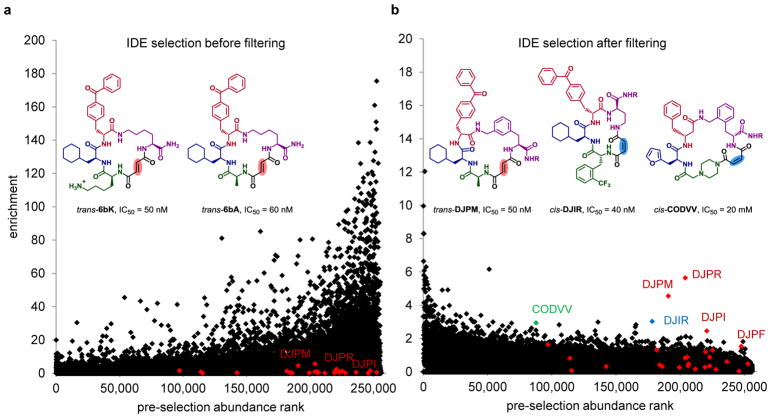
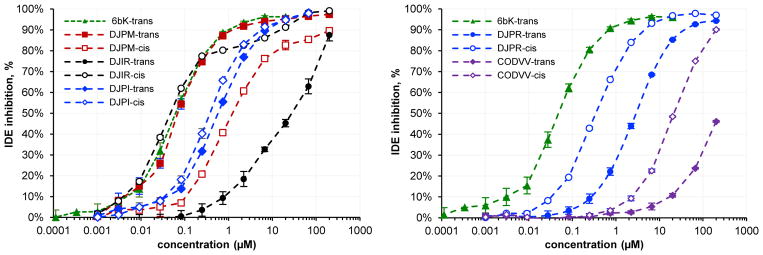
a, b, Results of the selection against IDE before (a) and after (b) computational filtering of nine structurally similar hydrophobic building blocks (1J, 1L, 1M, 1N, 1T, 3E, 3H, 3L, 3R) that were unusually represented among hits across multiple unrelated selections. Removal of the substantial non-specific noise revealed an enriched DJP* series of macrocycles. Compounds trans-DJPM and cis-DJIR were chemically synthesized in a DNA-free form and were found to be equipotent to the structurally similar trans-6bK and trans-6bA macrocycles developed from the first-generation DNA-templated library. The identified hits also included unrelated CODVV macrocycles of a new structural family. R = (CH2)2O(CH2)2NH2. c, Concentration-dependent IDE inhibition profiles of macrocyclic hits determined by fluorogenic decapeptide cleavage assay (see the Supplementary Information). Error bars reflect to standard error of the mean. The plots for a cis- and a trans-isomer of each hit are of the same color and marker shape, with filled markers for trans-isomers, and empty markers for cis-isomers). Whereas DJPM trans isomers were more potent than cis isomers), the opposite trend was observed for other tested hits.
Figure 6
Figure 6. In vitro selection of the 256,000-membered DNA-templated macrocycle library for binding to insulin-degrading enzyme (IDE)
a, b, Results of the selection against IDE before (a) and after (b) computational filtering of nine structurally similar hydrophobic building blocks (1J, 1L, 1M, 1N, 1T, 3E, 3H, 3L, 3R) that were unusually represented among hits across multiple unrelated selections. Removal of the substantial non-specific noise revealed an enriched DJP* series of macrocycles. Compounds trans-DJPM and cis-DJIR were chemically synthesized in a DNA-free form and were found to be equipotent to the structurally similar trans-6bK and trans-6bA macrocycles developed from the first-generation DNA-templated library. The identified hits also included unrelated CODVV macrocycles of a new structural family. R = (CH2)2O(CH2)2NH2. c, Concentration-dependent IDE inhibition profiles of macrocyclic hits determined by fluorogenic decapeptide cleavage assay (see the Supplementary Information). Error bars reflect to standard error of the mean. The plots for a cis- and a trans-isomer of each hit are of the same color and marker shape, with filled markers for trans-isomers, and empty markers for cis-isomers). Whereas DJPM trans isomers were more potent than cis isomers), the opposite trend was observed for other tested hits.

References

    1. Hüser J, Mannhold R, Kubinyi H, Folkers G. High-throughput screening in drug discovery. Wiley; 2006.
    1. Macarron R, et al. Impact of high-throughput screening in biomedical research. Nat Rev Drug Discovery. 2011;10:188–195. - PubMed
    1. Dandapani S, Marcaurelle LA. Grand Challenge commentary: accessing new chemical space for ‘undruggable’ targets. Nat Chem Biol. 2010;6:861–863. - PubMed
    1. Brenner S, Lerner RA. Encoded combinatorial chemistry. Proc Natl Acad Sci USA. 1992;89:5381–5383. - PMC - PubMed
    1. Gartner ZJ, Liu DR. The generality of DNA-templated synthesis as a basis for evolving non-natural small molecules. J Am Chem Soc. 2001;123:6961–6963. - PMC - PubMed

Publication types