. 2018 Mar 30:6:e4377.
doi: 10.7717/peerj.4377. eCollection 2018.

Acidification increases abundances of Vibrionales and Planctomycetia associated to a seaweed-grazer system: potential consequences for disease and prey digestion efficiency

Affiliations

Acidification increases abundances of Vibrionales and Planctomycetia associated to a seaweed-grazer system: potential consequences for disease and prey digestion efficiency

Tania Aires et al. PeerJ. .

Abstract

Ocean acidification significantly affects marine organisms in several ways, with complex interactions. Seaweeds might benefit from rising CO2 through increased photosynthesis and carbon acquisition, with subsequent higher growth rates. However, changes in seaweed chemistry due to increased CO2 may change the nutritional quality of tissue for grazers. In addition, organisms live in close association with a diverse microbiota, which can also be influenced by environmental changes, with feedback effects. As gut microbiomes are often linked to diet, changes in seaweed characteristics and associated microbiome can affect the gut microbiome of the grazer, with possible fitness consequences. In this study, we experimentally investigated the effects of acidification on the microbiome of the invasive brown seaweed Sargassum muticum and a native isopod consumer Synisoma nadejda. Both were exposed to ambient CO2 conditions (380 ppm, pH 8.16) and an acidification treatment (1,000 ppm, pH 7.86) for three weeks. Microbiome diversity and composition were determined using high-throughput sequencing of the variable regions V5-7 of 16S rRNA. We anticipated that as a result of acidification, the seaweed-associated bacterial community would change, leading to further changes in the gut microbiome of grazers. However, no significant effects of elevated CO2 on the overall bacterial community structure and composition were revealed in the seaweed. In contrast, significant changes were observed in the bacterial community of the grazer gut. Although the bacterial community of S. muticum as whole did not change, Oceanospirillales and Vibrionales (mainly Pseudoalteromonas) significantly increased their abundance in acidified conditions. The former, which uses organic matter compounds as its main source, may have opportunistically taken advantage of the possible increase of the C/N ratio in the seaweed under acidified conditions. Pseudoalteromonas, commonly associated to diseased seaweeds, suggesting that acidification may facilitate opportunistic/pathogenic bacteria. In the gut of S. nadejda, the bacterial genus Planctomycetia increased abundance under elevated CO2. This shift might be associated to changes in food (S. muticum) quality under acidification. Planctomycetia are slow-acting decomposers of algal polymers that could be providing the isopod with an elevated algal digestion and availability of inorganic compounds to compensate the shifted C/N ratio under acidification in their food. In conclusion, our results indicate that even after only three weeks of acidified conditions, bacterial communities associated to ungrazed seaweed and to an isopod grazer show specific, differential shifts in associated bacterial community. These have potential consequences for seaweed health (as shown in corals) and isopod food digestion. The observed changes in the gut microbiome of the grazer seem to reflect changes in the seaweed chemistry rather than its microbial composition.

Keywords: Algae microbiomes; Grazer microbiomes; Invasive seaweeds; Metabarcoding; Ocean acidification; Sargassum muticum; Synisoma nadejda.


Conflict of interest statement

The authors declare there are no competing interests.

Figures
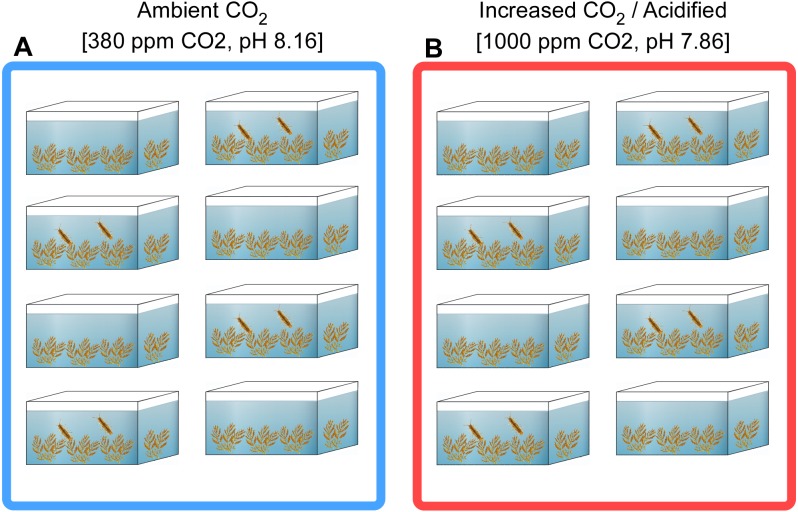
Figure 1
Figure 1. Schematic representation of the mesocosms experiment.
(A) Ambient (380 ppm) and (B) acidified (1,000 ppm) conditions each with four 3 L experimental units only containing 1 g wet weight (WW) S. muticum and four 3 L experimental units containing 1 g WW S. muticum along with the grazer S. nadejda were placed randomly in each CO2 treatment. Each unit represented a replicate from which sample(s) (seaweed or seaweed and grazer) were taken.
Figure 2
Figure 2. Community structure.
Plot of canonical analysis of principal coordinates (CAP) based on Bray–Curtis distances calculated on square-root transformed bacterial abundances, showing the axes that best discriminate the bacterial assemblages across CO2 levels (blue-ambient versus red-acidified), grazing by S. nadejda on S. muticum (open squares-grazed seaweed vs filled squares-non-grazed seaweed) and the gut of the isopod on a diet of S. muticum (circles).
Figure 3
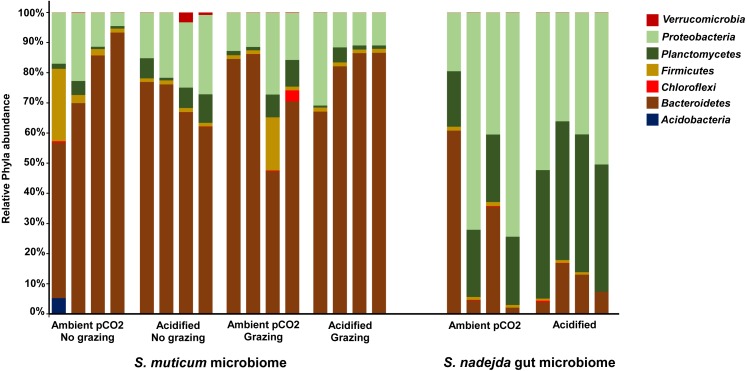
Figure 3. Host and treatment effects on associated bacteria phyla.
Relative abundance and distribution of the bacteria phyla associated to the brown seaweed Sargassum muticum, without (No grazing) and with (grazing) Synisoma nadejda isopods, and the gut of the isopod after three weeks on a Sargassum muticum diet, under ambient (380 ppm) and elevated/acidified (1,000 ppm) CO2 conditions.
Figure 4
Figure 4. Relative abundance of the genera belonging to the main bacterial phyla.
(A) Bacteroidetes, (B) Proteobacteria, and (C) Planctomycetes, associated with the brown seaweed Sargassum muticum grazed by Synisoma nadejda isopods (left side), and the gut microbiome of the isopod on a Sargassum muticum diet (right side), after three weeks under ambient (380 ppm; −CO2) and elevated/acidified (1,000 ppm; +CO2) CO2 conditions.
Figure 5
Figure 5. Mean relative abundances of bacterial classes, and respective orders (A, Flavobacteriales and Ricketsiales; B, Bdellovibrionales and Oceanospirillales; C, Acidithiobacillales; D, Alteromonadales; E, Non-ID SJA-4 and AKAU3564 Phycisphaerae), significantly more abundant in either grazed Sargassum muticum or the gut of Synisoma nadejda.
After three weeks under ambient (380 ppm) and elevated/acidified (1,000 ppm) CO2 conditions. Alpha = 0.05, error bars show standard error per treatment (n = 4).
Figure 6
Figure 6. Core communities.
Venn diagram representing the number of bacterial genera (present in at least 75% of samples) shared between the different CO2 treatments (ambient CO2− ↓ CO2; elevated/acidified CO2− ↑ CO2) and associated to grazed Sargassum muticum (Sm + G), and the gut microbiome of the isopod Synisoma nadejda on a Sargassum muticum diet. The bar plots show the distribution of Phyla of selected intersections.
Figure 7
Figure 7. Mean relative abundances of associated bacterial orders.
(A and B) Sargassum muticum under grazing/non grazing influence after three weeks under ambient (380 ppm) and elevated/acidified (1,000 ppm) CO2 conditions and (C–E) grazed Sargassum muticum and the gut of Synisoma nadejda after three weeks under ambient (380 ppm) and elevated/acidified (1,000 ppm) CO2 conditions, that responded to acidification, but for which a significant interaction between acidification and type of sample (seaweed or grazer gut) was observed. Alpha = 0.05, error bars show standard error per treatment (n = 4).

References

    1. Aires T, Moalic Y, Serrao EA, Arnaud-Haond S. Hologenome theory supported by co-occurrence networks of species-specific bacterial communities in siphonous algae (Caulerpa) FEMS Microbiology Ecology. 2015;91 doi: 10.1093/femsec/fiv067. fiv067. - DOI - PubMed
    1. Aires T, Muyzer G, Serrão EA, Engelen AH. Unraveling seaweeds bacteriomes—from field site to computer screen. In: Charrier B, Wichard T, Reddy CRK, editors. Protocols for macroalgae research. Taylor & Francis Group; Oxfordshire: 2018. pp. 97–112.
    1. Aires T, Serrão EA, Engelen AH. Host and environmental specificity in bacterial communities associated to two highly invasive marine species (Genus Asparagopsis) Frontiers in Microbiology. 2016;7:559. doi: 10.3389/fmicb.2016.00559. - DOI - PMC - PubMed
    1. Asnaghi V, Chiantore M, Mangialajo L, Gazeau F, Francour P, Alliouane S, Gattuso JP. Cascading effects of ocean acidification in a rocky subtidal community. PLOS ONE. 2013;8:e61978. doi: 10.1371/journal.pone.0061978. - DOI - PMC - PubMed
    1. Asplund ME, Baden SP, Russ S, Ellis RP, Gong N, Hernroth BE. Ocean acidification and host-pathogen interactions: blue mussels, Mytilus edulis, encountering Vibrio tubiashii. Environmental Microbiology. 2014;16:1029–1039. doi: 10.1111/1462-2920.12307. - DOI - PubMed

LinkOut - more resources