


Quantifying the Effects of Different Treadmill Training Speeds and Durations on the Health of Rat Knee Joints
- PMID: 29610999
- PMCID: PMC5880791
- DOI: 10.1186/s40798-018-0127-2
Quantifying the Effects of Different Treadmill Training Speeds and Durations on the Health of Rat Knee Joints
Abstract
Background: Walking and running provide cyclical loading to the knee which is thought essential for joint health within a physiological window. However, exercising outside the physiological window, e.g. excessive cyclical loading, may produce loading conditions that could be detrimental to joint health and lead to injury and, ultimately, osteoarthritis. The purpose of this study was to assess the effects of a stepwise increase in speed and duration of treadmill training on knee joint integrity and to identify the potential threshold for joint damage.
Methods: Twenty-four Sprague-Dawley rats were randomized into four groups: no exercise, moderate duration, high duration, and extra high duration treadmill exercise. The treadmill training consisted of a 12-week progressive program. Following the intervention period, histologic serial sections of the left knee were graded using a modified Mankin Histology Scoring System. Mechanical testing of the tibial plateau cartilage and RT-qPCR analysis of mRNA from the fat pad, patellar tendon, and synovium were performed for the right knee. Kruskal-Wallis testing was used to assess differences between groups for all variables.
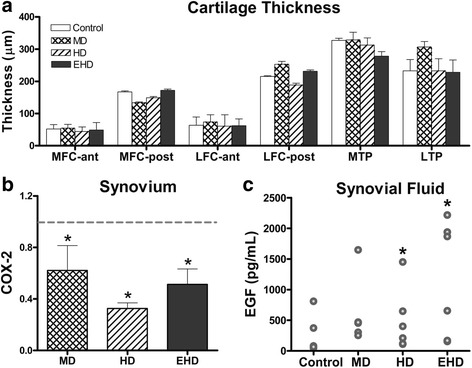
Results: There were no differences in cartilage integrity or mechanical properties between groups and no differences in mRNA from the fat pad and patellar tendon. However, COX-2 mRNA levels in the synovium were lower for all animals in the exercise intervention groups compared to those in the no exercise group.
Conclusions: Therefore, these exercise protocols did not exceed the joint physiological window and can likely be used safely in aerobic exercise intervention studies without affecting knee joint health.
Keywords: Aerobic exercise; Animal model; Cyclical loading; Histology; Joint health; Osteoarthritis.
Conflict of interest statement
Ethics Approval
All experiments were approved by the University of Calgary Life and Environmental Sciences Animal Care Committee (AC12-0139), and all methods were conducted in accordance with the animal welfare regulations and guidelines at the University of Calgary.
Consent for Publication
Not applicable.
Competing Interests
Jaqueline Lourdes Rios, Kevin Rudi Boldt, James William Mather, Ruth Anne Seerattan, David Arthur Hart, and Walter Herzog declare that they have no conflict of interest.
Publisher’s Note
Springer Nature remains neutral with regard to jurisdictional claims in published maps and institutional affiliations.
Figures

References
-
- Albert SL, Petrucelli RJ. Medicine: an illustrated history: Abradale Press/Abrams; 1978.
-
- Bassi D, Mendes RG, Arakelian VM, Caruso FC, Cabiddu R, Junior JC, et al. Potential effects on cardiorespiratory and metabolic status after a concurrent strength and endurance training program in diabetes patients—a randomized controlled trial. Sports Med Open. 2015;2:31. doi: 10.1186/s40798-016-0052-1. - DOI - PMC - PubMed
Grants and funding
LinkOut - more resources
Full Text Sources
Other Literature Sources
Research Materials
