Principles of Genetic Counseling in the Era of Next-Generation Sequencing
- PMID: 29611378
- PMCID: PMC5895857
- DOI: 10.3343/alm.2018.38.4.291
Principles of Genetic Counseling in the Era of Next-Generation Sequencing
Abstract
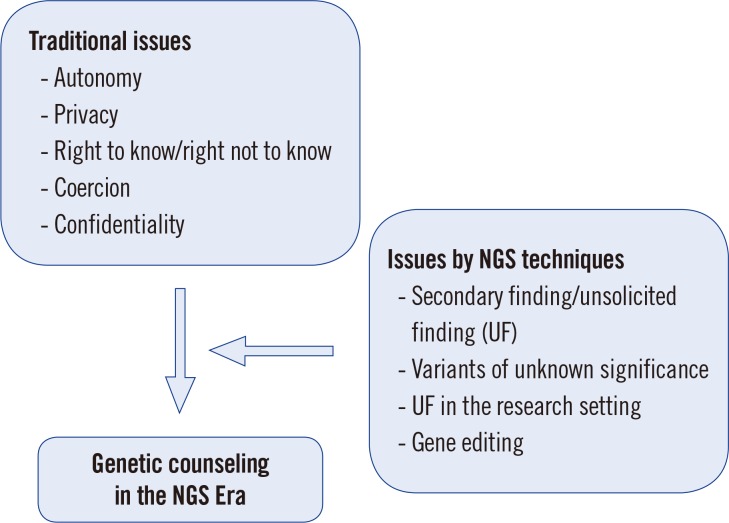
Traditional genetic counseling has focused on the target gene and its natural progress with respect to disease risk. Next-generation sequencing (NGS) can produce information on several genetic variants simultaneously, with different functions and consequences for each. Accordingly, determining the status of the patient or consultant and interpreting sequencing results from many genes can largely increase the complexity of genetic counseling. Moreover, the current environment of big data that can be readily shared via the internet and a ubiquitous network provides many different avenues for which a consultant must handle the traditional principle of genetic counseling in different ways. Thus, further consideration and rethinking of genetic counseling principles are necessary in the era of NGS. In this review, we discuss several aspects of genetic counseling that one can encounter when faced with NGS data.
Keywords: Genetic counseling; Incidental finding; Next-generation sequencing.
© The Korean Society for Laboratory Medicine.
Conflict of interest statement
No potential conflicts of interest relevant to this article were reported.
Figures
References
-
- Harper P. Practical genetic counselling. 5th ed. Woburn, MA: Butterworth-Heinemann; 1998. pp. 3–4.
-
- Kalia SS, Adelman K, Bale SJ, Chung WK, Eng C, Evans JP, et al. Recommendations for reporting of secondary findings in clinical exome and genome sequencing, 2016 update (ACMG SF v2.0): a policy statement of the American College of Medical Genetics and Genomics. Genet Med. 2017;19:249–255. - PubMed
-
- Park KS, Cho EY, Nam SJ, Ki CS, Kim JW. Comparative analysis of BRCA1 and BRCA2 variants of uncertain significance in patients with breast cancer: a multifactorial probability-based model versus ACMG standards and guidelines for interpreting sequence variants. Genet Med. 2016;18:1250–1257. - PubMed
Publication types
MeSH terms
LinkOut - more resources
Full Text Sources
Other Literature Sources
Medical