Trends in Blood Pressure and Prevalence of Hypertension in Korean Adults Based on the 1998-2014 KNHANES
- PMID: 29611397
- PMCID: PMC5889987
- DOI: 10.3349/ymj.2018.59.3.356
Trends in Blood Pressure and Prevalence of Hypertension in Korean Adults Based on the 1998-2014 KNHANES
Abstract
Purpose: To investigate trends in blood pressure (BP) and hypertension prevalence in Korea.
Materials and methods: Based on the Korean National Health and Nutrition Examination Survey (KNHANES) I (1998), II (2001), III (2005), IV (2007-2009), V (2010-2012), and VI (2013-2014), 56077 participants (23974 men and 32103 women) were included.
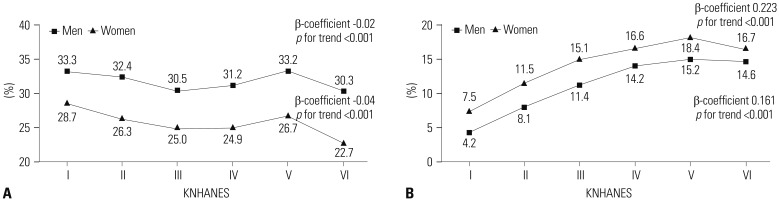
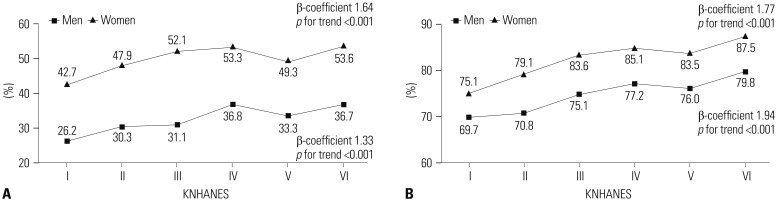
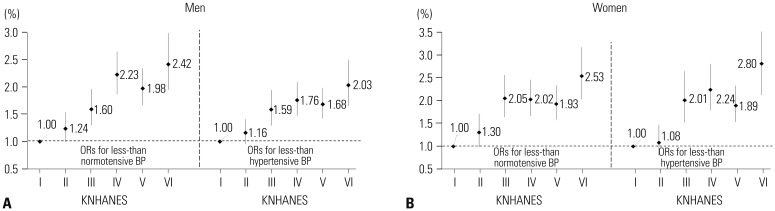
Results: Mean systolic BP (SBP) and diastolic BP (DBP) decreased in both sexes (male SBP: 128.1 to 120.2 mm Hg, male DBP: 82.0 to 78.5 mm Hg; female SBP: 125.7 to 116.0 mm Hg and female DBP: 77.4 to 73.2 mm Hg from the KNHANES I-VI). The age-standardized prevalence of hypertension was significantly decreased in both sexes (male; 33.3% to 30.3%, female; 28.7% to 22.7%, all p for trend <0.001). Regardless of taking anti-hypertensive medication or not, SBP and DBP declined universally in both sexes. Compared to the KNHANES I, the odds ratios (95% confidence intervals) of the KNHANES II to VI for less-than-normotensive and less-than-hypertensive BP increased in both sexes.
Conclusion: Mean BP levels in both sexes and hypertension prevalence showed downward trends during the 16-year period.
Keywords: Trend; blood pressure; epidemiology; hypertension; prevalence.
© Copyright: Yonsei University College of Medicine 2018.
Conflict of interest statement
The authors have no financial conflicts of interest.
Figures
References
-
- James PA, Oparil S, Carter BL, Cushman WC, Dennison-Himmelfarb C, Handler J, et al. 2014 evidence-based guideline for the management of high blood pressure in adults: report from the panel members appointed to the Eighth Joint National Committee (JNC 8) JAMA. 2014;311:507–520. - PubMed
-
- Writing Group Members. Mozaffarian D, Benjamin EJ, Go AS, Arnett DK, Blaha MJ, Cushman M, et al. Executive summary: heart disease and stroke statistics--2016 update: a report from the American Heart Association. Circulation. 2016;133:447–454. - PubMed
-
- Korea Centers for Disease Control and Prevention. Korea Health Statistics 2014: Korea National Health and Nutrition Examination Survey (KNHANES VI-2) Ministry of Health and Welfare; 2015.
-
- Kearney PM, Whelton M, Reynolds K, Muntner P, Whelton PK, He J. Global burden of hypertension: analysis of worldwide data. Lancet. 2005;365:217–223. - PubMed
-
- Kim HC, Nam CM, Jee SH, Suh I. Comparison of blood pressure-associated risk of intracerebral hemorrhage and subarachnoid hemorrhage: Korea Medical Insurance Corporation study. Hypertension. 2005;46:393–397. - PubMed
MeSH terms
Substances
LinkOut - more resources
Full Text Sources
Other Literature Sources
Medical