


Identification of HLA-DRB1 association to adalimumab immunogenicity
- PMID: 29614084
- PMCID: PMC5882140
- DOI: 10.1371/journal.pone.0195325
Identification of HLA-DRB1 association to adalimumab immunogenicity
Abstract
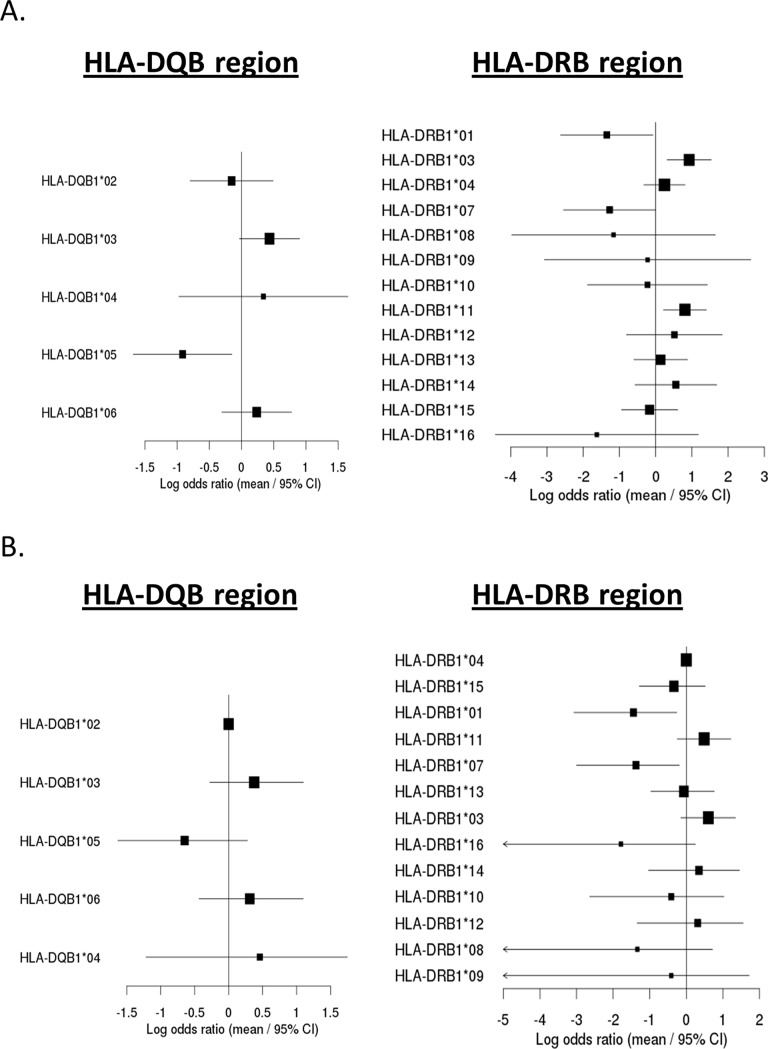
Anti-drug antibody formation occurs with most biological agents across disease states, but the mechanism by which they are formed is unknown. The formation of anti-drug antibodies to adalimumab (AAA) may decrease its therapeutic effects in some patients. HLA alleles have been reported to be associated with autoantibody formation against interferons and other TNF inhibitors, but not adalimumab. We analyzed samples from 634 subjects with either rheumatoid arthritis (RA) or hidradenitis suppurativa (HS): 37 subjects (17 RA and 20 HS) developed AAA (AAA+) during adalimumab treatment and 597 subjects (348 RA, 249 HS) did not develop AAA (AAA-) during the clinical trials. Using next-generation sequencing-based HLA typing, we identified three protective HLA alleles (HLA-DQB1*05, HLA-DRB1*01,and HLA-DRB1*07) that were less prevalent in AAA+ than AAA-subjects (ORs: 0.4, 0.25 and 0.28, respectively; and P values: 0.012, 0.012 and 0.018, respectively) and two risk HLA alleles (HLA-DRB1*03 and HLA-DRB1*011) that were more abundant in AAA+ than AAA-subjects (ORs: 2.52, and 2.64, respectively; and P values: 0.006 and 0.019). Similar to the finding of Billiet et al. who found that carriage of the HLA-DRB1*03 allele was more prevalent in those with anti-infliximab antibodies (OR = 3.6, p = 0.002, 95% CI: [1.5,8.6]).), we found HLA-DRB1*03 allele was also more prevalent in anti-adalimumab positive (OR = 2.52, p = 0.006, 95% CI: [1.37,4.63]). The results suggest that specific HLA alleles may play a key role in developing AAAs in RA and HS patients treated with adalimumab.
Conflict of interest statement
Figures
References
-
- Nazary M, Van Der Zee HH, Prens EP, Folkerts G, Boer J. Pathogenesis and pharmacotherapy of Hidradenitis suppurativa. European Journal of Pharmacology. 2011. pp. 1–8. doi: 10.1016/j.ejphar.2011.08.047 - DOI - PubMed
-
- Van Der Zee HH, De Ruiter L, Van Den Broecke DG, Dik WA, Laman JD, Prens EP. Elevated levels of tumour necrosis factor (TNF)-α, interleukin (IL)-1β and IL-10 in hidradenitis suppurativa skin: A rationale for targeting TNF- α and IL-1β Br J Dermatol. 2011;164: 1292–1298. doi: 10.1111/j.1365-2133.2011.10254.x - DOI - PubMed
-
- Kimball AB, Okun MM, Williams DA, Gottlieb AB, Papp KA, Zouboulis CC, et al. Two Phase 3 Trials of Adalimumab for Hidradenitis Suppurativa. N Engl J Med. 2016;375: 422–434. doi: 10.1056/NEJMoa1504370 - DOI - PubMed
-
- Schaeverbeke T, Truchetet ME, Kostine M, Barnetche T, Bannwarth B, Richez C. Immunogenicity of biologic agents in rheumatoid arthritis patients: Lessons for clinical practice. Rheumatology (United Kingdom). 2015. pp. 210–220. doi: 10.1093/rheumatology/kev277 - DOI - PubMed
-
- Garces S, Demengeot J, Benito-Garcia E. The immunogenicity of anti-TNF therapy in immune-mediated inflammatory diseases: a systematic review of the literature with a meta-analysis. Ann Rheum Dis. 2012; annrheumdis-2012-202220-. doi: 10.1136/annrheumdis-2012-202220 - DOI - PubMed
Publication types
MeSH terms
Substances
LinkOut - more resources
Full Text Sources
Other Literature Sources
Research Materials
