


Association Between Obesity and Weight Change and Risk of Diverticulitis in Women
- PMID: 29614301
- PMCID: PMC6035062
- DOI: 10.1053/j.gastro.2018.03.057
Association Between Obesity and Weight Change and Risk of Diverticulitis in Women
Abstract
Background & aims: There is little evidence that adiposity associates with diverticulitis, especially among women. We conducted a comprehensive evaluation of obesity, weight change, and incidence of diverticulitis in a large cohort of women.
Methods: We conducted a prospective cohort study of 46,079 women enrolled in the Nurses' Health Study who were 61-89 years old and free of diverticulitis, diverticular bleeding, cancers, or inflammatory bowel disease at baseline (in 2008). We used Cox proportional hazards models to examine the associations among risk of incident diverticulitis and body mass index (BMI), waist circumference, waist to hip ratio, and weight change from age 18 years to the present. The primary end point was first incident diverticulitis requiring antibiotic therapy or hospitalization.
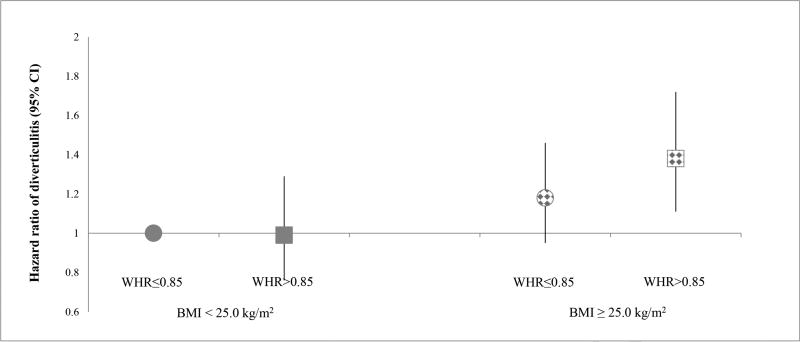
Results: We documented 1084 incident cases of diverticulitis over 6 years of follow-up, encompassing 248,001 person-years. After adjustment for other risk factors, women with a BMI ≥35.0 kg/m2 had a hazard ratio for diverticulitis of 1.42 (95% confidence interval [CI], 1.08-1.85) compared to women with a BMI <22.5 kg/m2. Compared to women in the lowest quintile, the multivariable hazard ratios among women in the highest quintile were 1.35 (95% CI, 1.02-1.78) for waist circumference and 1.40 (95% CI, 1.07-1.84) for waist to hip ratio; these associations were attenuated with further adjustment for BMI. Compared to women maintaining weight from age 18 years to the present, those who gained ≥20 kg had a 73% increased risk of diverticulitis (95% CI, 27%-136%).
Conclusions: During a 6-year follow-up period, we observed an association between obesity and risk of diverticulitis among women. Weight gain during adulthood was also associated with increased risk.
Keywords: Colon; Inflammation; Overweight; Risk Factor.
Copyright © 2018 AGA Institute. Published by Elsevier Inc. All rights reserved.
Conflict of interest statement
Figures
References
-
- Shaheen NJ, Hansen RA, Morgan DR, et al. The burden of gastrointestinal and liver diseases, 2006. Am J Gastroenterol. 2006;101:2128–38. - PubMed
-
- Everhart JE, Ruhl CE. Burden of digestive diseases in the United States part II: lower gastrointestinal diseases. Gastroenterology. 2009;136:741–54. - PubMed
-
- Strate LL. Lifestyle factors and the course of diverticular disease. Dig Dis. 2012;30:35–45. - PubMed
Publication types
MeSH terms
Substances
Grants and funding
LinkOut - more resources
Full Text Sources
Other Literature Sources
Medical
