Review
. 2018 May:151:28-34.
doi: 10.1016/j.nlm.2018.03.021. Epub 2018 Mar 31.

Running from fear: Exercise modulation of fear extinction

Affiliations
Review

Running from fear: Exercise modulation of fear extinction

Margaret K Tanner et al. Neurobiol Learn Mem. 2018 May.

Abstract

Extinction-based exposure therapy is the most common behavioral therapy for anxiety and trauma-related disorders, but fear tends to resurface even after successful extinction. Identification of novel strategies to enhance fear extinction and reduce fear relapse is of paramount importance to mental health. Exercise can enhance cognitive function, but it is not yet well understood whether exercise can be an effective augmentation strategy for fear extinction. In the current review, we present the current state of knowledge on the effects of exercise on fear extinction. Effects of exercise duration, explanations for conflicting results, and potential mechanisms, focusing on a hypothesized role for dopamine, are all discussed. We also provide new data suggesting that the timing in which acute exercise occurs relative to fear extinction, is a crucial variable in determining whether exercise can enhance fear extinction. Clinical implications and ideas to guide future research endeavors in this area are provided.

Keywords: Dopamine; Exposure therapy; Fear conditioning; Fear renewal; Voluntary exercise; Wheel running.


Figures

Figure 1
Figure 1
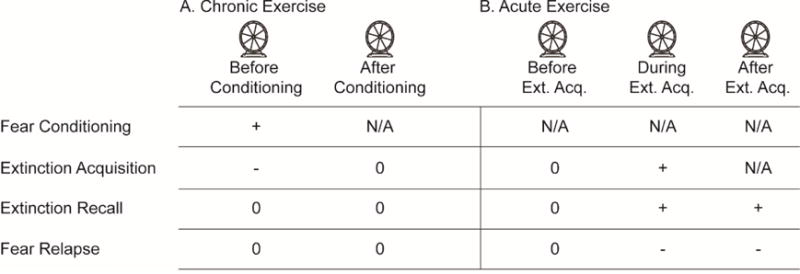
Exercise modulation of fear extinction. A) Chronic exercise prior to fear conditioning delays fear extinction acquisition, likely by strengthening fear memory and making it more difficult to extinguish. Chronic exercise between fear conditioning and extinction has no impact on extinction. B) Acute bouts of exercise prior to fear extinction (Before Ext. Acq.) does not impact extinction acquisition, recall or relapse. Exercise during the acquisition (During Ext. Acq.) or consolidation (After Ext. Acq.) phases of fear extinction learning improves fear extinction memory recall and reduces fear relapse. + enhancement of memory process; − impairment of memory process; 0 no effect on memory process, N/A not applicable.
Figure 2
Figure 2
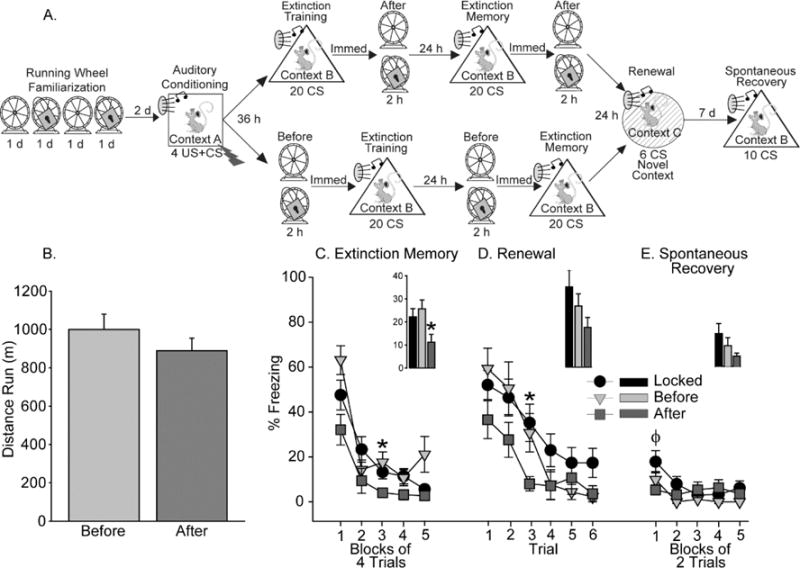
Effects of acute exercise before or after fear extinction on fear extinction memory retention and relapse. A) Experimental timeline. B) Distance run before or after fear extinction. C) Levels of freezing during the 2nd fear extinction training session, which also served as a fear extinction memory test. Exercise afterfear extinction (After) improved fear extinction retention compared to both Locked controls and rats that ran before fear extinction (Before). D) Levels of freezing during re-exposure to the auditory CS in a novel context, indicative of fear renewal. Exercise after, but not before, fear extinction reduced fear renewal. E) Levels of freezing during re-exposure to the auditory CS 7 d after fear renewal. Exercise after, but not before, fear extinction reduced freezing relative to Locked controls during the first trial block. All data represent means ± SEM. * Indicates After group is different from Locked and Before groups (p < 0.05); ɸ Indicates After group is different from Locked controls (p < 0.05).
Figure 3
Figure 3
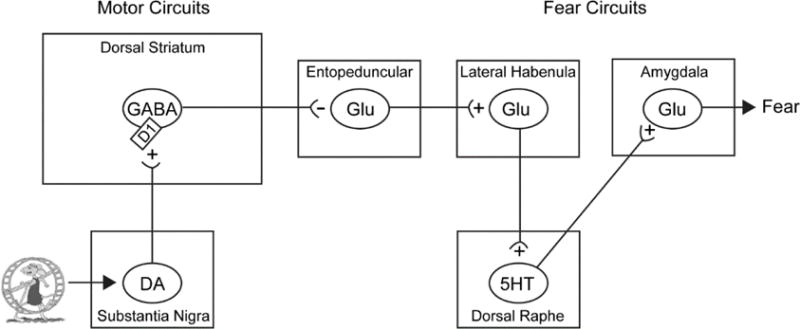
Proposed circuit through which nigrostriatal dopamine DA neurons recruited during acute exercise could communicate with fear circuits. Exercise-induced activation of D1 receptor (D1)-expressing, GABAergic neurons in the dorsal striatum could inhibit fear by inhibiting glutamatergic (Glu) neurons in the entopeduncular nucleus that activate the lateral habenula. Potential exercise-induced plasticity could occur within the nigrostriatal dopamine pathway or within D1 receptor-expressing neurons in the dorsal striatum. DA, dopamine; 5-HT, serotonin; GABA, gamma-Aminobutyric acid; + excitatory pathway; − inhibitory pathway.

References

    1. Abraham AD, Cunningham CL, Lattal KM. Methylphenidate enhances extinction of contextual fear. Learn Mem. 2012;19:67–72. - PMC - PubMed
    1. Abraham AD, Neve KA, Lattal KM. Dopamine and extinction: a convergence of theory with fear and reward circuitry. Neurobiology of learning and memory. 2014;108:65–77. - PMC - PubMed
    1. Abraham AD, Neve KA, Lattal KM. Activation of D1/5 Dopamine Receptors: A Common Mechanism for Enhancing Extinction of Fear and Reward-Seeking Behaviors. Neuropsychopharmacology. 2016;41:2072–2081. - PMC - PubMed
    1. Akers KG, Martinez-Canabal A, Restivo L, Yiu AP, De Cristofaro A, Hsiang HL, Wheeler AL, Guskjolen A, Niibori Y, Shoji H, Ohira K, Richards BA, Miyakawa T, Josselyn SA, Frankland PW. Hippocampal neurogenesis regulates forgetting during adulthood and infancy. Science. 2014;344:598–602. - PubMed
    1. Badrinarayan A, Wescott SA, Vander Weele CM, Saunders BT, Couturier BE, Maren S, Aragona BJ. Aversive stimuli differentially modulate real-time dopamine transmission dynamics within the nucleus accumbens core and shell. The Journal of neuroscience : the official journal of the Society for Neuroscience. 2012;32:15779–15790. - PMC - PubMed

Publication types