


Metabolomics and Transcriptomics Identify Multiple Downstream Targets of Paraburkholderia phymatum σ54 During Symbiosis with Phaseolus vulgaris
- PMID: 29614780
- PMCID: PMC5979394
- DOI: 10.3390/ijms19041049
Metabolomics and Transcriptomics Identify Multiple Downstream Targets of Paraburkholderia phymatum σ54 During Symbiosis with Phaseolus vulgaris
Abstract
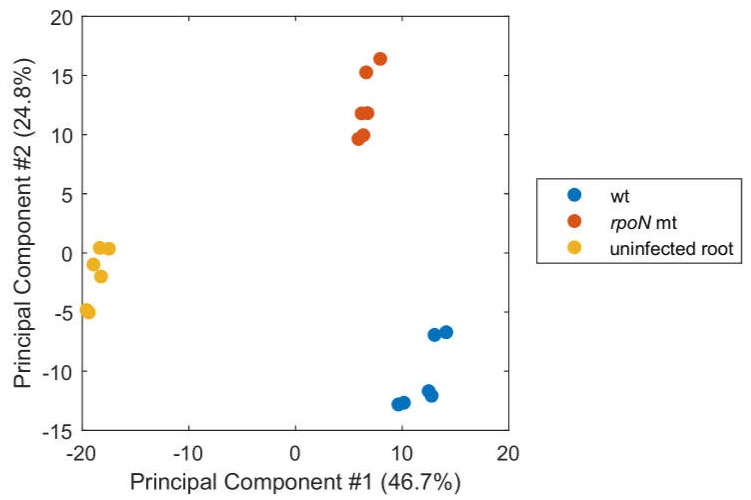
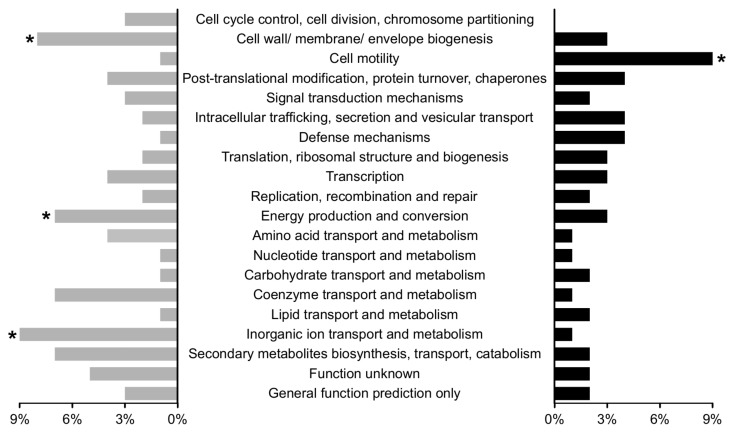
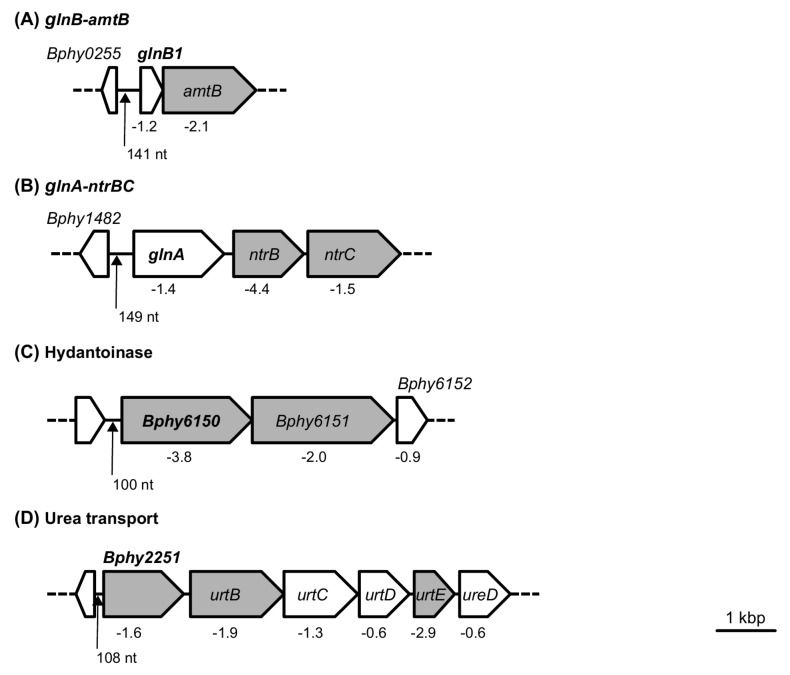
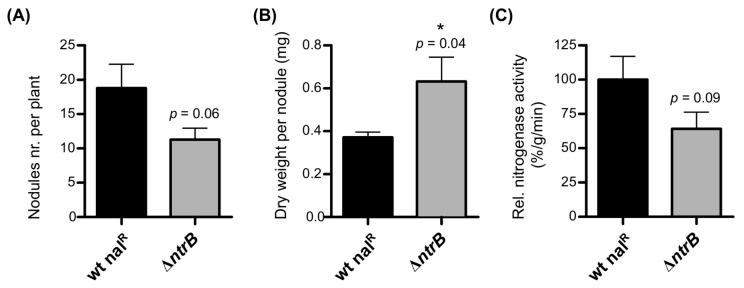
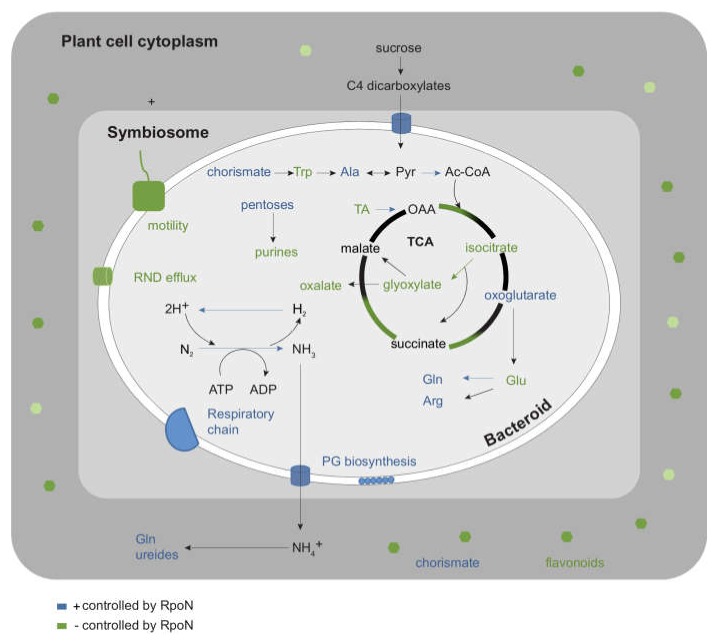
RpoN (or σ54) is the key sigma factor for the regulation of transcription of nitrogen fixation genes in diazotrophic bacteria, which include α- and β-rhizobia. Our previous studies showed that an rpoN mutant of the β-rhizobial strain Paraburkholderia phymatum STM815T formed root nodules on Phaseolus vulgaris cv. Negro jamapa, which were unable to reduce atmospheric nitrogen into ammonia. In an effort to further characterize the RpoN regulon of P. phymatum, transcriptomics was combined with a powerful metabolomics approach. The metabolome of P. vulgaris root nodules infected by a P. phymatumrpoN Fix- mutant revealed statistically significant metabolic changes compared to wild-type Fix⁺ nodules, including reduced amounts of chorismate and elevated levels of flavonoids. A transcriptome analysis on Fix- and Fix⁺ nodules-combined with a search for RpoN binding sequences in promoter regions of regulated genes-confirmed the expected control of σ54 on nitrogen fixation genes in nodules. The transcriptomic data also allowed us to identify additional target genes, whose differential expression was able to explain the observed metabolite changes in numerous cases. Moreover, the genes encoding the two-component regulatory system NtrBC were downregulated in root nodules induced by the rpoN mutant, and contained a putative RpoN binding motif in their promoter region, suggesting direct regulation. The construction and characterization of an ntrB mutant strain revealed impaired nitrogen assimilation in free-living conditions, as well as a noticeable symbiotic phenotype, as fewer but heavier nodules were formed on P. vulgaris roots.
Keywords: RNA-sequencing; legumes; metabolome; nitrogen fixation; papilionoid; rhizobia; rpoN; sigma factor.
Conflict of interest statement
The authors declare no conflict of interest. The founding sponsors had no role in the design of the study; in the collection, analyses, or interpretation of data; in the writing of the manuscript; or in the decision to publish the results.
Figures

References
-
- Elliott G.N., Chen W.-M., Chou J.-H., Wang H.-C., Sheu S.-Y., Perin L., Reis V.M., Moulin L., Simon M.F., Bontemps C., et al. Burkholderia phymatum is a highly effective nitrogen-fixing symbiont of Mimosa spp. and fixes nitrogen ex planta. New Phytol. 2007;173:168–180. doi: 10.1111/j.1469-8137.2006.01894.x. - DOI - PubMed
-
- Mishra R.P.N., Tisseyre P., Melkonian R., Chaintreuil C., Miché L., Klonowska A., Gonzalez S., Bena G., Laguerre G., Moulin L. Genetic diversity of Mimosa pudica rhizobial symbionts in soils of French Guiana: Investigating the origin and diversity of Burkholderia phymatum and other β-rhizobia. FEMS Microbiol. Ecol. 2012;79:487–503. doi: 10.1111/j.1574-6941.2011.01235.x. - DOI - PubMed
-
- Dos Reis F.B., Jr., Simon M.F., Gross E., Boddey R.M., Elliott G.N., Neto N.E., de Fatima Loureiro M., de Queiroz L.P., Scotti M.R., Chen W.-M., et al. Nodulation and nitrogen fixation by Mimosa spp. in the Cerrado and Caatinga biomes of Brazil. New Phytol. 2010;186:934–946. doi: 10.1111/j.1469-8137.2010.03267.x. - DOI - PubMed
-
- Moulin L., Klonowska A., Caroline B., Booth K., Vriezen J.A.C., Melkonian R., James E.K., Young J.P.W., Bena G., Hauser L., et al. Complete Genome sequence of Burkholderia phymatum STM815T, a broad host range and efficient nitrogen-fixing symbiont of Mimosa species. Stand. Genom. Sci. 2014;9:763–774. doi: 10.4056/sigs.4861021. - DOI - PMC - PubMed
MeSH terms
LinkOut - more resources
Full Text Sources
Other Literature Sources
Molecular Biology Databases
