


A GATA3-specific DNAzyme attenuates sputum eosinophilia in eosinophilic COPD patients: a feasibility randomized clinical trial
- PMID: 29615049
- PMCID: PMC5883532
- DOI: 10.1186/s12931-018-0751-x
A GATA3-specific DNAzyme attenuates sputum eosinophilia in eosinophilic COPD patients: a feasibility randomized clinical trial
Abstract
Background: A subset of COPD-patients presents with eosinophilic airway inflammation. While treatment of asthmatic patients with the GATA3-specific DNAzyme SB010 attenuated sputum eosinophilia after allergen challenge, this specific treatment has not been evaluated in patients with COPD. Our objective was to evaluate the feasibility and safety of inhaled SB010 in COPD patients with sputum eosinophilia.
Methods: We conducted a randomized, double-blind, placebo-controlled, multicentre clinical trial in COPD-patients with sputum eosinophilia (≥2.5% non-squamous cells). Patients inhaled 10 mg SB010 bid or matching placebo via the controlled inhalation system AKITA2 APIXNEB for 28 days. Endpoints included the feasibility of the study (primary), patient's safety, sputum eosinophils, FENO, lung function, symptoms, and biomarkers. The study was registered in the German Clinical Trials Register: DRKS00006087.
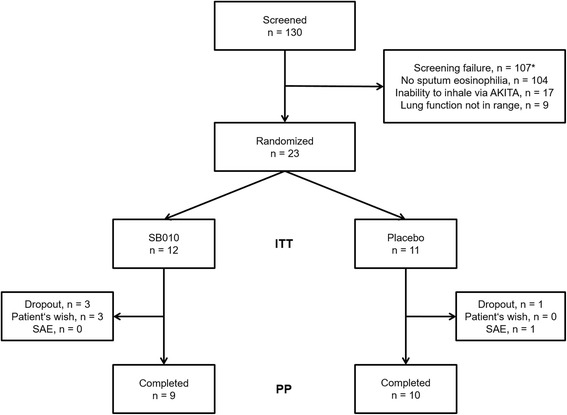
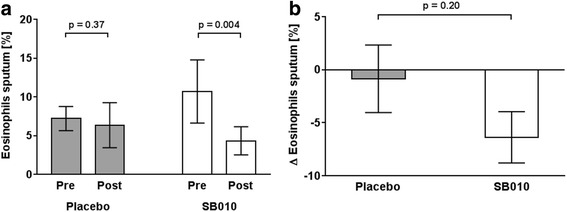
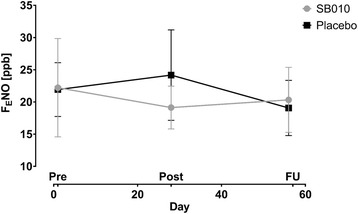
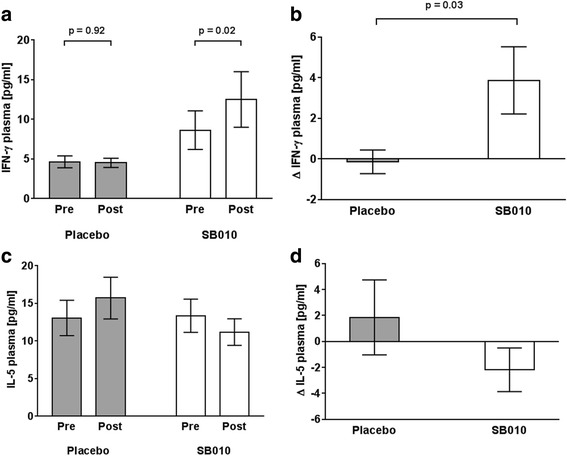
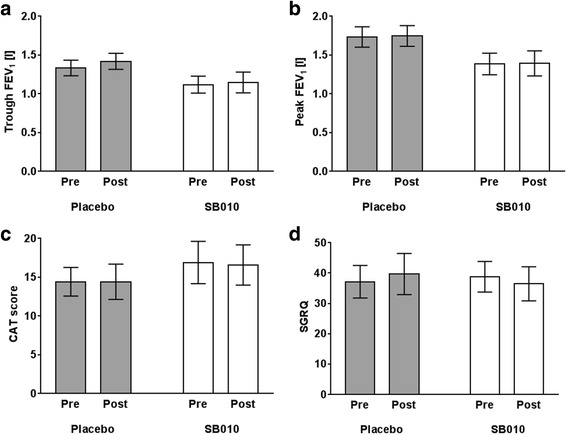
Results: One hundred thirty patients were screened, 23 patients were randomized (FEV1 49.4 ± 11.5%; sputum eosinophils 8.0 ± 8.4%) and 19 patients completed the study (10 placebo, 9 SB010. After 28 days, SB010 decreased the relative sputum eosinophil count (p = 0.004) as compared to no changes in placebo-treated patients. FENO, lung function, and symptoms were not affected significantly. We found an increase in blood IFN-γ (p = 0.02) and a trend to lower IL-5 levels in patients treated with SB010. SB010 was safe and well tolerated. Thirty five AEs (22 SB010, 13 placebo including 1 SAE) were observed with 3 AEs in each group judged to be possibly treatment-related.
Conclusion: In patients with eosinophilic COPD, sputum eosinophils could be reduced by inhalation of SB010. Long-term studies are needed to demonstrate clinical efficacy.
Keywords: COPD; DNAzyme; Eosinophils; SB010; Sputum; T-helper-2-cells.
Conflict of interest statement
Ethics approval and consent to participate
The study was approved for all centres by the ethics committee at the University of Marburg as leading ethics committee (AZ: 149/13 A-ff, Jan 2014).
Consent for publication
NA
Competing interests
Dr. Greulich reports personal fees from Astra Zeneca, personal fees from Berlin-Chemie, personal fees from Boehringer-Ingelheim, personal fees from Chiesi, personal fees from CSL-Behring, grants and personal fees from Grifols, personal fees from GSK, personal fees from Novartis, outside the submitted work; and reports grants from German Center for Lung Research during the conduct of the study.
Dr. Hohlfeld reports personal fees from Boehringer Ingelheim, personal fees from Merck & Co, Inc., personal fees from Novartis, grants from Novartis, grants from Almirall, grants from Takeda, grants from ALK, grants from Boehringer Ingelheim, grants from LETI, grants from GlaxoSmithKline, grants from Sanofi-Aventis, grants from Allergopharma, grants from Astra Zeneca AB, outside the submitted work; and grants from German Center for Lung Research during the conduct of the study.
P. Neuser reports grants from German Center for Lung Research during the conduct of the study.
Dr. Lüer reports grants from German Center for Lung Research during the conduct of the study.
Dr. Klemmer reports grants from German Center for Lung Research during the conduct of the study.
C. Schade-Brittinger reports grants from German Center for Lung Research, during the conduct of the study.
S. Harnisch reports grants from German Center for Lung Research during the conduct of the study.
Dr. Garn reports personal fees from sterna biologicals GmbH & Co. KG, during the conduct of the study; and is shareholder of sterna biologicals GmbH & Co.KG. Additionally, he reports grants from DZL (German Center for Lung Research) and UGMLC (Universities Gießen and Marburg Lung Center) during the conduct of the study.
Dr. Renz reports grants from Institute of Laboratory Medicine, during the conduct of the study; In addition, Dr. Renz has a patent GATA-3 DNAzyme licensed.
U. Homburg reports other (employee) from sterna biologicals GmbH & Co KG, outside the submitted work.
J. Renz reports other (employee) from Sterna Biologicals GmbH & Co. KG, outside the submitted work.
Dr. Kirsten reports other from Sterna Biologicals, during the conduct of the study; other from Astra Zeneca, other from Berlin Chemie, other from Boehringer Ingelheim, other from Novartis, other from Astra Zeneca, other from Boehringer Ingelheim, other from Roche, other from GSK, other from Novartis, other from Chiesi, other from Takeda, other from Bayer, other from Sterna biologicals, other from Johnson u. Johnson, other from Sanofi, outside the submitted work.
Dr. Pedersen reports grants from German Center for Lung Research, during the conduct of the study.
Dr. Mueller reports grants from Novartis, grants from Allmirall, grants from Takeda, grants from Boehringer Ingelheim, grants from ALK, grants from LETI, grants from Glaxo SmithKline, grants from Sanofi-Aventis, grants from Allergopharma, grants from Astra Zeneca AB, outside the submitted work; and from German Center for Lung Research, during the conduct of the study.
Dr. Vogelmeier reports grants and personal fees from AstraZeneca, grants and personal fees from Boehringer Ingelheim, personal fees from CSL Behring, personal fees from Chiesi, grants and personal fees from GlaxoSmithKline, grants and personal fees from Grifols, personal fees from Menarini, personal fees from Mundipharma, grants and personal fees from Novartis, personal fees from Teva, personal fees from Cipla, outside the submitted work.
Dr. Watz reports grants from German Center for Lung Research, during the conduct of the study.
Publisher’s Note
Springer Nature remains neutral with regard to jurisdictional claims in published maps and institutional affiliations.
Figures
References
-
- Vogelmeier CF, Criner GJ, Martinez FJ, Anzueto A, Barnes PJ, Bourbeau J, Celli BR, Chen R, Decramer M, Fabbri LM, et al. Global strategy for the diagnosis, management, and prevention of chronic obstructive lung disease 2017 report: GOLD executive summary. Eur Respir J. 2017;49(3). - PubMed
-
- Bafadhel M, Saha S, Siva R, McCormick M, Monteiro W, Rugman P, Dodson P, Pavord ID, Newbold P, Brightling CE. Sputum IL-5 concentration is associated with a sputum eosinophilia and attenuated by corticosteroid therapy in COPD. Respiration. 2009;78:256–262. doi: 10.1159/000221902. - DOI - PMC - PubMed
Publication types
MeSH terms
Substances
Grants and funding
LinkOut - more resources
Full Text Sources
Other Literature Sources
Medical
